
What Is Shore D Hardness?
Shore D hardness is a measurement used to describe the hardness of relatively rigid polymers, hard elastomers and plastics. It indicates how strongly a material resists indentation when tested with a Shore D durometer.
Shore hardness is commonly used when selecting polymers because materials that look similar can behave very differently under pressure, bending, sealing or mechanical loading. However, Shore D is only one hardness scale. Softer elastomers, including most silicone rubber compounds, are more commonly measured using Shore A.
This creates an important question for silicone buyers: when should Shore D be used, how is it different from Shore A, and can high-hardness silicone rubber be specified using the Shore D scale?
This guide explains Shore D hardness, Shore A vs Shore D, how durometer testing works, and how hardness should be interpreted when selecting silicone rubber for industrial applications.
What Does Shore D Hardness Mean?
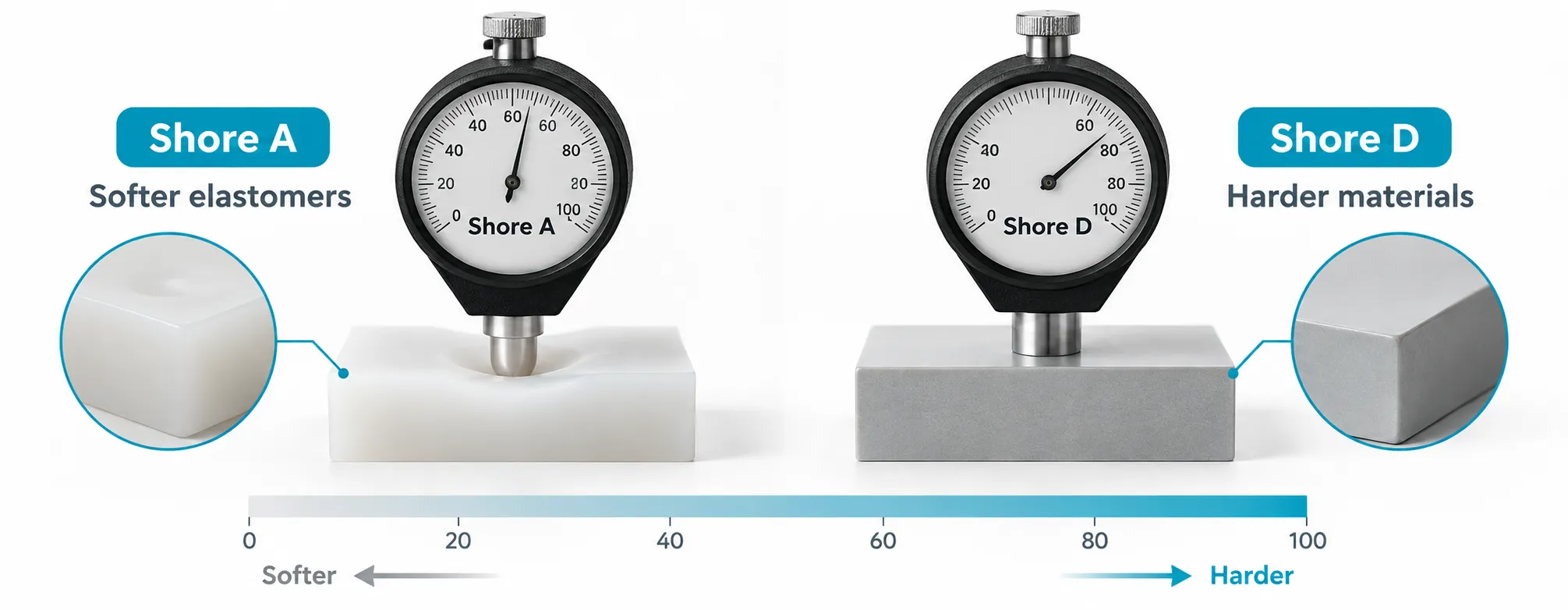
Shore D hardness measures the resistance of a material to indentation using a standardized durometer.
The instrument presses a pointed indenter into the material using a defined spring force. The amount of penetration is converted into a hardness value on a scale from 0 to 100.
A higher Shore D number generally indicates a harder material with greater resistance to indentation.
More compliantThe material allows greater penetration under the test force.
Rigid polymer rangeCommon for many harder plastics and semi-rigid materials.
Very hardIndicates relatively low indentation under the Shore D test.
How Is Shore D Hardness Tested?
Shore D testing is commonly performed using a durometer according to standards such as ASTM D2240 or comparable methods.
The Shore D instrument uses an indenter geometry and spring force designed for harder materials. When the indenter is pressed against the sample, the instrument measures how deeply it penetrates.
The result is displayed as a hardness value between 0 and 100 Shore D.
1Prepare the Sample
The test piece should have sufficient thickness and a suitable flat surface.
2Position the Durometer
The instrument is placed perpendicular to the material surface.
3Apply the Test Force
The Shore D indenter presses into the sample under the instrument's spring load.
4Read the Hardness
The measured penetration resistance is reported as a Shore D value.
What Materials Use Shore D Hardness?
Shore D is typically used for relatively hard materials where Shore A would be too soft a scale to provide useful differentiation.
Common examples include harder thermoplastics, rigid or semi-rigid polymers, hard polyurethane materials and certain high-hardness elastomers.
| Material Category | Common Hardness Scale |
|---|---|
| Soft Silicone Rubber | Usually Shore A |
| General Rubber Elastomers | Usually Shore A |
| Hard Elastomers | Shore A or Shore D depending on hardness |
| Rigid Plastics | Often Shore D |
| Hard Polyurethane | Often Shore D |
Shore A vs Shore D Hardness
The most important difference between Shore A and Shore D is the hardness range they are designed to measure.
Shore A is used mainly for flexible elastomers and softer rubber materials. Shore D is designed for harder elastomers and rigid polymers.
| Comparison | Shore A | Shore D |
|---|---|---|
| Typical Material | Rubber and flexible elastomers | Hard elastomers and plastics |
| Relative Test Force | Lower | Higher |
| Indenter | Designed for softer materials | Designed for harder materials |
| Silicone Rubber | Most common scale | Used only for sufficiently hard materials |
| Typical Use | Seals, gaskets, flexible molded parts | Rigid plastics and hard polymer components |
Is Shore D Hardness Used for Silicone Rubber?
Most conventional silicone rubber compounds are measured using Shore A rather than Shore D.
This is because cured silicone rubber normally remains flexible enough that the Shore A scale provides a more meaningful measurement.
Typical industrial silicone compounds may be offered at hardness levels such as 30A, 40A, 50A, 60A or 70A.
Very high-hardness silicone materials can enter a region where Shore D measurement becomes more relevant, but this should not be assumed automatically.
Can Shore A Be Converted Directly to Shore D?
There is no universal exact mathematical conversion between Shore A and Shore D.
The two scales use different indenter geometries and spring forces. Approximate comparison charts are sometimes used for engineering reference, especially in the overlapping hardness region, but they should not replace an actual measurement.
For example, a very hard Shore A elastomer may fall into the lower Shore D region, but the exact relationship depends on the material.
Why Silicone Rubber Usually Uses Shore A
Silicone rubber is an elastomer. Its ability to deform and recover is one of the reasons it is used in seals, electrical insulation, composite insulators, cable, EV components and flexible molded products.
These materials typically fall within the range where Shore A provides useful differentiation.
This range covers many practical silicone rubber applications without requiring the Shore D scale.
Does Higher Shore Hardness Mean Stronger Silicone Rubber?
No. Hardness and mechanical strength are different material properties.
A harder silicone compound is more resistant to indentation, but it does not automatically have higher tensile strength, tear resistance or longer service life.
| Property | What It Measures |
|---|---|
| Shore Hardness | Resistance to indentation |
| Tensile Strength | Resistance to failure under tensile loading |
| Elongation | Ability to stretch before breaking |
| Tear Strength | Resistance to tear initiation or propagation |
| Compression Set | Permanent deformation after compression |
For silicone rubber selection, all relevant mechanical properties should be evaluated together.
Why Two Silicone Materials with the Same Hardness Perform Differently
Hardness tells only one part of the material story.
Two silicone rubber compounds can both measure 60 Shore A while using different polymer structures, reinforcing silica systems, filler loadings and cure chemistry.
As a result, they can behave differently during extrusion, molding and final service.
Does Shore Hardness Affect Silicone Processing?
Cured Shore hardness can influence the mechanical behavior of the finished part, but it does not directly describe how the uncured silicone will process.
This distinction is particularly important for HTV and HCR silicone compounds.
A 60 Shore A compound can be easy to extrude, while another 60 Shore A grade may require significantly greater extrusion or injection pressure.
Processing behavior depends on factors such as polymer molecular weight, filler loading, filler surface treatment, processing aids and curing chemistry.
Shore Hardness for HTV and HCR Silicone Rubber
HTV/HCR silicone rubber is commonly supplied across a range of Shore A hardness values to support different industrial applications.
The appropriate hardness depends on whether the material needs to deform easily, maintain structural shape, seal under compression or resist mechanical loading.
| Application | Hardness Consideration |
|---|---|
| Flexible Seals | Softer grades can conform more easily to mating surfaces |
| Industrial Gaskets | Medium hardness often balances compression and dimensional stability |
| Wire & Cable | Hardness must be balanced with extrusion and flexibility requirements |
| Composite Insulators | Mechanical strength, tear resistance and molding are more important than hardness alone |
| Rigid Molded Parts | Higher hardness may provide greater dimensional support |
Shore Hardness for Composite Insulator Silicone
Composite insulator silicone rubber is typically evaluated using Shore A rather than Shore D.
The external housing needs enough flexibility and tear resistance to form sheds and protect the FRP core while also maintaining electrical and outdoor performance.
Hardness must therefore be balanced with hydrophobicity, tracking and erosion resistance, tear strength, elongation and mold flow.
A higher hardness value alone does not make a silicone compound better for high-voltage insulation.
Shore Hardness for Silicone Rubber Gaskets
Rubber gasket applications illustrate why hardness should be selected according to function.
A soft silicone gasket can conform more easily to uneven mating surfaces, while a firmer gasket resists deformation under load.
Compression set, temperature and sealing pressure must also be considered when selecting gasket hardness.
Shore Hardness for Wire and Cable Silicone
Silicone cable compounds need sufficient flexibility for installation and repeated movement while maintaining stable dimensions during extrusion.
A harder compound may create a firmer cable jacket or insulation layer, but hardness alone cannot predict extrusion quality.
Cable manufacturers should also evaluate extrusion pressure, die swell, surface quality, cure response and heat aging.
Shore Hardness for EV Silicone Components
EV systems use silicone elastomers for high-voltage cable, connector seals, battery components, boots and electrical insulation.
Different components require different hardness levels.
A connector seal may need a softer compound to create reliable contact pressure, while a larger molded insulating component may require higher dimensional stability.
Electrical properties, temperature cycling and compression performance should therefore be specified together with Shore hardness.
When Should Shore D Be Used Instead of Shore A?
Shore D becomes useful when the material is sufficiently hard that Shore A readings approach the upper portion of the scale and no longer provide the most appropriate differentiation.
Examples may include hard plastics, rigid polymer components and certain very hard elastomeric materials.
Common Mistakes When Comparing Shore D Hardness
Assuming Harder Means Stronger
Hardness measures indentation resistance, not overall mechanical strength.
Directly Converting Shore A to Shore D
Approximate conversion charts should not replace actual durometer testing.
Ignoring Test Conditions
Sample thickness, temperature, test timing and material condition can influence hardness readings.
Comparing Different Scales as If They Were Identical
60 Shore A and 60 Shore D describe very different levels of material hardness.
Using Shore D for Soft Silicone
Most flexible silicone rubber is more appropriately measured using Shore A.
How Temperature Affects Shore Hardness
Polymer hardness can change with temperature.
At lower temperatures, silicone rubber may become firmer. At elevated temperatures, the immediate material response can also change.
Long-term heat aging can permanently alter hardness by changing the polymer network.
For temperature-critical applications, hardness should be considered together with heat-aging data rather than relying only on room-temperature Shore measurements.
How Sample Thickness Affects Shore Hardness Testing
Durometer testing requires an appropriate sample thickness to reduce the influence of the supporting surface underneath the material.
If a test specimen is too thin, the substrate may influence the measured hardness and produce an artificially high reading.
Testing should therefore follow the relevant standard for specimen preparation, thickness, measurement location and conditioning.
How to Specify Silicone Rubber Hardness Correctly
OEM drawings and material specifications should clearly identify both the hardness value and the test scale.
Writing only “60 hardness” is incomplete because 60 Shore A and 60 Shore D are very different materials.
The acceptable hardness tolerance should also reflect the actual functional requirements rather than being unnecessarily narrow.
What Should Buyers Include in a Silicone Hardness RFQ?
Silicone Rubber Hardness Solutions from Yakows
Yakows supplies HTV/HCR silicone rubber, liquid silicone rubber and custom silicone compounds across different Shore A hardness levels for industrial applications.
Materials can be evaluated for composite insulators, wire and cable, EV systems, seals, gaskets and other molded or extruded products.
Rather than selecting silicone rubber by hardness alone, Yakows can evaluate the combination of Shore A hardness, tensile strength, elongation, tear resistance, temperature performance, electrical properties and processing behavior.
Customers replacing an existing material can provide the current hardness, datasheet, processing method and production issues to help compare a suitable silicone rubber compound.
Frequently Asked Questions
What is Shore D hardness?
Shore D hardness measures the indentation resistance of relatively hard polymers, plastics and hard elastomers using a Shore D durometer.
What is the difference between Shore A and Shore D?
Shore A is designed mainly for softer elastomers and rubber materials, while Shore D is used for harder elastomers and rigid polymers.
Is Shore D used for silicone rubber?
Most silicone rubber is measured using Shore A. Shore D may become relevant for sufficiently hard silicone or other rigid silicone-based materials.
Can Shore A be converted to Shore D?
Approximate comparison charts exist, but there is no universal exact conversion. The actual material should be measured using the required scale.
Is Shore D harder than Shore A?
The Shore D scale is designed for harder materials, but numbers from the two scales should not be compared directly as if they represent the same hardness.
What Shore hardness is silicone rubber?
Industrial silicone rubber is available in many Shore A hardness levels, commonly including grades around 30A to 70A depending on the application.
Does higher Shore hardness mean better silicone?
No. The best hardness depends on the application, and properties such as tear strength, heat resistance, electrical performance and processing should also be evaluated.
What hardness is best for silicone gaskets?
The correct hardness depends on gasket thickness, sealing pressure, mating surfaces and available clamping force.
Why can two 60 Shore A silicone grades behave differently?
They can use different polymer, filler and curing systems, which affect tear strength, extrusion, molding and thermal performance even if cured hardness is the same.
How should OEMs specify silicone hardness?
Specify the hardness value, Shore scale, acceptable tolerance and test method together with other critical material properties.