
Does Rubber Conduct Electricity Under High Voltage?
Does rubber conduct electricity under high voltage? Under normal conditions, most conventional rubber materials are electrical insulators rather than conductors. Their polymer structure limits the movement of free electrical charge, which is why rubber has long been used around cables, connectors, electrical equipment and insulating components.
However, the answer becomes more complicated when voltage increases. No insulating material has unlimited electrical resistance. Under sufficiently high electric stress, rubber can experience leakage current, surface tracking, partial discharge, thermal damage or complete dielectric breakdown.
The actual behavior depends on the rubber formulation, thickness, electric-field intensity, surface contamination, moisture, temperature, aging and whether conductive fillers have been intentionally added.
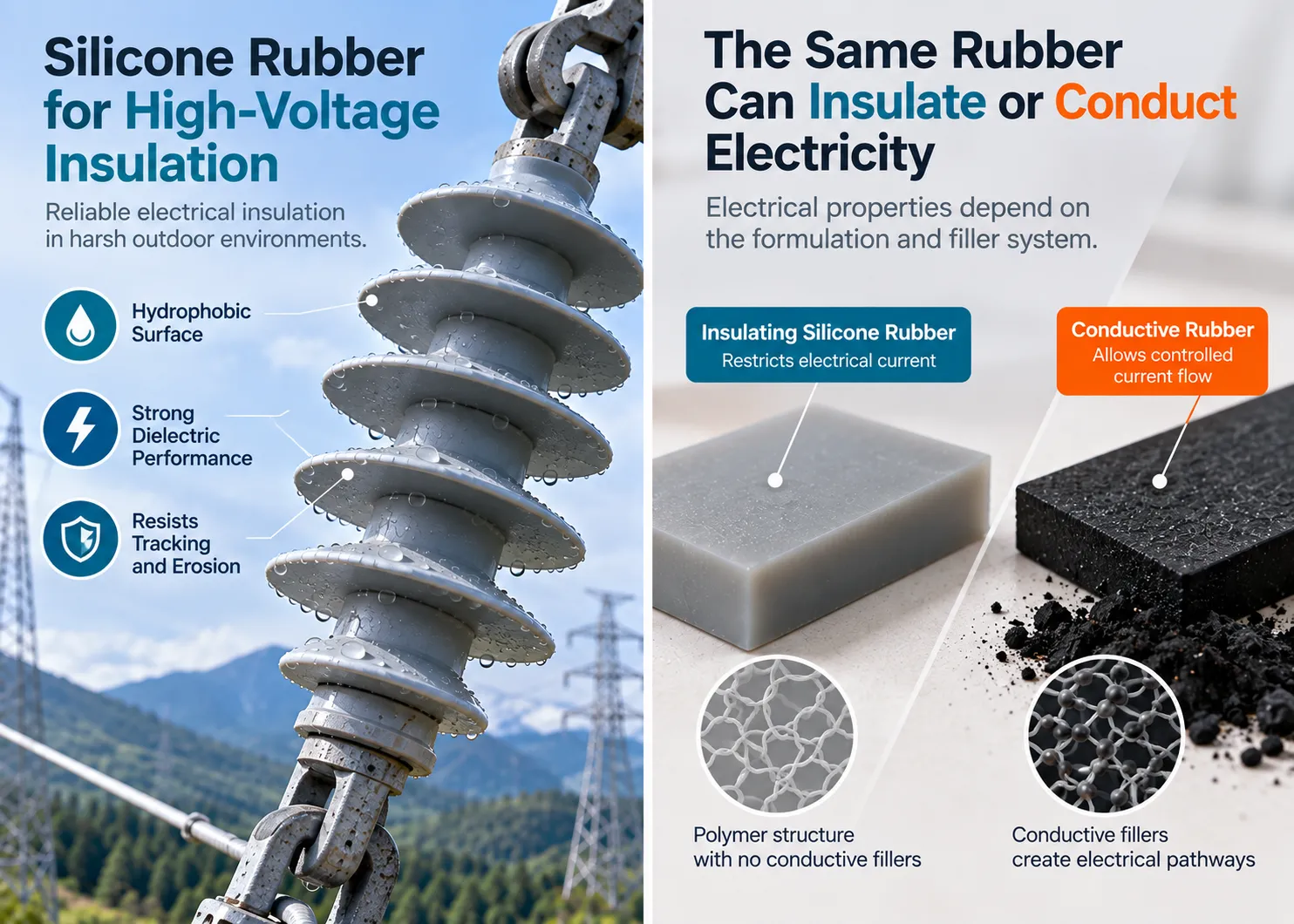
For high-voltage applications such as composite insulators, surge arresters, cable accessories and EV electrical systems, silicone rubber is widely used because it combines electrical insulation with hydrophobicity, weather resistance and strong resistance to tracking and erosion.
Does Rubber Conduct Electricity?
In general, most rubber compounds do not conduct electricity easily. They are considered electrical insulators because their molecular structures contain relatively few mobile charge carriers.
When voltage is applied across an insulating rubber material, only a very small current normally passes through the bulk material.
This is why rubber is commonly used as insulation around electrical wires and as a protective material in electrical equipment.
Why Rubber Normally Acts as an Electrical Insulator
Electrical conduction requires mobile charge carriers that can move through a material when an electric field is applied.
Metals contain large numbers of mobile electrons, so they conduct electricity very easily. Most elastomers contain tightly bonded electrons and relatively few free carriers, so their electrical conductivity is much lower.
What Changes When Voltage Becomes Very High?
Increasing voltage increases the electric field inside and across the surface of the rubber insulation.
If the electric field becomes too strong, the insulating system can begin to degrade. Electrical stress may create localized heating, partial discharge, charge injection or conductive paths through damaged regions.
The material may still appear physically intact while its electrical resistance is gradually being reduced.
What Is Dielectric Breakdown?
Dielectric breakdown occurs when an insulating material can no longer withstand the applied electric field and suddenly allows significant current to pass through it.
Before breakdown, the material acts primarily as an insulator. After breakdown begins, a conductive channel can form through the material.
The required breakdown field depends on the exact rubber formulation, specimen thickness, temperature, test method and material condition.
| Factor | How It Can Affect Breakdown |
|---|---|
| Material Formulation | Polymer, fillers, impurities and additives influence electrical strength. |
| Thickness | Electrical stress distribution changes with insulation geometry. |
| Moisture | Can reduce surface insulation and increase leakage current. |
| Temperature | Can alter conductivity and accelerate material aging. |
| Contamination | Salt, dust and industrial pollution can create conductive surface paths. |
| Aging | Cracks, erosion and chemical changes may reduce insulation performance. |
Dielectric Strength of Rubber
Dielectric strength describes how much electric field an insulating material can withstand before electrical breakdown occurs under specified test conditions.
It is commonly expressed in units such as kV/mm.
Electrical-grade silicone rubber can provide dielectric strength in the range of tens of kilovolts per millimeter, depending on formulation, specimen thickness and test conditions.
However, a dielectric-strength value from a laboratory sample should not be treated as the operating voltage of a finished high-voltage component.
Real insulation systems also depend on creepage distance, geometry, field concentration, contamination, moisture and long-term aging.
Volume Resistivity and Electrical Resistance
Volume resistivity describes how strongly a material resists current flowing through its bulk.
Electrical insulating rubber generally has very high volume resistivity.
A high volume resistivity is desirable for applications where current must remain confined to conductors rather than flowing through the insulating body.
In outdoor high-voltage systems, surface conduction can become more important than bulk conduction.
Why Rubber Can Conduct Electricity on a Wet Surface
Pure water itself is a relatively poor conductor, but environmental water usually contains dissolved ions, salts, dust or industrial contaminants.
When moisture combines with surface contamination, a conductive film can form across an insulating component.
This can allow leakage current to flow along the surface even though the rubber itself remains highly resistive internally.
What Is Leakage Current?
Leakage current is a small unwanted electrical current that flows through or across an insulating system.
In outdoor high-voltage insulation, leakage current often develops across wet or contaminated surfaces.
Small leakage current does not necessarily mean immediate failure, but it can produce localized heating and dry-band formation.
If the electrical stress becomes concentrated across these dry regions, arcing can occur.
What Is Dry-Band Arcing?
When leakage current flows along a contaminated wet surface, localized heating can evaporate moisture from part of the conductive layer.
This creates a relatively dry region with greater electrical resistance.
The voltage can then concentrate across that dry region and produce an electrical arc.
Repeated dry-band arcing is one of the important mechanisms involved in surface tracking and erosion of outdoor polymeric insulation.
What Is Electrical Tracking in Rubber?
Electrical tracking is the progressive formation of a conductive path along the surface of an insulating material.
Repeated electrical discharges, contamination and heat can gradually carbonize or chemically damage the surface.
Once a more conductive path forms, leakage current can increase further, accelerating the degradation process.
| Stage | What Happens |
|---|---|
| Surface Contamination | Dust, salt or industrial pollution accumulates on the insulation. |
| Moisture | Rain, fog or condensation forms a conductive layer. |
| Leakage Current | Electrical current begins flowing across the surface. |
| Dry-Band Arcing | Localized arcs form across partially dried regions. |
| Surface Degradation | Heat and discharge damage the polymer surface. |
| Tracking | A conductive path can gradually develop. |
What Is Electrical Erosion?
Electrical erosion is the physical loss of insulating material caused by repeated electrical discharge and localized thermal stress.
Unlike tracking, which focuses on conductive-path formation, erosion describes actual material removal.
In severe cases, erosion can reduce housing thickness, expose internal interfaces or weaken the insulating structure.
High-voltage silicone rubber compounds are therefore often formulated specifically to improve tracking and erosion resistance.
Why Silicone Rubber Is Widely Used Under High Voltage
Silicone rubber is widely used in high-voltage systems because it combines several properties that are difficult to obtain from one flexible material.
Why Hydrophobicity Matters in High-Voltage Silicone Rubber
Hydrophobicity means that water tends to form droplets rather than spreading easily across the surface.
This is particularly valuable in outdoor insulation because a discontinuous water layer can reduce the formation of continuous conductive paths.
Silicone rubber is well known for its hydrophobic surface behavior.
Some silicone formulations can also gradually transfer hydrophobic characteristics to contamination layers through migration of low-molecular-weight silicone species.
This helps explain why silicone rubber performs well in polluted outdoor environments.
Why ATH Is Added to High-Voltage Silicone Rubber
Electrical-grade silicone rubber for composite insulators and similar applications often contains aluminum trihydrate, commonly called ATH.
ATH can improve resistance to tracking and erosion during severe surface electrical stress.
When exposed to high localized temperatures, ATH can release chemically bound water and help absorb thermal energy.
This can reduce the severity of local thermal degradation during dry-band arcing.
The correct electrical silicone formulation therefore requires a balance between ATH, reinforcing silica, polymer and processing aids.
Silicone Rubber in Composite Insulators
Composite insulators are one of the clearest examples of silicone rubber operating under high-voltage conditions.
A typical composite insulator contains an FRP core for mechanical strength, metal end fittings and a silicone rubber housing with multiple sheds.
The silicone housing provides the external electrical insulating surface while protecting the internal core from moisture and environmental exposure.
| Silicone Rubber Function | Why It Matters |
|---|---|
| Surface Insulation | Supports creepage distance and limits surface current. |
| Hydrophobic Surface | Reduces continuous conductive water-film formation. |
| Tracking Resistance | Helps resist conductive-path formation. |
| Erosion Resistance | Helps withstand repeated discharge and localized heating. |
| Core Protection | Protects the FRP rod from environmental exposure. |
| Weather Resistance | Supports long outdoor service under UV, rain and pollution. |
Can a Composite Insulator Still Conduct Electricity?
A properly designed composite insulator is intended to prevent significant current from flowing between the energized conductor and grounded structure.
However, small leakage currents can still occur across the external surface, especially under wet and contaminated conditions.
This does not mean the silicone rubber has become a metallic conductor.
Instead, the current may be traveling through a contamination layer, moisture film or degraded surface region.
This distinction is important when diagnosing high-voltage insulation performance.
Silicone Rubber in Surge Arresters
Silicone rubber is also used as an external housing material for polymer-housed surge arresters.
The housing provides electrical insulation and environmental protection around the internal arrester components.
As with composite insulators, the silicone material needs strong hydrophobicity, weather resistance and resistance to surface electrical degradation.
Mechanical integrity and reliable bonding around internal components are also important.
Silicone Rubber for High-Voltage Cable
Silicone rubber is used in high-temperature and specialized electrical cable applications because it combines flexibility with dielectric insulation.
In cable systems, the silicone layer must prevent current from escaping the conductor while remaining flexible during manufacturing, installation and operation.
Cable-grade silicone selection can involve:
Silicone Rubber in EV High-Voltage Systems
Modern EV systems operate at increasingly high electrical voltages and contain batteries, inverters, motors, connectors and high-voltage cables.
Silicone rubber may be used in cable insulation, connector seals, protective boots and other electrically insulating components.
These materials need to tolerate electrical stress together with vibration, temperature cycling and mechanical movement.
Can Rubber Be Made Conductive?
Yes. Rubber can be intentionally formulated to conduct electricity.
Conductive rubber compounds use fillers that create electrically conductive networks inside the elastomer.
Possible conductive fillers include carbon black, graphite, carbon nanotubes, metal particles or other conductive materials.
This creates an important distinction:
The same basic polymer family can therefore be formulated either as an electrical insulator or as a conductive elastomer depending on the filler system.
Conductive Silicone Rubber vs Insulating Silicone Rubber
| Property | Insulating Silicone Rubber | Conductive Silicone Rubber |
|---|---|---|
| Electrical Function | Restricts electrical current | Allows controlled conduction |
| Typical Filler | Reinforcing and electrical insulation filler systems | Carbon or conductive filler systems |
| Typical Application | Insulators, cable, electrical seals | EMI shielding, grounding or conductive interfaces |
| Volume Resistivity | Very high | Much lower |
| High-Voltage Insulation | Suitable when properly formulated | Normally not used as the main insulating layer |
Can Carbon Black Make Rubber Conduct Electricity?
Yes. Carbon black can significantly change the electrical behavior of rubber.
At relatively low loading, some carbon black grades may mainly reinforce or color the material. At higher effective conductive loading, carbon particles can form interconnected pathways that allow electrical current to move through the compound.
This phenomenon is sometimes described in terms of an electrical percolation threshold.
For electrical insulation compounds, filler selection and contamination control are therefore important.
Does Temperature Make Rubber More Conductive?
Temperature can influence the electrical resistance of polymer materials.
As temperature rises, charge mobility can increase and insulation resistance may decrease depending on the compound.
Long-term heat exposure can also alter the polymer structure and accelerate aging.
In high-voltage applications, electrical properties should therefore be considered together with thermal-aging performance.
Does Aging Affect Rubber Electrical Insulation?
Yes. Aging can change both the surface and bulk properties of rubber insulation.
Possible aging mechanisms include thermal oxidation, UV exposure, ozone, moisture, electrical discharge and mechanical cracking.
Why Surface Cleanliness Matters
Even a high-quality electrical silicone compound can perform poorly if the surface becomes heavily contaminated.
Salt, conductive dust, industrial emissions and other contaminants can reduce surface resistance when wet.
Composite insulator design uses shed geometry and creepage distance to help control this risk.
Silicone rubber's hydrophobicity provides an additional advantage, but it does not eliminate the need for appropriate insulation design.
How Electric Field Concentration Causes Problems
Electric fields are not always distributed evenly across an insulating component.
Sharp metal edges, small radii, air gaps and geometric transitions can create regions of higher local electric stress.
These areas may experience partial discharge or accelerated aging even when the average electric field appears acceptable.
This is why high-voltage insulation design must consider both material properties and geometry.
Material Thickness and High-Voltage Insulation
Increasing insulation thickness can increase the distance through which electrical breakdown would need to occur, but thicker material is not automatically a complete solution.
Electrical field distribution, voids, interfaces and defects can still dominate performance.
For molded silicone components, uniform housing thickness and good bonding are important for reliable high-voltage insulation.
Why Air Voids Are Dangerous in High-Voltage Rubber Insulation
Air voids inside molded insulation can create local electric-field concentration because air and silicone rubber have different dielectric properties.
Discharge can occur inside these voids before the surrounding solid insulation breaks down.
Repeated partial discharge can gradually damage the nearby polymer.
How to Choose Rubber for High-Voltage Insulation
High-voltage rubber selection should consider electrical, mechanical, environmental and processing properties together.
Why General-Purpose Silicone Is Not Always Suitable for High Voltage
General-purpose silicone rubber may provide good basic electrical insulation but may not have the tracking and erosion resistance required for severe outdoor high-voltage environments.
High-voltage silicone compounds often use specialized filler systems and formulation strategies designed specifically for electrical stress.
This is why a standard silicone molding compound should not automatically be substituted for composite-insulator or surge-arrester silicone.
What Tests Matter for High-Voltage Silicone Rubber?
Testing depends on the final component and applicable specification, but several properties are commonly important when evaluating electrical-grade silicone.
| Test Area | What It Evaluates |
|---|---|
| Dielectric Strength | Resistance to electrical breakdown through the material |
| Volume Resistivity | Resistance to bulk current flow |
| Tracking & Erosion | Resistance to surface electrical degradation |
| Hydrophobicity | Surface water-repelling behavior |
| Heat Aging | Property retention after elevated-temperature exposure |
| Tensile & Elongation | Mechanical integrity of the cured silicone |
| Tear Strength | Resistance to damage at thin edges or defects |
What Should Electrical OEMs Include in a Silicone RFQ?
Electrical Silicone Rubber from Yakows
Yakows supplies HTV/HCR silicone rubber compounds for high-voltage electrical applications including composite insulator housings, surge arresters, wire and cable and other electrical insulation systems.
Electrical-grade materials can be evaluated around dielectric strength, volume resistivity, hydrophobicity, tracking and erosion resistance, tear strength, heat aging and processing behavior.
For composite insulator applications, material selection also needs to consider injection or compression molding performance, ATH filler systems and consistent batch-to-batch processing.
Customers replacing an existing compound can provide their current specification, processing method, voltage application and observed production or field problems for comparison.
Frequently Asked Questions
Does rubber conduct electricity?
Most ordinary rubber is electrically insulating and conducts very little current under normal conditions. However, conductive rubber can be intentionally formulated using carbon or other conductive fillers.
Does rubber conduct electricity under high voltage?
Rubber remains insulating until electrical stress exceeds the capability of the material or insulation system. High voltage can lead to leakage current, tracking, partial discharge or dielectric breakdown.
Can electricity pass through rubber?
A very small leakage current may pass through insulating rubber, and significant current can flow if dielectric breakdown occurs or if the material is intentionally conductive.
Does wet rubber conduct electricity?
The rubber itself may remain highly insulating, but contaminated water on the surface can create a conductive path and increase leakage current.
Why is silicone rubber used for high voltage?
Silicone rubber combines electrical insulation with hydrophobicity, weather resistance, thermal stability and resistance to tracking and erosion.
What is dielectric breakdown in rubber?
Dielectric breakdown occurs when the applied electric field exceeds the material's insulation capability and a conductive path forms through the material.
What is tracking in silicone rubber?
Tracking is progressive surface degradation that can create a conductive path under electrical stress, contamination and moisture.
Why is ATH added to electrical silicone rubber?
ATH is commonly used to improve tracking and erosion resistance under severe electrical and thermal surface stress.
Can silicone rubber be conductive?
Yes. Silicone rubber can be formulated with conductive fillers such as carbon or metallic particles to provide controlled electrical conductivity.
Is all silicone rubber suitable for composite insulators?
No. Composite insulators require specialized electrical-grade silicone rubber with appropriate hydrophobicity, tracking and erosion resistance, mechanical properties and processing behavior.