
What's the Difference Between EPDM and Silicone Rubber?
Silicone rubber vs EPDM is a common material-selection question for engineers, OEMs and manufacturers choosing elastomers for seals, gaskets, electrical insulation, outdoor equipment, automotive components and industrial molded parts.
Both materials provide excellent resistance to ozone, UV exposure and weathering, and both can be formulated across useful Shore A hardness ranges. However, they are not interchangeable. Silicone rubber generally offers a wider useful temperature range, better low-temperature flexibility and important advantages in electrical and specialized high-temperature applications. EPDM is often selected for water, steam, outdoor sealing and cost-sensitive applications where extreme temperature performance is not required.
The correct choice depends on much more than temperature. Chemical exposure, compression set, tear strength, abrasion, processing method, regulatory requirements and the actual failure mechanism of the finished component all matter.
This guide compares EPDM and silicone rubber from an engineering and manufacturing perspective so you can determine which material better fits your application.
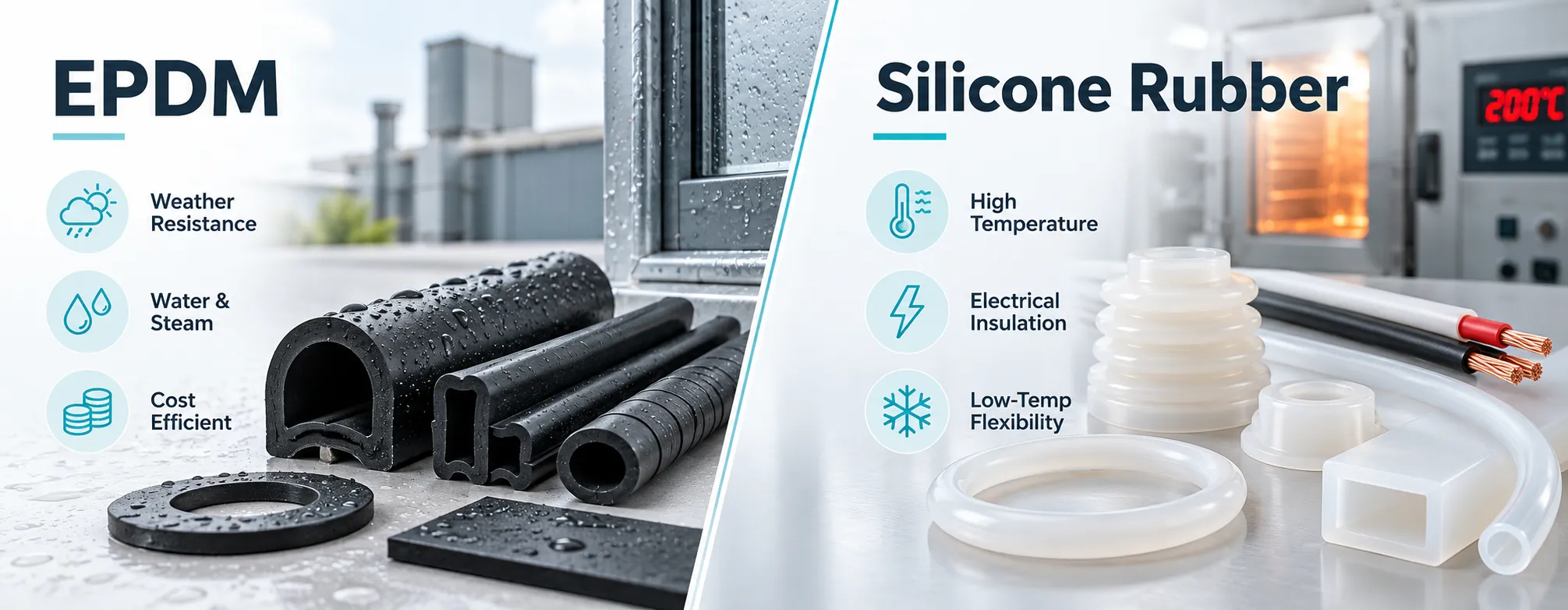
EPDM vs Silicone Rubber: Quick Answer
Choose the material according to the application, not simply which rubber is “better.”EPDM is often the practical choice for outdoor sealing, water and steam exposure and cost-sensitive industrial applications. Silicone rubber becomes more attractive when extreme temperatures, low-temperature flexibility, electrical insulation, food-contact formulations or long-term thermal stability are important.
High TemperatureSilicone usually has the advantage.
Water & SteamEPDM is often a strong choice.
UV & OzoneBoth materials perform very well.
Electrical InsulationSpecialized silicone grades offer major advantages.
Abrasion & ToughnessEPDM often provides stronger mechanical durability.
Material CostEPDM is generally more economical.
What Is EPDM Rubber?
EPDM stands for ethylene propylene diene monomer. It is a synthetic elastomer based primarily on ethylene and propylene with a diene component that provides sites for vulcanization.
EPDM is widely used because it combines flexibility, weather resistance and relatively good mechanical durability with attractive manufacturing economics.
Common applications include automotive weather seals, HVAC gaskets, roofing membranes, enclosure seals, water-system components, hoses and general outdoor rubber parts.
EPDM is particularly well known for resistance to ozone, sunlight, water and many polar fluids. However, standard EPDM is generally not a good choice for petroleum oils, fuels and many hydrocarbon-based fluids.
What Is Silicone Rubber?
Silicone rubber is an elastomer based on a siloxane polymer backbone containing alternating silicon and oxygen atoms.
This polymer structure is fundamentally different from the carbon-based backbone of EPDM and helps explain silicone rubber's broad temperature performance and long-term resistance to heat, ozone and weathering.
Industrial silicone materials include HTV/HCR silicone rubber, liquid silicone rubber and RTV systems. For extrusion, compression molding and many industrial molded products, HTV/HCR silicone is particularly important.
Silicone rubber is widely used in wire and cable, composite insulators, surge arresters, EV components, seals, gaskets, food-processing equipment, medical components and high-temperature molded products.
Silicone Rubber vs EPDM: Main Differences
| Property | EPDM | Silicone Rubber |
|---|---|---|
| Polymer Backbone | Primarily carbon-based organic polymer | Silicon-oxygen siloxane backbone |
| High-Temperature Performance | Good | Excellent for suitable grades |
| Low-Temperature Flexibility | Good to excellent depending on grade | Excellent for suitable grades |
| UV & Ozone Resistance | Excellent | Excellent |
| Water Resistance | Excellent | Good, grade and conditions dependent |
| Steam Resistance | Often very good with suitable compounds | Requires appropriate grade and conditions |
| Petroleum Oil & Fuel | Generally poor | Standard VMQ generally not preferred |
| Tear / Abrasion | Generally stronger | More formulation and design dependent |
| Electrical Insulation | Useful in selected formulations | Excellent in specialized electrical grades |
| Relative Cost | Generally lower | Generally higher |
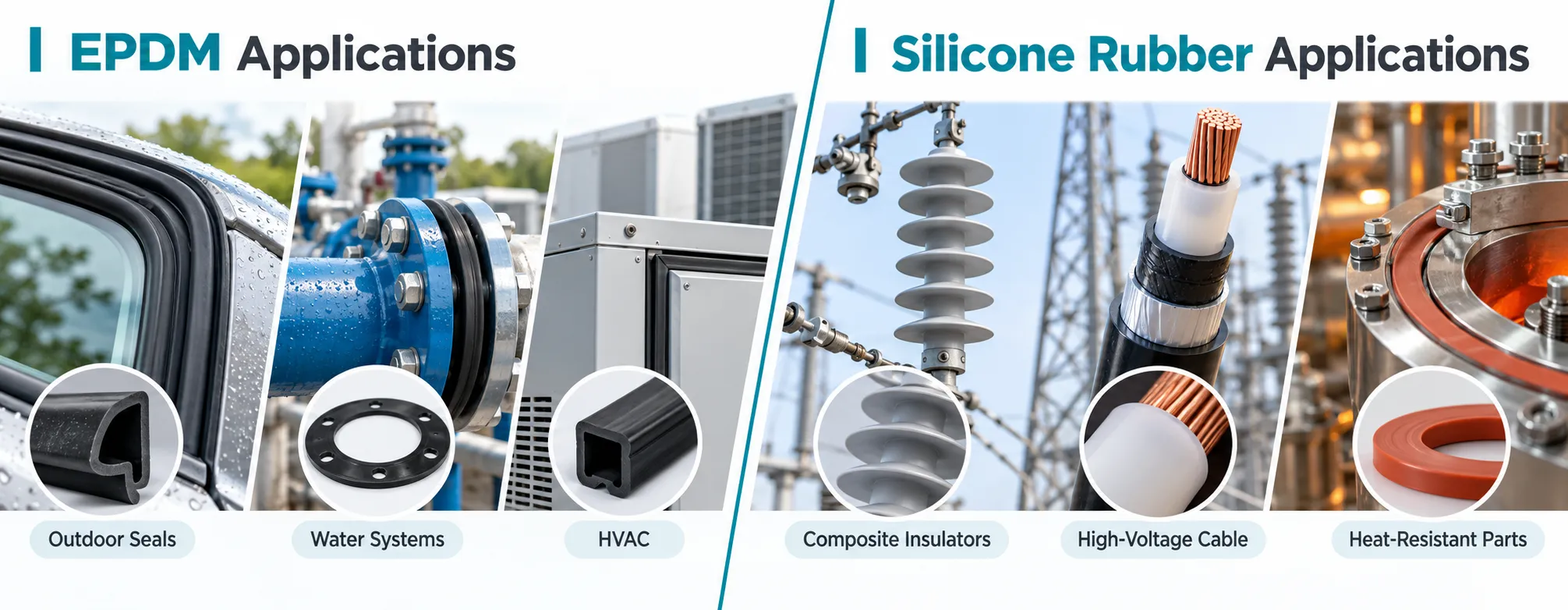
EPDM vs Silicone Temperature Range
Temperature capability is one of the clearest differences between silicone rubber and EPDM.
Many industrial EPDM compounds are suitable from approximately the -40°C region through around 120°C to 150°C depending on formulation, medium and service conditions.
Industrial silicone rubber commonly provides useful low-temperature flexibility around -50°C to -60°C and can operate around 180°C to 200°C in many applications. Specialized high-temperature formulations may extend further.
Strong moderate-temperature performanceExcellent for many outdoor, water and industrial sealing applications where extreme heat is not required.
Much wider thermal operating windowParticularly useful where high heat, low-temperature flexibility or repeated thermal cycling is important.
Temperature ranges are not universal material limits.Actual service temperature depends on compound formulation, contact medium, load, exposure duration and required retained properties.
Which Is Better at High Temperature?
Silicone rubber generally provides the stronger high-temperature capability.
Its siloxane backbone remains stable across temperature conditions that can accelerate hardening, shrinkage or mechanical-property loss in many conventional organic elastomers.
This is why silicone is frequently selected for oven seals, heat-resistant cables, electrical components, automotive thermal systems and industrial equipment operating close to heat sources.
The important engineering question is not simply the highest temperature a sample can survive. The material should retain sufficient hardness, tensile strength, elongation, sealing force and electrical performance throughout the required service life.
Which Is Better at Low Temperature?
Both EPDM and silicone can provide useful low-temperature flexibility, but silicone typically has an advantage in more extreme cold conditions.
As elastomers cool, they become progressively stiffer. If the temperature becomes sufficiently low, sealing and mechanical recovery can deteriorate.
Silicone rubber is widely used where the component must remain flexible through large temperature changes, making it suitable for outdoor electrical systems, transportation, cable and cold-environment applications.
EPDM vs Silicone for Outdoor Applications
Both EPDM and silicone rubber provide excellent resistance to ozone, UV radiation and general weathering.
This makes both materials suitable candidates for outdoor seals and exposed components.
EPDM is widely used for building seals, automotive weatherstrips, HVAC systems and outdoor gaskets because it provides excellent environmental resistance at a relatively economical cost.
Silicone becomes especially valuable outdoors when weather resistance must be combined with extreme temperature performance or electrical insulation.
Choose EPDM WhenThe primary requirement is economical outdoor sealing with excellent UV, ozone and water resistance.
Choose Silicone WhenThe outdoor component also requires extreme temperature performance, electrical insulation or specialized functional properties.
EPDM vs Silicone for Water and Steam
EPDM is widely used for water, hot-water and steam-related sealing applications when the selected compound is qualified for the required temperature and pressure.
Its resistance to water and many polar fluids makes it a common material for HVAC, plumbing, industrial water systems and selected steam seals.
Standard silicone rubber can also withstand moisture and water exposure, but high-temperature water and steam should not automatically be treated the same as hot air.
A silicone compound that operates successfully at high temperature in dry air may have a lower practical temperature limit when continuously exposed to water or steam.
For hot water or steam, evaluate the actual medium rather than comparing air-temperature ratings.Temperature and chemical compatibility must always be considered together.
EPDM vs Silicone Oil Resistance
Oil resistance is often oversimplified when EPDM and silicone rubber are compared.
Standard EPDM has poor compatibility with petroleum oils, fuels and many hydrocarbons.
Standard VMQ silicone rubber should also not automatically be selected for continuous petroleum fuel or oil exposure.
If oil or fuel resistance is the main requirement, materials such as NBR, FKM or fluorosilicone may be more appropriate depending on temperature, fluid chemistry and mechanical requirements.
| Medium | EPDM | Standard Silicone | Potential Alternative |
|---|---|---|---|
| Water | Excellent candidate | Generally suitable | Application dependent |
| Steam | Strong with suitable grades | Grade dependent | EPDM / specialized elastomer |
| Petroleum Oil | Generally poor | Limited / grade dependent | NBR or FKM |
| Fuel | Generally poor | Standard VMQ not preferred | FKM or FVMQ |
Silicone vs EPDM Tear Strength
EPDM generally offers strong mechanical toughness and resistance to tearing and abrasion.
Standard silicone rubber is softer in mechanical character and can be more sensitive to cuts, sharp edges and abrasion.
However, silicone formulations can be optimized for high tear strength through polymer selection, reinforcing silica and compound design.
For silicone components containing thin sections, holes or complex molded geometry, tear strength should be treated as a separate specification rather than assumed from Shore A hardness.
Silicone vs EPDM Abrasion Resistance
EPDM generally provides better abrasion resistance than standard silicone rubber.
If a component continuously rubs against a moving surface, experiences sliding contact or is exposed to significant mechanical wear, silicone may not be the first material to consider.
Silicone performs best where thermal stability, flexibility, insulation and environmental resistance are more important than continuous mechanical abrasion.
EPDM vs Silicone Compression Set
Compression set is critical for gaskets and seals because it measures how much permanent deformation remains after a material has been compressed for a defined period.
Silicone can provide excellent elastic recovery across a broad temperature range, particularly in static sealing applications.
EPDM can also provide good compression-set performance, especially within its intended temperature and medium range.
Compression-set performance must be compared at the actual service temperature.A room-temperature test alone may not predict how a seal will perform after thousands of hours under heat and compression.
Does Shore A Hardness Decide Which Material Is Better?
No. Both EPDM and silicone can be formulated across overlapping Shore A hardness levels.
A 60 Shore A EPDM compound and a 60 Shore A silicone compound have similar resistance to indentation, but they can behave very differently in heat, water, extrusion, tear, compression and electrical service.
HardnessResistance to indentation.
Tear StrengthResistance to tear propagation.
Compression SetPermanent deformation after compression.
Heat AgingProperty retention after thermal exposure.
OEMs replacing an EPDM compound with silicone—or the reverse—should therefore compare the complete material specification.
Silicone Rubber vs EPDM for Electrical Insulation
This is an area where specialized silicone rubber has important advantages.
Electrical-grade silicone can combine high volume resistivity and dielectric strength with heat resistance, hydrophobicity and long-term outdoor weatherability.
These properties make silicone particularly valuable in high-voltage applications such as composite insulators, surge arrester housings, cable and electrical components.
EPDM is also used in electrical cable and insulation systems, but material selection depends on the exact electrical environment and component design.
Dielectric StrengthSupports resistance to electrical breakdown.
Volume ResistivityHelps restrict current through the bulk material.
HydrophobicityImportant for wet outdoor high-voltage surfaces.
Tracking ResistanceCritical under contaminated electrical stress.
Why Silicone Is Used for Composite Insulators
Composite insulators require a material that performs mechanically, electrically and environmentally at the same time.
The silicone rubber housing surrounds an FRP core and forms the external sheds that create the insulating surface.
Electrical-grade HTV/HCR silicone can be formulated for hydrophobicity, dielectric properties, tracking and erosion resistance and outdoor aging.
The material must also provide sufficient tear strength and suitable rheology for injection or compression molding.
This is different from a general-purpose gasket compound.Composite insulator silicone is designed around high-voltage electrical performance as well as molding and mechanical requirements.
Silicone vs EPDM for Gaskets and Seals
Both silicone and EPDM are widely used for static sealing, but they usually serve different operating environments.
| Gasket Application | Preferred Direction | Reason |
|---|---|---|
| Outdoor Enclosure | EPDM or silicone | Both provide strong weather and ozone resistance |
| High-Temperature Oven | Silicone | Broader elevated-temperature capability |
| Hot Water System | EPDM often preferred | Strong water and steam compatibility |
| Electrical Enclosure | Silicone often attractive | Heat and electrical insulation capability |
| Petroleum Oil Seal | Neither by default | NBR or FKM may be more appropriate |
| High-Abrasion Dynamic Seal | Application dependent | Standard silicone may not provide enough wear resistance |
Silicone vs EPDM for Food Applications
Silicone rubber is widely used in food-contact seals, tubing, kitchenware and processing components because suitable formulations combine temperature resistance with flexibility and cleanliness.
However, silicone is not automatically “food grade” simply because it is silicone.
The exact compound must have appropriate formulation and supporting documentation for the intended market and application.
EPDM compounds can also be formulated for certain food, beverage and potable-water applications. The correct choice should be based on regulatory requirements, temperature, contact medium and cleaning process.
EPDM vs Silicone for Automotive Applications
EPDM is extensively used in automotive weatherstrips, door seals, window seals and cooling-system components because of its outdoor durability, water resistance and cost efficiency.
Silicone becomes attractive in automotive and EV applications when wider temperature performance, electrical insulation or special sealing requirements are involved.
Examples include high-voltage cable, connector components, battery sealing parts and heat-resistant components.
EPDM vs Silicone for Wire and Cable
Both elastomer families can appear in electrical cable systems, but silicone is particularly useful where heat resistance and flexible electrical insulation are critical.
HTV/HCR silicone can be extruded around conductors and cured continuously to produce heat-resistant cable insulation.
Cable-grade silicone should be evaluated for extrusion stability, dielectric properties, tensile strength, elongation and heat aging.
The best compound is not necessarily the hardest or strongest material; it is the one that provides the required electrical performance while processing consistently on the cable line.
How Are EPDM and Silicone Processed?
Both materials can be molded and extruded, but their compounding and curing systems differ.
| Process | EPDM | Silicone Rubber |
|---|---|---|
| Extrusion | Common | Common for HCR/HTV |
| Compression Molding | Common | Common |
| Injection Molding | Possible | HCR and LSR systems available |
| Cure System | Sulfur or peroxide depending on compound | Peroxide or platinum systems depending on silicone type |
| Continuous Profiles | Common | Common |
Why Two Rubber Compounds with the Same Hardness Process Differently
Shore A hardness measures the cured material, while extrusion and molding behavior depend on the uncured compound.
Two materials that both cure to 60 Shore A can have completely different viscosity, plasticity, filler loading and curing behavior.
This matters when an OEM attempts to replace EPDM with silicone or switch between silicone suppliers.
A successful material change usually requires a production trial rather than only a technical-datasheet comparison.
Silicone vs EPDM Cost
EPDM is generally less expensive than silicone rubber and is often the economical choice for high-volume outdoor sealing applications.
Silicone usually carries a higher raw-material cost because it is selected for more specialized thermal, electrical or regulatory performance.
However, purchase price per kilogram does not represent total component cost.
Total material cost should consider:Raw material + cycle time + scrap + replacement frequency + maintenance + downtime + product failure risk.
If an EPDM part repeatedly fails because of extreme heat, selecting the cheaper raw material does not create a lower-cost system.
Likewise, using silicone in a moderate-temperature outdoor seal where EPDM already provides sufficient performance may create unnecessary material cost.
When Should You Choose EPDM?
EPDM is usually worth considering when the application involves outdoor weathering, ozone, rain, water or selected steam environments without unusually high temperature requirements.
It is also attractive where good mechanical toughness and material economics are important.
Automotive Weather SealsStrong outdoor durability and economical volume production.
HVAC SystemsUseful for air, water and weather-exposed sealing.
Building SealsExcellent ozone and UV resistance.
Water SystemsStrong resistance to water in suitable formulations.
When Should You Choose Silicone Rubber?
Silicone should be considered when the application requires properties that move outside the comfortable operating window of ordinary EPDM.
High TemperatureIndustrial equipment, ovens and heat-exposed components.
Extreme ColdApplications requiring flexibility at very low temperatures.
Electrical InsulationCable, composite insulators, surge arresters and EV systems.
Specialized ApplicationsFood-contact, medical or customized silicone formulations where applicable.
When Neither EPDM nor Silicone Is the Best Choice
Choosing between EPDM and silicone should not become a forced two-material decision.
If the component is continuously exposed to petroleum oil or fuel, NBR, HNBR, FKM or fluorosilicone may be more suitable depending on temperature and fluid chemistry.
If severe abrasion is the primary failure mechanism, polyurethane or another wear-resistant elastomer may provide better performance.
Material selection should always begin with the actual failure risk.
How to Choose Between EPDM and Silicone Rubber
TemperatureDefine minimum, normal and peak temperatures.
Contact MediumIdentify water, steam, oil, fuel, chemicals or air.
EnvironmentIndoor, outdoor, UV, ozone or high pollution.
Mechanical LoadCompression, stretching, abrasion or repeated movement.
Electrical RequirementDetermine whether dielectric insulation is required.
Processing MethodExtrusion, compression or injection molding.
ComplianceIdentify food-contact or other application-specific requirements.
Service LifeDefine expected operating hours and maintenance interval.
Cost TargetCompare total lifecycle cost rather than raw-material price alone.
EPDM or Silicone? Application Decision Table
| Application Requirement | Material Direction |
|---|---|
| Economical outdoor weather seal | EPDM is often the practical first choice |
| High continuous temperature | Silicone generally has the advantage |
| Extreme low-temperature flexibility | Silicone is often preferred |
| Water / selected steam service | EPDM is frequently attractive |
| High-voltage outdoor insulation | Specialized electrical silicone rubber |
| Petroleum fuel | Consider FKM or FVMQ rather than standard EPDM / VMQ |
| Severe abrasion | Review EPDM or another abrasion-resistant elastomer |
| Heat-resistant food-contact component | Qualified food-contact silicone is often attractive |
What Should OEMs Include in a Silicone Rubber RFQ?
Final ApplicationSeal, cable, insulator, gasket or molded component.
Current MaterialEPDM, silicone or another existing compound.
Temperature RangeMinimum, continuous and peak conditions.
Contact MediumAir, water, steam, oil, chemicals or food products.
Shore A HardnessTarget hardness and acceptable tolerance.
Mechanical PropertiesTensile, elongation, tear and compression requirements.
Electrical PropertiesWhere dielectric or high-voltage performance is required.
Processing MethodExtrusion, compression or injection molding.
Current FailureHardening, cracking, tearing, leakage or processing instability.
Silicone Rubber Solutions from Yakows
Yakows supplies HTV/HCR silicone rubber, liquid silicone rubber and customized silicone compounds for manufacturers requiring broader temperature capability, electrical insulation, mechanical flexibility and application-specific performance.
Material solutions can be developed for composite insulators, wire and cable, EV high-voltage systems, industrial seals, rubber gaskets, food-contact products and other molded or extruded components.
For OEMs considering a change from EPDM to silicone rubber, material selection should begin with the reason for the change. High-temperature hardening, poor low-temperature flexibility, electrical insulation requirements or specialized compliance needs may each require a different silicone formulation.
Customers can provide their existing EPDM or silicone datasheet, Shore A hardness, production process, operating environment and current failure problem for material comparison.
Frequently Asked Questions
What is the difference between EPDM and silicone rubber?
EPDM is a carbon-based synthetic rubber widely used for outdoor, water and general sealing applications. Silicone rubber has a siloxane backbone and generally provides a wider operating-temperature range, strong low-temperature flexibility and specialized electrical performance.
Which is better, EPDM or silicone?
Neither material is universally better. EPDM is often more economical for outdoor and water-related sealing, while silicone is usually preferred for extreme temperatures, electrical insulation and certain specialized applications.
Is silicone more heat resistant than EPDM?
Generally yes. Suitable silicone rubber formulations can operate at significantly higher temperatures than typical EPDM compounds.
Which is better for outdoor use, EPDM or silicone?
Both provide excellent UV and ozone resistance. EPDM is often more economical for standard outdoor sealing, while silicone becomes attractive when outdoor exposure is combined with extreme temperature or electrical requirements.
Is EPDM better than silicone for water?
EPDM is widely used in water and selected steam applications. Actual suitability depends on temperature, pressure, fluid chemistry and the exact compound.
Can EPDM be used with petroleum oil?
Standard EPDM is generally not recommended for petroleum oils and fuels. Another elastomer such as NBR or FKM may be more appropriate.
Is silicone rubber oil resistant?
Standard silicone has limited compatibility with many petroleum oils and fuels. Fluorosilicone or another oil-resistant elastomer may be more suitable for demanding fluid exposure.
Which has better tear strength, EPDM or silicone?
EPDM generally offers stronger tear and abrasion performance, although silicone can be specially formulated for high tear strength.
Which is better for electrical insulation?
Specialized silicone rubber is widely used for demanding electrical and high-voltage insulation because it combines dielectric properties with heat resistance, hydrophobicity and outdoor durability.
Can silicone replace EPDM directly?
Not always. Even at the same Shore A hardness, silicone and EPDM have different rheology, mechanical properties, temperature behavior and chemical compatibility. A production and application trial is recommended.
Which is cheaper, silicone or EPDM?
EPDM is generally less expensive. Silicone's higher cost is usually justified when the application requires its wider temperature range or specialized functional performance.
Can both EPDM and silicone be food grade?
Suitable compounds from either family can be formulated for specific food-contact requirements. Compliance should be verified for the exact compound and intended application.