
Silicone Rubber Performance Guide
Understanding Tensile Strength vs Tear Strength in Silicone Rubber
When buyers compare silicone rubber grades, they often focus on hardness, color or temperature resistance first. However, for many molded, extruded and high-voltage components, the more important question is how the material behaves under stress. In practice, two of the most critical mechanical properties are tensile strength and tear strength. Although they are related, they are not the same. A silicone rubber grade may perform well in one test but still fail in another application condition. Understanding the difference helps engineers, buyers and product designers choose a more suitable compound for seals, cable accessories, composite insulators, tubing, gaskets and industrial rubber parts.
Contents
What Is Tensile Strength in Silicone Rubber?
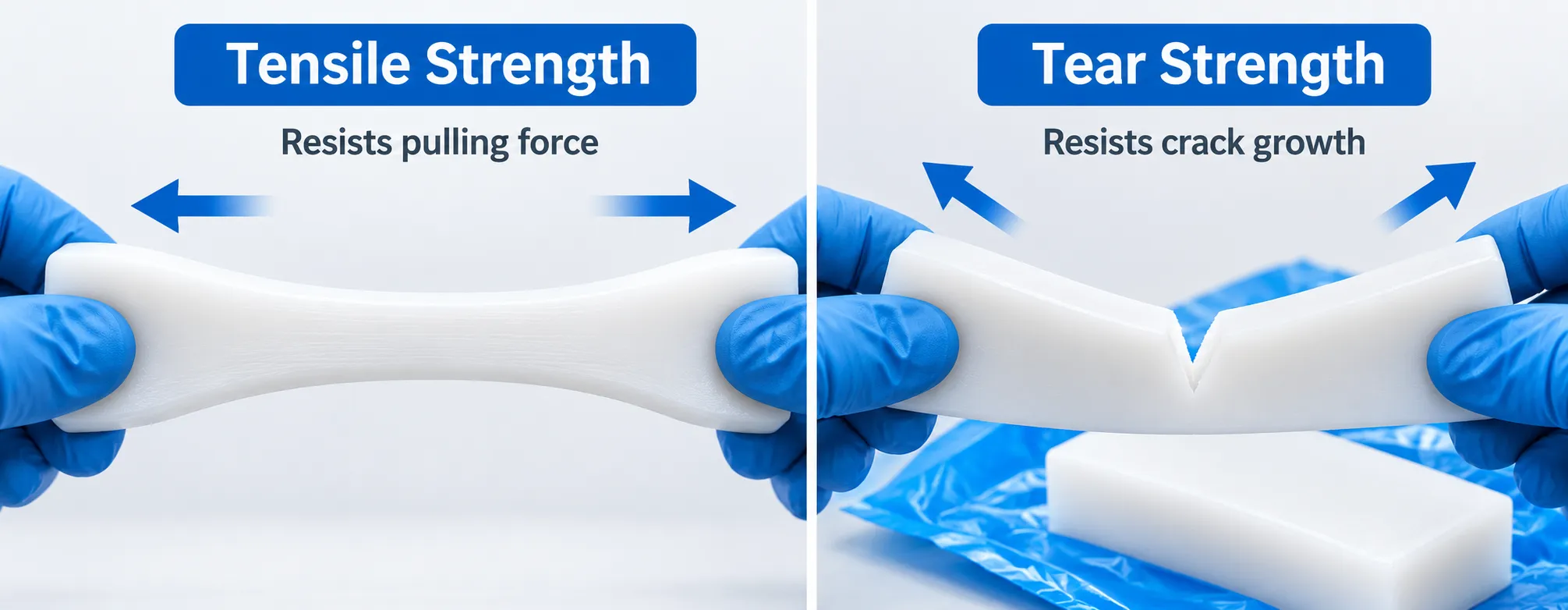
Tensile strength refers to the maximum pulling force that a silicone rubber material can withstand before it breaks. In other words, it measures how strongly the material resists being stretched apart. It is usually expressed in MPa. For silicone rubber buyers, tensile strength is useful when evaluating how the material will behave in parts that experience tension, elongation or repeated mechanical load.
For example, a silicone rubber seal, gasket or cable accessory may need to stretch slightly during installation. A material with insufficient tensile strength can crack or rupture under load. In extrusion and molding applications, tensile strength is also one sign of reinforcement quality, filler balance and crosslink density.
In general, higher tensile strength often indicates a better reinforced silicone compound, especially when fumed silica and formulation design are properly optimized. However, high tensile strength alone does not guarantee good resistance to cutting, nicking or tearing.
What Is Tear Strength in Silicone Rubber?
Tear strength describes how well silicone rubber resists the growth of a cut, notch or small crack once damage has started. It is usually expressed in kN/m. While tensile strength looks at the force required to pull the whole sample until it breaks, tear strength focuses on how easily an existing weak point spreads through the material.
This property is especially important in parts with thin edges, complex geometries, demolding stress, sharp corners or repeated mechanical contact. A silicone rubber grade with low tear strength may look acceptable in standard tensile testing, but once a small cut forms during processing or service, the material can fail much more quickly than expected.
That is why tear strength is a major concern for products such as composite insulator sheds, cable accessories, diaphragms, keypads, sleeves and extruded profiles. These products often face handling stress, assembly friction, or long-term environmental fatigue that can turn a small defect into a much larger failure.
Key Difference Between Tensile Strength and Tear Strength
The simplest way to understand the difference is this: tensile strength measures resistance to overall stretching and breaking, while tear strength measures resistance to crack propagation. They describe different failure modes. A silicone rubber material can have good tensile performance but still show only moderate tear resistance, especially if the formulation is optimized more for elongation than for notch resistance.
This distinction matters in real products. If your silicone rubber part mainly experiences uniform pulling force, tensile strength may be one of the main decision factors. If your product has thin sections, exposed edges or a risk of mechanical nicking, tear strength may be even more critical than tensile strength.
Practical rule: Tensile strength tells you how strong the material is when pulled. Tear strength tells you how tough the material is once damage begins.
Why These Properties Matter in Silicone Rubber Applications
Silicone rubber is widely used because it combines flexibility, heat resistance, weather resistance, electrical insulation and chemical stability. But different applications place different mechanical demands on the material. That is why buyers should not ask only for “silicone rubber” in a general way. They should ask which performance property matters most in their part.
In composite insulators, for example, the housing and sheds must maintain integrity under weathering, electrical stress and handling. If shed edges are thin, tear strength becomes very important. In wire and cable applications, extrusion stability, elongation and tensile strength influence production and installation performance. In gaskets and sealing products, the material may need a balance of tensile strength, tear strength and compression set. In medical or food-contact parts, mechanical performance must also be balanced with purity and compliance requirements.
Therefore, understanding tensile strength vs tear strength helps avoid over-specifying the wrong property and under-specifying the one that actually determines product life.
What Affects Tensile Strength and Tear Strength?
Several factors influence these two properties in silicone rubber. The first is the base polymer quality. Different gum structures and molecular weights can change reinforcement response and final mechanical behavior. The second is the type and loading of reinforcing fillers, especially silica. Properly dispersed silica usually improves tensile strength and can also improve tear performance when the formulation is balanced correctly.
The curing system also matters. Peroxide-cured and platinum-cured silicone compounds may show different property balances depending on formulation and process conditions. In addition, hardness level affects performance. A higher Shore A hardness does not automatically mean higher tear strength or higher tensile strength. The relationship depends on filler structure, polymer-filler interaction and cure density.
Processing conditions, including mixing quality, temperature control, molding pressure, extrusion stability and post-curing, also influence the final result. Even a well-designed silicone rubber formulation can lose performance if dispersion is poor or curing is incomplete.
Application-Based Material Selection
When choosing a silicone rubber grade, the best method is to begin with the actual failure risk in the application. If the product may be stretched during installation or use, prioritize tensile strength and elongation. If the product has thin edges, sharp corners or a risk of nicking, prioritize tear strength. If the part serves outdoors or in electrical systems, mechanical properties should be evaluated together with weather resistance, dielectric strength and long-term aging performance.
For extruded tubing and profiles, good tensile strength helps support handling and use, but tear strength is also valuable if the profile includes thin lips or sealing edges. For composite insulator housings, a balanced combination of mechanical strength, hydrophobicity and electrical insulation is essential. For industrial molded parts, the ideal property balance depends on whether the part sees stretching, cutting, abrasion or repeated assembly cycles.
Typical Property Comparison
| Property | What It Measures | Typical Unit | Why It Matters |
|---|---|---|---|
| Tensile Strength | Maximum force before break under pulling | MPa | Useful for stretching, installation and load-bearing performance |
| Tear Strength | Resistance to crack or notch propagation | kN/m | Critical for thin edges, complex shapes and damage resistance |
| Elongation at Break | How far the material can stretch before failure | % | Helps evaluate flexibility and deformation capacity |
| Hardness | Surface firmness of the silicone rubber | Shore A | Affects feel, sealing force and structural support |
Example: Why Two Silicone Rubber Grades Can Behave Differently
Imagine two silicone rubber compounds with similar hardness, such as 60 Shore A. One may show higher tensile strength but only moderate tear resistance. Another may show slightly lower tensile strength but better tear strength and improved edge durability. If your product is a simple molded block, the first grade may be acceptable. If your product includes thin sealing lips or demolding-sensitive geometry, the second grade may perform better in real use even though its tensile value is lower.
This is why datasheet comparison should never stop at hardness alone. Buyers should compare silicone rubber properties in relation to the actual product structure and service condition.
How to Choose the Right Silicone Rubber Grade
To select the right silicone rubber, first define the product type and process method, such as molding, extrusion or injection. Then identify the most important failure mode: stretching, tearing, deformation, electrical breakdown, weather aging or thermal exposure. Once the key risk is clear, it becomes easier to prioritize the correct property set.
Ask your supplier for a clear data sheet including tensile strength, tear strength, elongation, hardness, density and relevant electrical or environmental properties. If the application is in power transmission, cable insulation, medical parts or food-contact components, compliance and long-term stability should also be reviewed. In many cases, the best choice is not the material with the highest single number, but the one with the most balanced performance for the target use.
For OEM buyers, it is also recommended to discuss sample testing before full production. Real-part trials often reveal whether the silicone rubber grade truly fits the mold design, extrusion die, demolding force and final-use condition.
FAQ
Is higher tensile strength always better for silicone rubber?
Not always. Higher tensile strength is useful, but if the product is vulnerable to cuts or edge damage, tear strength may be more important.
What is more important for composite insulators?
For composite insulators, a balanced combination of tear strength, tensile strength, electrical insulation, weather resistance and hydrophobicity is important. Thin shed edges often make tear resistance particularly valuable.
Can hardness tell me tensile or tear strength?
No. Hardness alone cannot accurately predict either tensile strength or tear strength. Two silicone rubber grades with the same Shore A hardness can perform quite differently.
Why does tear strength matter in extrusion?
Extruded profiles, tubing and seals may have thin sections or edges. Good tear strength helps reduce damage during handling, cutting, installation and service.
Conclusion
When evaluating silicone rubber, tensile strength and tear strength should never be treated as interchangeable. Tensile strength focuses on the material’s resistance to being pulled apart, while tear strength reflects its ability to resist crack growth once a flaw appears. Choosing the right property depends on the real working condition of the final part. For better product reliability, silicone rubber buyers should match the material not only to hardness and cost, but also to the actual mechanical risks in the application.