
HCR Silicone Processing Guide
HCR Silicone Processing: Mixing, Molding, and Curing Guide
HCR silicone, also known as high consistency rubber, is a solid silicone elastomer used in industrial molding, extrusion, electrical insulation, cable manufacturing and other demanding applications. Unlike liquid silicone rubber (LSR), HCR has a high consistency and is typically processed as a millable compound before being shaped and cured.
Successful HCR silicone processing depends on more than selecting the right material. Mixing quality, compound temperature, preform preparation, mold design, extrusion conditions and curing parameters all influence dimensional accuracy, surface quality and finished-part performance.
This guide explains how to process HCR silicone rubber, compare common manufacturing methods, control curing conditions and troubleshoot defects. It also outlines how to select an HCR silicone compound according to your equipment, production method and application requirements.
Yakows Silicone Rubber Solutions
Select HCR Silicone for Your Manufacturing Process
Different HCR silicone compounds are designed for different combinations of processing behavior, hardness and mechanical performance. Start with the material category most relevant to your production requirements.
HTV / HCR Silicone Rubber
Solid silicone rubber compounds for molding, extrusion and industrial component production.
High Hardness Silicone Rubber
For applications requiring a specified hardness and a suitable balance of mechanical properties.
Silicone Rubber for Insulators and Cables
Material solutions for electrical insulation and demanding outdoor service environments.
Need a compound matched to your molding or extrusion process?
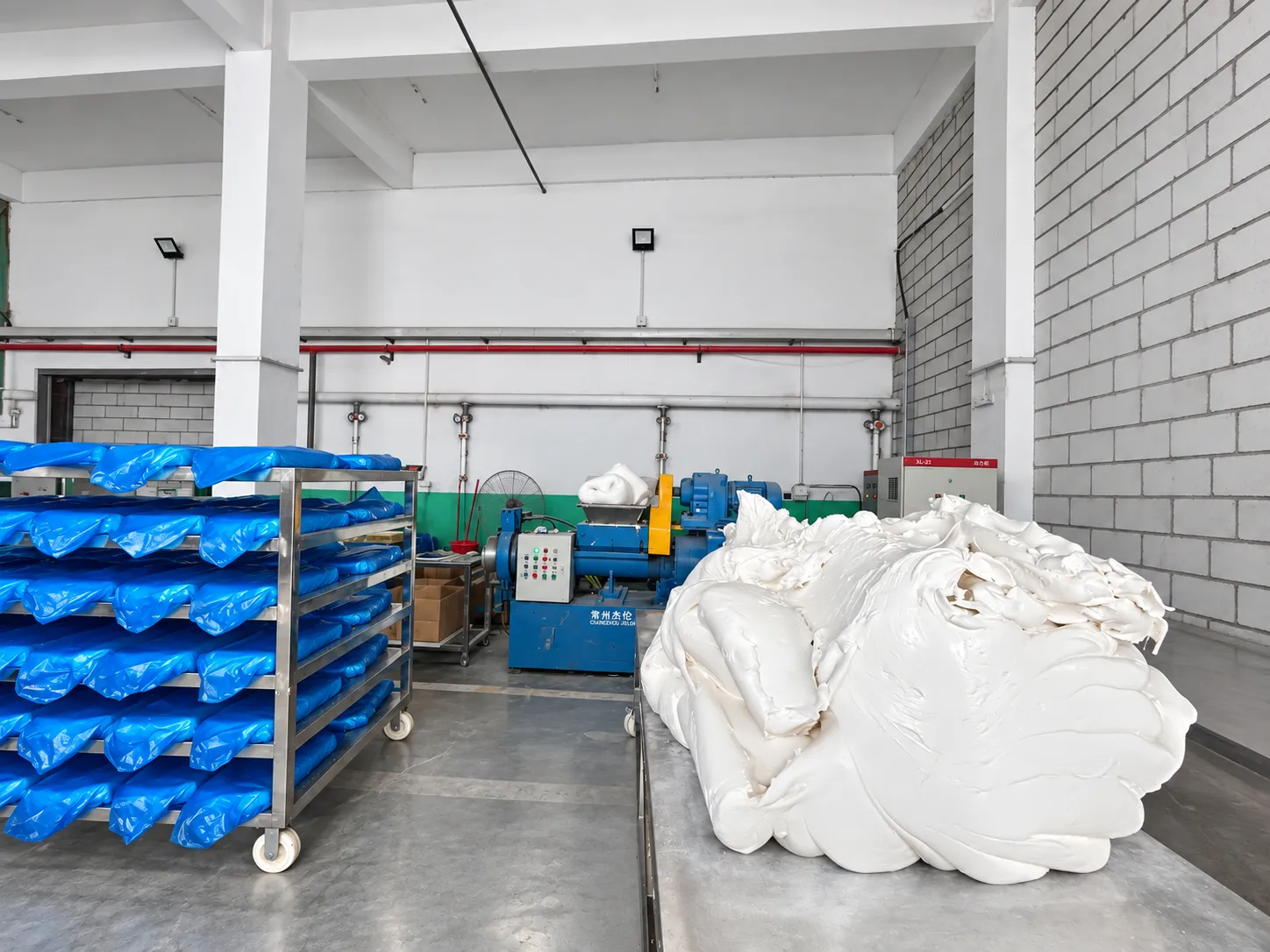
1. Understanding HCR Silicone Before Processing
High consistency rubber (HCR) is a high-viscosity silicone elastomer supplied in a solid, gum-like form. It is commonly used to manufacture molded components, extruded profiles, tubing, seals, gaskets, cable insulation and electrical insulating parts.
HCR is often associated with HTV silicone rubber, or high-temperature-vulcanizing silicone. The terms overlap substantially in industrial practice, although the exact terminology used by a supplier may depend on the material grade and curing system.
Compared with LSR, HCR is generally handled as a solid compound rather than as two pumpable liquid components. It can be softened, mixed, formed and then vulcanized using a suitable manufacturing process.
Key characteristics that affect processing
- High consistency: The material needs suitable feeding, handling and forming equipment.
- Compound-dependent plasticity: Softening behavior and flow characteristics affect preform preparation, mold filling and extrusion.
- Different curing systems: Peroxide-cured and platinum-cured HCR grades may require different processing and post-curing procedures.
- Application-specific formulation: Hardness, tear resistance, color, electrical properties and other requirements influence material selection.
Before production begins, confirm whether the material is a ready-to-process compound or a base gum requiring additional compounding. Also obtain the technical datasheet and processing instructions for the specific grade.
2. HCR Silicone Mixing and Compound Preparation
Consistent mixing is a critical step in HCR silicone processing. Poor dispersion, inconsistent catalyst distribution or excessive heat during preparation can lead to variation in curing behavior, mechanical properties and finished-part quality.
The exact workflow depends on whether the supplier provides a fully compounded, ready-to-process HCR material or a base compound that requires additional ingredients. Follow the supplier's formulation and processing instructions rather than assuming every HCR grade uses the same preparation sequence.
Step 1: Inspect and condition the material
Check the material identification, batch number, shelf life and storage condition before use. Keep the compound protected from contamination, moisture or other conditions identified in the supplier's handling instructions.
Review the intended curing system and confirm that the material is compatible with the planned production process.
Step 2: Soften the compound when required
A two-roll mill is commonly used to soften HCR silicone and prepare it for subsequent mixing or forming. The purpose is to achieve suitable plasticity and consistent handling, not simply to heat the material as much as possible.
Excessive heat or prolonged processing can affect the compound and, depending on the cure system, may shorten its usable processing time or cause premature curing. Control roll temperature, frictional heating and mixing time according to the grade-specific instructions.
Step 3: Incorporate approved additives and curing agents
Where the formulation requires additional ingredients, follow the specified addition sequence and mixing procedure. Colorants, functional additives and curing agents must be compatible with the silicone formulation.
Curing agents should be dispersed uniformly. Inconsistent distribution can cause local differences in cure behavior, surface appearance or mechanical performance.
Step 4: Check the compound before forming
Inspect the material for visible contamination, uneven color, inconsistent texture or other abnormalities. Confirm that it has the required processability before transferring it to the molding or extrusion operation.
Where applicable, prepare and identify the material according to the production batch and traceability requirements.
Mixing controls to prioritize
- Maintain consistent roll settings and mixing time.
- Control material temperature during preparation.
- Prevent contamination between compounds or colors.
- Follow the correct curing-agent addition sequence.
- Use the supplier's specified storage and usable processing time.
3. Choosing the Right HCR Silicone Processing Method
HCR silicone can be processed through several manufacturing methods. The right choice depends on component geometry, production volume, dimensional requirements, tooling investment and the compound's processing characteristics.
| Process | Typical Products | Main Considerations |
|---|---|---|
| Compression Molding | Gaskets, seals and molded rubber parts | Preform weight, mold filling, pressure, venting and demolding. |
| Transfer Molding | Complex parts and selected multi-cavity components | Transfer behavior, cavity filling, trapped air and material waste. |
| Injection Molding | Repeatable molded components and production parts | Feeding consistency, injection conditions, mold design and cure control. |
| Extrusion | Tubing, continuous profiles and cable insulation | Compound plasticity, die design, dimensional stability and continuous curing. |
| Calendering | Sheets and continuous rubber layers | Thickness uniformity, surface quality and stable material feeding. |
These processes are not interchangeable in every situation. For example, extrusion is suited to continuous profiles, while compression molding is often appropriate for discrete components and comparatively straightforward tooling requirements.
Injection molding can support repeatable production, but successful processing requires suitable compound rheology, feeding equipment and mold design. The production method should therefore be selected together with the HCR grade, not after material procurement has been completed.
4. HCR Silicone Molding: Compression, Transfer and Injection
Compression molding
Compression molding is widely used for HCR silicone parts. A prepared preform is placed into the mold cavity, after which the mold closes and applies pressure while heat initiates and completes vulcanization.
Preform design is particularly important. The material quantity and placement must support complete cavity filling without creating excessive flash or trapping air in critical areas.
Important controls include:
- Preform weight and shape.
- Mold temperature and closing conditions.
- Cavity venting and material flow paths.
- Cure time appropriate to the part and compound.
- Demolding technique and handling of thin features.
Transfer molding
Transfer molding moves a prepared quantity of HCR silicone from a transfer chamber into the mold cavities. It can be useful for more complex geometries or selected multi-cavity designs where controlled material transfer is advantageous.
The transfer path, material flow, venting and curing conditions must be matched to the compound. Poor filling or trapped air can cause incomplete parts and internal defects.
Injection molding
HCR injection molding feeds the solid compound into an injection system and forces it into a heated mold, where vulcanization takes place. It can support repeatable production, but it requires careful coordination of feeding, material temperature, injection conditions and mold design.
Air entrapment, shrinkage variation and hot tearing during demolding are important issues to evaluate. Raising the mold temperature may shorten the cure cycle, but it does not automatically improve overall quality. The process must balance cure speed with the compound's demolding behavior and the geometry of the finished part.
For injection-molded components, validate the complete process window through controlled trials instead of relying on a single temperature or cycle-time value.
5. HCR Silicone Extrusion and Continuous Vulcanization
HCR silicone extrusion is used to produce continuous products such as tubing, seals, gaskets, profiles and wire or cable insulation. The compound is fed through an extruder and shaped by a die before undergoing a suitable curing process.
Unlike a discrete molding cycle, extrusion requires stable feeding, consistent material flow and dimensional control throughout the production run.
Control compound feed and plasticity
The compound must feed consistently without excessive heating or unstable flow. Variations in material preparation, feeding rate or compound temperature can lead to fluctuations in profile dimensions and surface appearance.
Optimize the extrusion die
Die geometry influences material flow, profile shape and dimensional stability. Die swell, shrinkage during curing and cooling, and differences between the die opening and final product dimensions should be considered during process development.
Profiles with thin lips, hollow sections or complex cross-sections may require particular attention to flow balance and dimensional stability.
Match the curing line to the extruded profile
Continuous curing systems, including hot-air vulcanization, are used for suitable HCR extrusion applications. The curing line must provide sufficient heat transfer and residence time for the profile to cure without unacceptable deformation or surface defects.
Line speed, profile thickness, oven conditions and compound cure characteristics must be evaluated together. Increasing line speed without validating cure completion can produce material that appears formed correctly but does not meet the required mechanical properties.
Common extrusion quality checks
- Profile dimensions and cross-sectional consistency.
- Surface finish and visible porosity.
- Continuity of the extruded profile.
- Cure completion and mechanical properties.
- Dimensional stability after cooling and any specified post-treatment.
6. HCR Silicone Curing and Post-Curing
Curing converts the uncured HCR compound into an elastomeric component with the required mechanical and functional properties. The appropriate cure conditions depend on the curing chemistry, material formulation, component thickness and manufacturing process.
Peroxide-cured HCR silicone
Peroxide-cured HCR is used in many industrial molding and extrusion applications. The curing agent decomposes under appropriate thermal conditions to initiate crosslinking.
Temperature and time must be controlled to achieve the required cure while limiting premature curing during processing. The cure system and compound specification determine the appropriate process conditions.
Platinum-cured HCR silicone
Platinum-cured HCR uses an addition-curing system. Depending on the grade, it may be selected where specific requirements for byproducts, clarity, cleanliness or application performance are important.
Because the chemistry differs from peroxide curing, the handling, processing and post-curing instructions should be followed for the exact compound. Avoid assuming that one curing procedure is suitable for both systems.
How to establish curing conditions
When developing a process, evaluate the following together:
- Compound specification: Follow the supplier's recommended cure system and processing window.
- Part thickness: Consider heat transfer and the time needed for the entire section to cure.
- Mold or oven conditions: Confirm actual operating temperatures and temperature uniformity.
- Cycle time or line speed: Ensure sufficient curing without creating avoidable production bottlenecks.
- Demolding behavior: Check whether the component can be removed without tearing or deformation.
When is post-curing required?
Post-curing is an additional heating stage used for selected HCR formulations and applications. Depending on the curing system and product requirements, it may help reduce residual volatile substances and achieve specified final properties.
Post-curing is not a universal requirement for every HCR compound. Whether it is necessary, and the appropriate temperature and duration, should be determined from the supplier's technical guidance and the finished product's requirements.
For medical, food-contact and electrical applications, additional qualification or testing may be necessary. A post-curing step alone does not establish regulatory compliance or guarantee suitability for a particular application.
7. Common HCR Silicone Processing Problems and Solutions
When defects occur, identify whether the primary cause is related to material preparation, equipment, mold or die design, curing conditions, or handling. Changing several process variables simultaneously can make the root cause difficult to identify.
| Problem | Possible Causes | Recommended Checks |
|---|---|---|
| Incomplete mold filling | Unsuitable preform, restricted flow, insufficient material or inappropriate process settings. | Review preform quantity, material flow, cavity design and processing conditions. |
| Air bubbles or voids | Trapped air, contamination, unsuitable material preparation or inadequate venting. | Inspect compound preparation, vents, flow paths and material condition. |
| Excessive flash | Mold mismatch, excessive material, insufficient clamping or unsuitable process conditions. | Check mold condition, preform weight, clamping and material flow. |
| Premature curing | Excessive material temperature, long processing time or unsuitable handling conditions. | Review compound temperature, mixing sequence, storage and usable processing time. |
| Hot tearing during demolding | Unsuitable demolding timing, part geometry, cure conditions or local stress concentration. | Evaluate cure balance, demolding technique, mold surface and component design. |
| Variable extrusion dimensions | Unstable feed, temperature variation, die effects or inconsistent curing and cooling. | Check feed consistency, die condition, line speed, curing and dimensional compensation. |
| Inconsistent hardness or strength | Material variation, uneven curing, mixing differences or inconsistent test conditions. | Verify batch traceability, cure conditions, specimen preparation and test methods. |
These are diagnostic starting points rather than universal fixes. Confirm the defect pattern, review the production record and change one controllable factor at a time where practical. If the defect persists, consult the compound supplier and evaluate whether the material grade is appropriate for the process.
8. Quality Control for HCR Silicone Products
Quality control should verify both the incoming compound and the finished product. The appropriate inspection plan depends on the component's function, applicable standards and customer acceptance criteria.
Incoming material checks
Verify material identity, batch number, shelf life, packaging condition and relevant documentation. Where required, confirm hardness, appearance or other agreed incoming inspection properties.
In-process controls
Monitor mixing consistency, compound temperature, preform preparation, molding or extrusion conditions, curing and handling. Recording key process variables makes it easier to identify production drift and investigate defects.
Finished-product testing
Depending on the application, testing may include:
- Shore hardness.
- Tensile strength and elongation at break.
- Tear strength.
- Compression set.
- Dimensional inspection and visual examination.
- Electrical, thermal, aging or application-specific performance tests.
Not every test is necessary for every product. Define the acceptance criteria according to the actual application and customer specification, and ensure that test methods and specimen conditions are appropriate for the material.
For electrical insulation and composite insulator applications, mechanical testing should be combined with the required electrical and environmental performance evaluations. A satisfactory hardness or tensile result alone cannot establish the suitability of a material for high-voltage service.
9. How to Select the Right HCR Silicone Compound
The right HCR silicone compound must match both the manufacturing process and the finished product's performance requirements. Selecting material solely by hardness or price can create problems later in production.
Start with the manufacturing method
Tell the supplier whether the compound will be compression molded, transfer molded, injection molded or extruded. Different processes place different demands on plasticity, feeding behavior, cure characteristics and dimensional control.
Define mechanical requirements
Specify the target hardness and tolerance, tensile strength, elongation, tear resistance and any other critical properties. For sealing applications, compression set may be particularly important. For thin extruded profiles, tear resistance and dimensional stability may deserve greater attention.
Confirm the curing system
Check whether the compound is peroxide-cured or platinum-cured and establish the applicable curing and post-curing requirements. This is particularly important where processing conditions, cleanliness, residual byproducts or regulatory requirements affect the final product.
Consider the operating environment
Temperature exposure, weathering, electrical requirements, chemical contact and mechanical loading may all influence the material specification. Choose a grade that addresses the complete set of operating conditions rather than one isolated property.
Validate the material before production approval
Where the application is critical, request samples and evaluate them using representative production equipment and the intended quality tests. Trial production can help identify problems with feeding, mold filling, extrusion stability, cure behavior and finished-part performance before large-scale manufacturing.
Providing the supplier with the part drawing, processing method, target properties and operating conditions makes the material recommendation more precise.
10. HCR Silicone vs. LSR: Processing Differences
HCR and LSR are both used to manufacture silicone rubber components, but their physical forms and processing workflows differ significantly.
| Consideration | HCR Silicone | LSR |
|---|---|---|
| Material form | High-consistency solid compound | Low-viscosity liquid system, commonly supplied as two components |
| Preparation | May require mill softening, compounding or preform preparation, depending on supply form | Typically uses metering and mixing equipment for the specified components |
| Common processes | Compression molding, transfer molding, injection molding and extrusion | Primarily liquid injection molding |
| Continuous products | Widely used for tubing, profiles and cable-related products | Suitable for selected liquid-injection-molded designs and specialized applications |
| Process priorities | Compound plasticity, feeding, forming, dimensional stability and curing | Component metering, mixing, temperature control, mold filling and curing |
Neither material is universally better. The correct choice depends on part geometry, production volume, available equipment, mechanical requirements and cost targets.
For manufacturers evaluating solid silicone compounds, Yakows' HTV silicone rubber product range is a suitable starting point for discussing HCR material requirements.
Frequently Asked Questions About HCR Silicone Processing
What does HCR stand for in silicone rubber?
HCR stands for high consistency rubber. It describes a solid, high-viscosity silicone elastomer commonly used in molding, extrusion and other rubber manufacturing processes.
Is HCR silicone the same as HTV silicone rubber?
The terms overlap substantially in industrial use. HCR emphasizes the material's high consistency, while HTV refers to high-temperature vulcanizing. Confirm the exact grade and curing requirements with the supplier.
Does HCR silicone require a two-roll mill?
A two-roll mill is commonly used to soften or further compound HCR silicone. However, the exact preparation requirements depend on whether the material is supplied as a ready-to-process compound or as a base gum requiring additional ingredients.
Which molding methods can be used for HCR silicone?
Common methods include compression molding, transfer molding and injection molding. Extrusion and calendering are also used for suitable product geometries and compound grades.
What temperature should be used to cure HCR silicone?
There is no single curing temperature suitable for every HCR compound. The correct conditions depend on the cure chemistry, grade, component thickness, equipment and production method. Follow the supplier's technical instructions and validate the process.
Does every HCR silicone product require post-curing?
No. Post-curing depends on the formulation, curing system and application requirements. Confirm whether it is needed and follow the grade-specific instructions rather than applying a universal post-cure cycle.
Why does HCR silicone tear during demolding?
Possible causes include unsuitable demolding timing, cure conditions, local stress concentrations, part geometry or mold-surface issues. Investigate the defect pattern and validate changes to the process rather than changing the mold temperature alone.
How can I reduce defects in HCR silicone extrusion?
Focus on stable compound feeding, consistent material preparation, suitable die design, controlled line speed, dimensional compensation and complete curing. The correct adjustments depend on the observed defect and compound grade.
How do I choose an HCR silicone supplier for OEM production?
Evaluate material consistency, technical documentation, processing compatibility, available property data, sample support and the supplier's ability to match your application requirements. Confirm the compound through representative trials before production approval.
Yakows Silicone Rubber Manufacturer
Looking for HCR Silicone for Molding or Extrusion?
Yakows supplies silicone rubber compounds for industrial and OEM manufacturing applications. Share your processing method, target hardness, required mechanical properties and operating environment to discuss a suitable material option.
For a more accurate recommendation, include the product type, component drawing where available, production process and any applicable technical specifications.
Request HCR Silicone Information →
Email: info@yakows.com