
ELECTRICAL INSULATION · MATERIAL ENGINEERING
Understanding Rubber Dielectric Strength and Electrical Insulation Performance
Rubber dielectric strength is an important property used to evaluate the ability of rubber materials to withstand electrical stress without electrical breakdown. It is particularly important in electrical insulation systems, power transmission equipment, cable accessories and composite insulators.
Although many rubber materials are electrical insulators, their ability to resist electrical breakdown varies according to polymer composition, formulation, thickness, temperature, moisture, contamination and manufacturing quality.
For manufacturers selecting electrical insulating rubber, understanding dielectric strength alone is not enough. Volume resistivity, dielectric constant, dielectric loss, mechanical strength and resistance to environmental aging must also be considered.
This guide explains how rubber dielectric strength is measured, which factors influence electrical insulation performance, and how to select suitable silicone rubber compounds for industrial and high-voltage electrical applications.
YAKOWS · ELECTRICAL INSULATION MATERIALS
Electrical Insulation Silicone Rubber for Power Applications
Yakows manufactures HTV/HCR silicone rubber compounds for electrical insulation and industrial applications. For power equipment manufacturers, material selection should consider dielectric performance, hydrophobicity, mechanical properties, tracking resistance and long-term environmental exposure.
Electrical Insulation HTV Silicone Rubber
Designed for electrical insulation applications requiring suitable dielectric properties, mechanical strength, weather resistance and stable material performance.
Composite Insulator Silicone Rubber
Silicone rubber compounds for composite insulator manufacturing, where electrical insulation, hydrophobicity, resistance to tracking and erosion, and outdoor aging performance are important.
Customized Electrical Insulation Rubber Compounds
Material selection can be evaluated according to required hardness, tensile strength, elongation, dielectric properties, processing method and environmental conditions.
Developing silicone rubber components for electrical equipment or composite insulators?
1. What Is Rubber Dielectric Strength?
Rubber dielectric strength describes the electric field intensity that an insulating rubber specimen can withstand before electrical breakdown occurs under specified test conditions.
When an electric field is applied across an insulating rubber material, the material resists the movement of electrical charge. As the applied voltage increases, the electrical stress within the specimen also increases. Once the material can no longer withstand the electrical stress, a conductive path may form through the material, resulting in dielectric breakdown.
Dielectric strength is commonly expressed in kilovolts per millimeter (kV/mm) or volts per mil (V/mil).
E = V / dE = Dielectric strength or average breakdown field (kV/mm)
V = Breakdown voltage (kV)
d = Specimen thickness (mm)
For example, if a 2 mm thick specimen experiences electrical breakdown at 40 kV, its calculated average breakdown field is 20 kV/mm.
This is a simplified calculation based on the specimen thickness. Actual test results depend on electrode geometry, field distribution, specimen condition and the specified testing procedure.
Why Is Dielectric Strength Important?
Dielectric strength helps engineers assess the electrical insulation capability of a rubber material and compare different compounds under controlled test conditions.
- Evaluates resistance to electrical breakdown.
- Supports the selection of insulating materials for electrical equipment.
- Helps monitor formulation and manufacturing consistency.
- Provides technical information for electrical insulation design.
- Helps identify changes caused by aging, moisture or material defects.
2. Dielectric Strength vs. Breakdown Voltage
Dielectric strength and breakdown voltage are related, but they are not interchangeable terms.
Breakdown voltage is the voltage at which a specific specimen experiences electrical breakdown during a defined test. Dielectric strength expresses the breakdown voltage relative to the specimen thickness.
| Parameter | Bedeutung | Common Unit |
|---|---|---|
| Breakdown Voltage | Voltage at which electrical breakdown occurs in the specimen. | kV |
| Durchschlagfestigkeit | Breakdown voltage divided by specimen thickness. | kV/mm |
| Volumenwiderstand | Resistance to electrical current passing through the material volume. | Ω·cm |
| Oberflächenwiderstand | Resistance to current flowing along the material surface. | Ω or Ω/square, depending on method |
| Dielektrizitätskonstante | Relative permittivity describing the material's response to an electric field. | Dimensionless |
| Dielectric Loss | Energy dissipated within the material under an alternating electric field. | Dissipation factor or tan δ |
A material with high dielectric strength is not necessarily the best choice for every insulation application. Engineers must also consider electrical resistivity, dielectric loss, thermal behavior, mechanical properties and long-term operating conditions.
3. Electrical Properties of Different Rubber Materials
Different elastomers have different electrical, thermal and environmental characteristics. The appropriate material depends on the voltage level, operating environment, mechanical requirements and service life of the component.
Silicone Rubber (VMQ)
Silicone rubber is widely used in electrical insulation because of its dielectric properties, thermal stability, flexibility and resistance to outdoor environmental exposure.
Its hydrophobic surface characteristics are particularly valuable in outdoor high-voltage applications. Suitable formulations can also be designed to provide resistance to tracking and erosion.
EPDM Rubber
EPDM is commonly used in electrical cable accessories and insulation components. It offers good weather resistance, ozone resistance and electrical insulation properties in appropriately formulated grades.
Naturkautschuk
Natural rubber can provide good electrical insulation properties in suitable formulations. However, its resistance to ozone, weathering and long-term outdoor exposure may require additional consideration.
Nitrile Rubber (NBR)
NBR is primarily selected for its resistance to oils and fuels. Although certain NBR compounds provide electrical insulation, their suitability for high-voltage outdoor applications must be assessed against the specific electrical and environmental requirements.
| Rubber Material | Electrical Characteristics | Important Advantages | Typische Anwendungsbereiche |
|---|---|---|---|
| Silikonkautschuk | Good dielectric insulation in suitable grades. | Thermal stability, hydrophobicity and weather resistance. | Composite insulators, electrical seals and insulation components. |
| EPDM | Good insulation in electrical-grade formulations. | Ozone and weather resistance. | Cable accessories and electrical insulation. |
| Naturkautschuk | Good insulating properties in suitable compounds. | Elasticity and mechanical performance. | Selected electrical insulating components. |
| NBR | Depends on formulation and application. | Oil and fuel resistance. | Oil-resistant industrial seals and components. |
These are general material characteristics rather than guaranteed performance rankings. Actual dielectric strength and electrical properties must be verified using the technical datasheet and test results of the specific rubber compound.
4. Factors Affecting Rubber Dielectric Strength
The dielectric strength of rubber is influenced by its formulation, physical structure, manufacturing quality and testing environment. Two compounds based on the same polymer may produce different electrical performance results.
Material Formulation
Polymer selection, reinforcing fillers, pigments, additives and curing systems can influence the electrical properties of rubber.
Electrical insulating compounds must be formulated with suitable raw materials and controlled impurity levels. Certain conductive contaminants or unsuitable additives may reduce electrical resistance.
Specimen Thickness
Dielectric strength is calculated using breakdown voltage and specimen thickness. However, the relationship is not always directly proportional.
Electrical field distribution, specimen defects and the statistical probability of breakdown can influence measured values. Therefore, results from specimens of different thicknesses should not be compared without considering the test method.
Moisture and Humidity
Moisture can influence surface conductivity, leakage current and the electrical behavior of insulating materials. Surface contamination combined with moisture may create additional electrical stress.
This is especially important for outdoor electrical insulation systems exposed to rain, fog, condensation and polluted environments.
Temperature
Temperature changes can affect polymer mobility, electrical conductivity, dielectric loss and the long-term stability of rubber compounds.
For electrical applications involving continuous thermal exposure, dielectric performance should be considered together with heat aging and mechanical property retention.
Manufacturing Defects
Air voids, contamination, poor filler dispersion, incomplete curing and inconsistent material thickness can affect electrical breakdown behavior.
Proper mixing, molding, curing and quality control are essential for producing consistent electrical insulating rubber.
Aging and Environmental Exposure
Long-term exposure to UV radiation, ozone, heat, moisture and electrical stress can change the surface and internal structure of rubber materials.
For outdoor high-voltage applications, engineers should evaluate electrical insulation performance alongside tracking resistance, erosion resistance, hydrophobicity and weathering durability.
5. How Is Rubber Dielectric Strength Tested?
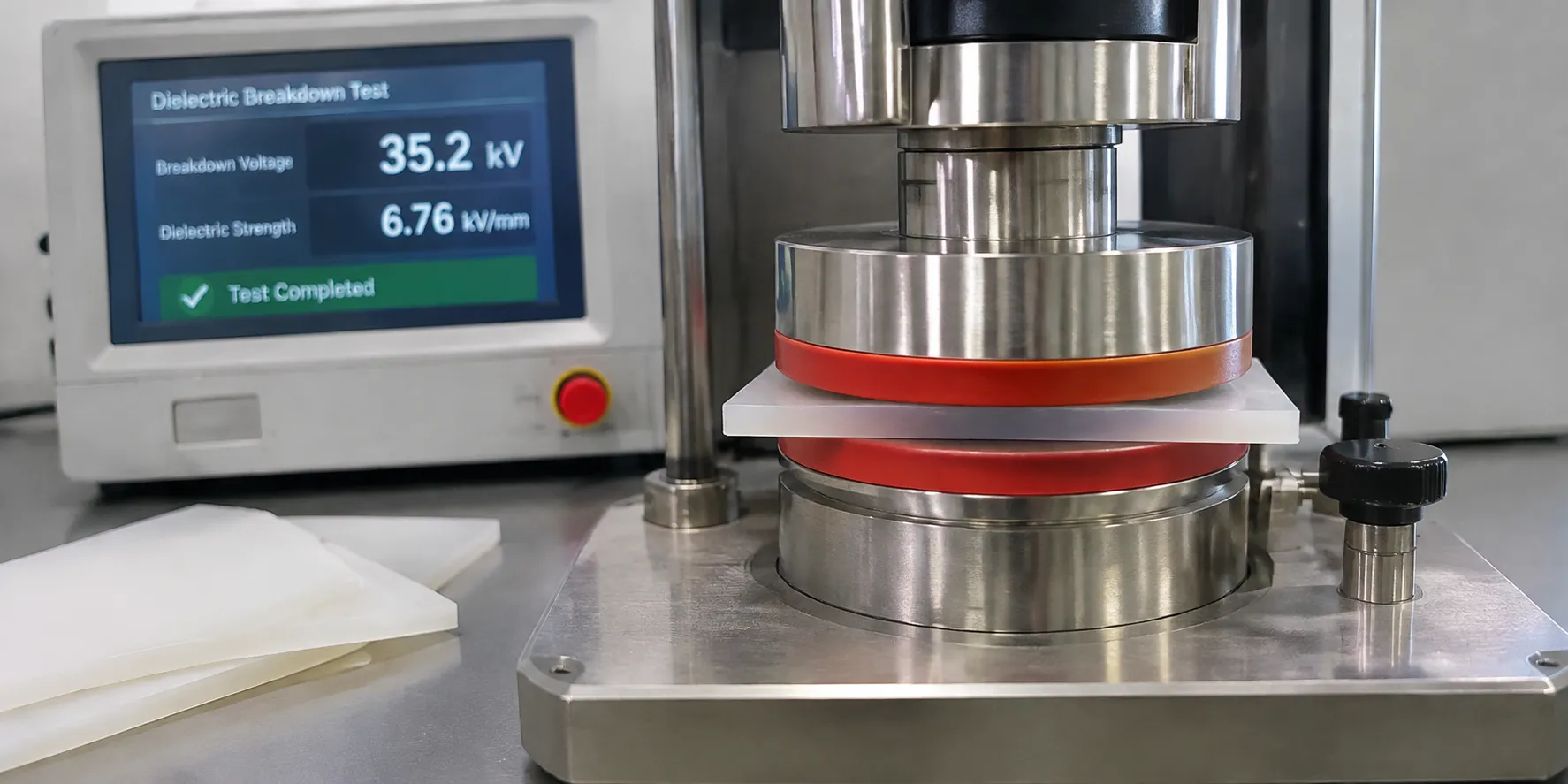
Rubber dielectric strength is commonly evaluated by applying an increasing electrical voltage across a prepared specimen until breakdown occurs. The measured breakdown voltage is then related to the specimen thickness to calculate dielectric strength.
Step 1: Prepare the Test Specimen
Prepare rubber specimens with controlled thickness, dimensions and surface condition according to the applicable test procedure.
Specimen preparation is important because surface defects, uneven thickness and internal voids can influence the breakdown result.
Step 2: Condition the Specimen
Specimens may need to be conditioned under specified temperature and humidity conditions before testing.
The conditioning procedure should be recorded because moisture and temperature can affect electrical measurements.
Step 3: Position the Electrodes
Place the specimen between the specified electrodes. Electrode geometry, contact conditions and the surrounding medium influence the electrical field distribution.
Step 4: Apply Electrical Voltage
Apply the voltage according to the selected test procedure. ASTM D149 describes different voltage application methods, including short-time, step-by-step and slow rate-of-rise testing.
Voltage application conditions should be controlled and documented to ensure meaningful comparisons.
Step 5: Record Breakdown Voltage
When electrical breakdown occurs, record the corresponding voltage and relevant specimen information.
Step 6: Calculate Dielectric Strength
Calculate the average breakdown field using the measured breakdown voltage and specimen thickness. Multiple specimens are normally evaluated to assess material consistency.
Dielectric Strength = Breakdown Voltage ÷ ThicknessExample: 40 kV ÷ 2 mm = 20 kV/mm
Illustrative calculation only, not a Yakows product specification.
ASTM D149 also emphasizes that dielectric breakdown test results should not normally be used directly to predict the electrical behavior of a finished component. Application-specific testing and engineering evaluation are necessary.
6. ASTM Standards for Testing Electrical Insulating Rubber
Several ASTM methods are relevant to evaluating the electrical properties of insulating rubber. The selected standard depends on the property being measured and the intended application.
ASTM D149 – Dielectric Breakdown Voltage and Dielectric Strength
ASTM D149 is used to determine the dielectric breakdown voltage and dielectric strength of solid electrical insulating materials at commercial power frequencies under specified conditions.
It includes different voltage application methods and covers breakdown through the specimen thickness as well as breakdown along the interface between a specimen and its surrounding medium.
The standard requires important test conditions to be specified, including voltage application method, specimen preparation, conditioning, surrounding medium, temperature and electrodes.
ASTM D257 – Volume and Surface Resistivity
ASTM D257 covers DC measurements of insulation resistance, volume resistance and surface resistance. These measurements can be used to calculate volume resistivity and surface resistivity.
Volume resistivity helps characterize resistance to electrical conduction through the material, while surface resistivity is associated with electrical conduction along the surface.
ASTM D150 – Dielectric Constant and Dissipation Factor
Dielectric constant and dissipation factor provide additional information about how an insulating material responds to an alternating electrical field.
These properties can be relevant when evaluating dielectric behavior and energy losses in electrical insulation systems.
| Standard | Measured Property | Application Value |
|---|---|---|
| ASTM D149 | Dielectric breakdown voltage and dielectric strength. | Evaluates resistance to electrical breakdown. |
| ASTM D257 | Insulation resistance and volume/surface resistivity. | Evaluates electrical resistance characteristics. |
| ASTM D150 | Dielectric constant and dissipation factor. | Evaluates dielectric response and electrical losses. |
| ASTM D2240 | Durometer hardness. | Supports mechanical material selection. |
| ASTM D412 | Tensile strength and elongation. | Evaluates mechanical integrity. |
These methods evaluate different properties and should not be treated as interchangeable. A complete electrical insulation assessment may require several complementary tests.
7. Why Silicone Rubber Is Used for Electrical Insulation
Silicone rubber is widely used in electrical insulation because it combines electrical insulating properties with flexibility, thermal stability and environmental resistance.
Electrical Insulation Performance
Suitable silicone rubber formulations can provide high electrical resistivity and dielectric strength. These characteristics make them useful for insulating components in electrical equipment and power systems.
Hydrophobie
One of the important characteristics of silicone rubber is its hydrophobic surface behavior. Water tends to form droplets rather than spreading into a continuous film across a clean silicone surface.
For outdoor electrical insulation, this characteristic can help reduce the formation of continuous conductive water films and support improved pollution performance.
Tracking and Erosion Resistance
Outdoor insulators may be exposed to moisture, pollution and electrical stress. Under severe conditions, dry-band arcing and surface discharge can contribute to tracking and erosion.
Electrical-grade silicone rubber compounds are designed to provide appropriate resistance to these environmental and electrical stresses.
Thermal and Weather Resistance
Silicone rubber maintains useful flexibility across a broad temperature range and offers good resistance to ozone and outdoor weathering in suitable formulations.
These properties are important for electrical insulation products that must operate outdoors over extended service periods.
Mechanical Flexibility
Silicone rubber can accommodate deformation and mechanical movement while maintaining its elastic properties. This is valuable for electrical components exposed to vibration, thermal cycling and installation stresses.
8. Rubber Dielectric Performance in Composite Insulators
Composite insulators are widely used in power transmission and distribution systems. Their external insulating housing commonly uses silicone rubber, while a structural core provides mechanical load-bearing capacity.
For composite insulator manufacturers, electrical performance cannot be evaluated by dielectric strength alone. The material must also maintain its surface characteristics and withstand environmental and electrical stresses throughout its service life.
Key Silicone Rubber Requirements for Composite Insulators
- Dielectric properties: Suitable dielectric strength, resistivity and electrical insulation behavior.
- Hydrophobicity: Reduced surface wetting under appropriate environmental conditions.
- Tracking resistance: Resistance to the development of conductive paths on the insulating surface.
- Erosion resistance: Ability to resist surface material deterioration caused by electrical discharge.
- Weather resistance: Resistance to UV radiation, ozone, moisture and temperature fluctuations.
- Mechanical properties: Suitable tensile strength, elongation and tear resistance for manufacturing and service conditions.
Why Is Hydrophobicity Important?
When outdoor insulator surfaces become wet, water films can combine with deposited pollution and create conductive paths. These conditions can increase leakage current and contribute to dry-band arcing.
Silicone rubber's hydrophobic surface characteristics help limit continuous water-film formation. Under suitable conditions, low-molecular-weight silicone species can also migrate toward the surface and support hydrophobicity recovery.
Dielectric Strength Is Not the Same as Insulator Voltage Rating
A silicone rubber compound with a high laboratory dielectric strength does not automatically qualify a composite insulator for a specific system voltage.
Finished-insulator performance depends on the complete design, including creepage distance, shed geometry, core construction, interfaces, electrical field distribution, pollution conditions and applicable type and routine tests.
Therefore, rubber dielectric strength should be treated as one material-level property within a broader composite insulator qualification program.
9. How to Select Rubber with the Right Dielectric Strength
Electrical insulation material selection should begin with the actual operating requirements rather than choosing a rubber compound based on one headline dielectric strength value.
Step 1: Define the Electrical Requirements
Identify the operating voltage, electrical field conditions, AC or DC exposure, frequency and required insulation function.
Step 2: Establish Mechanical Requirements
Define hardness, tensile strength, elongation, tear strength and deformation requirements according to the finished component.
Step 3: Evaluate Environmental Conditions
Consider temperature, humidity, UV exposure, ozone, pollution and potential surface contamination. Outdoor high-voltage applications require particular attention to tracking and erosion performance.
Step 4: Review Electrical Test Data
Request dielectric strength, breakdown voltage, volume resistivity, dielectric constant and dissipation factor data where applicable.
Make sure the reported values include test standards, specimen thickness, test conditions and measurement units.
Step 5: Verify Manufacturing Consistency
Check the supplier's mixing, curing, material inspection and batch traceability procedures. Consistent dispersion and curing are important for reliable electrical insulation performance.
Step 6: Conduct Application-Specific Validation
Test the selected rubber compound in representative component designs and service conditions. For composite insulators, material-level test data must be supplemented by the relevant finished-insulator tests.
| Anwendung | Important Material Properties | Additional Evaluation |
|---|---|---|
| Verbundisolatoren | Dielectric strength, resistivity, hydrophobicity, tracking and erosion resistance. | Finished-insulator electrical and environmental testing. |
| Cable Accessories | Dielectric strength, resistivity, flexibility and thermal stability. | Component-level electrical and aging tests. |
| Electrical Seals | Insulation resistance, hardness, compression set and sealing performance. | Leakage, compression and electrical testing. |
| Insulating Components | Dielectric strength, volume resistivity and mechanical strength. | Voltage and environmental performance testing. |
YAKOWS · ELECTRICAL GRADE HTV SILICONE RUBBER
Looking for Electrical Insulation Silicone Rubber?
Yakows supplies HTV/HCR silicone rubber compounds for electrical insulation, composite insulators and industrial applications.
We can discuss material requirements involving dielectric properties, mechanical strength, hydrophobicity, tracking resistance, thermal stability and manufacturing processes.
Share your application, target technical specifications and production requirements to discuss suitable silicone rubber material options.
Request a Quote & Technical Support →
E-Mail: info@yakows.com
Frequently Asked Questions About Rubber Dielectric Strength
What is the dielectric strength of rubber?
Rubber dielectric strength is the average electric field at which an insulating rubber specimen experiences electrical breakdown under specified test conditions. It is commonly expressed in kV/mm or V/mil.
How is rubber dielectric strength calculated?
It is commonly calculated by dividing the breakdown voltage by the specimen thickness. The result is an average breakdown field and must be interpreted according to the test method and specimen conditions.
What is the ASTM standard for rubber dielectric strength testing?
ASTM D149 is commonly used to determine the dielectric breakdown voltage and dielectric strength of solid electrical insulating materials at commercial power frequencies under specified conditions.
What is the difference between dielectric strength and volume resistivity?
Dielectric strength evaluates resistance to electrical breakdown under an applied electric field. Volume resistivity characterizes resistance to electrical conduction through the material. Both properties are useful when evaluating electrical insulating rubber.
Does rubber thickness affect dielectric strength?
Thickness influences measured breakdown voltage and calculated dielectric strength. However, dielectric strength does not necessarily remain constant across different thicknesses because field distribution and breakdown mechanisms can change.
Does moisture reduce the electrical insulation performance of rubber?
Moisture and surface contamination can influence surface resistance, leakage current and electrical behavior. The actual effect depends on the rubber formulation, surface condition and exposure environment.
Why is silicone rubber used in composite insulators?
Silicone rubber offers useful electrical insulation properties, hydrophobicity, thermal stability and outdoor weather resistance. Suitable formulations can also provide tracking and erosion resistance for high-voltage applications.
Is higher dielectric strength always better?
Not necessarily. Dielectric strength is only one material property. Electrical insulation selection must also consider resistivity, dielectric loss, mechanical strength, thermal stability, tracking resistance and the finished component design.
What electrical properties should I request from a silicone rubber supplier?
Depending on the application, request dielectric strength, breakdown voltage, volume resistivity, surface resistivity, dielectric constant and dissipation factor. Confirm the test methods, specimen thickness and test conditions.
Can HTV silicone rubber be used for high-voltage electrical insulation?
Specially formulated electrical-grade HTV silicone rubber can be used in high-voltage insulation applications, including composite insulators. Its suitability must be established through material testing and finished-product qualification.