
Silicone Rubber for Composite Insulator
Silicone rubber, widely used in composite insulators, exhibits exceptional thermal stability, with decomposition beginning around 200–300°C and significant structural degradation occurring near 350°C. This property ensures that composite insulators maintain electrical insulation, mechanical integrity, and hydrophobicity under high-voltage and high-temperature conditions. Proper understanding of the thermal characteristics of silicone rubber is critical for material selection, insulator design, and long-term operational reliability.
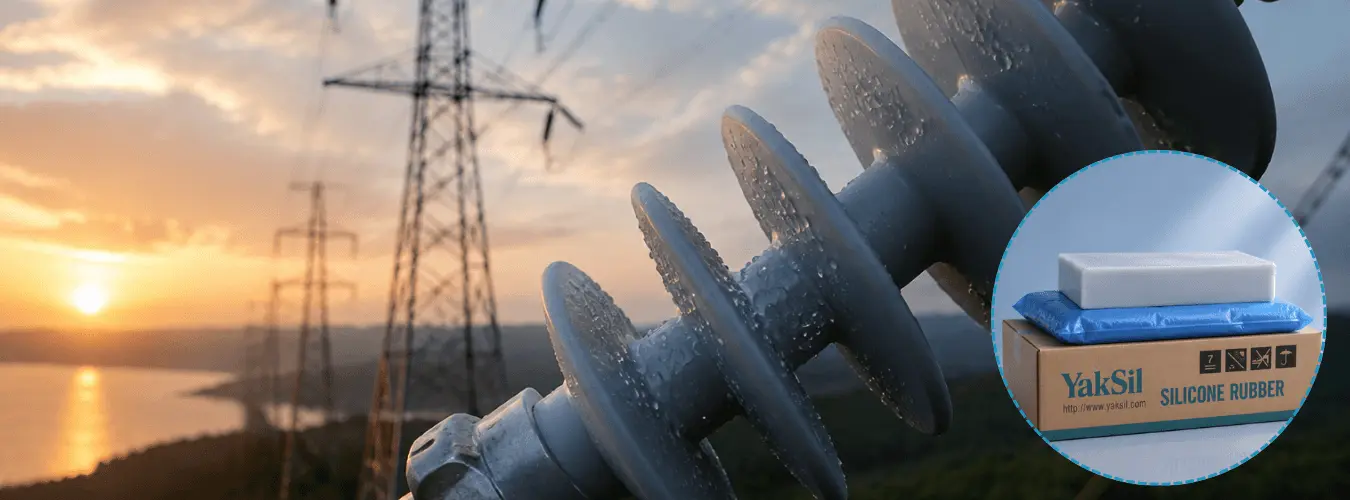
Introduction
High-voltage transmission systems require insulators that can withstand mechanical, electrical, and environmental stress. Silicone rubber has become the preferred material for the housing of composite insulators due to its unique combination of thermal stability, electrical insulation, hydrophobicity, and mechanical flexibility. Unlike crystalline materials, silicone rubber does not have a sharp melting point; instead, it gradually softens and ultimately decomposes over a wide temperature range. Accurate knowledge of these thermal characteristics is essential to ensure that composite insulators function reliably in diverse environmental conditions.
Thermal Behavior of Silicone Rubber
Silicone rubber is a polymer with a Si–O–Si backbone, which gives it excellent thermal resistance. Thermogravimetric analysis (TGA) demonstrates that silicone rubber begins to thermally degrade between 200°C and 300°C, with noticeable mass loss and structural breakdown above 350°C. Decomposition involves chain scission, release of low-molecular-weight siloxanes, and formation of carbonaceous residues.
Because silicone rubber is crosslinked and amorphous, it does not exhibit a well-defined melting point. Instead, its thermal limit is often defined by the onset of decomposition. For composite insulator applications, this high decomposition threshold ensures that the polymer housing retains its mechanical and electrical properties even under extreme environmental and operational conditions, including solar heating and fault currents.
Role of Silicone Rubber in Composite Insulators
Composite insulators typically consist of:
- Core rod: Glass fiber-reinforced epoxy (GFRE) providing mechanical strength.
- Metal fittings: For electrical and mechanical connection.
- Silicone rubber housing: Providing electrical insulation and environmental protection.
The caoutchouc de silicone housing serves several critical functions:
- Isolation électrique: High dielectric strength prevents surface flashover and reduces leakage currents.
- Hydrophobicité: The low surface energy of silicone rubber prevents water film formation, mitigating pollution-induced flashover.
- Mechanical protection: Flexibility absorbs shocks and environmental wear, protecting the brittle core rod.
- Thermal resilience: The high decomposition temperature ensures stability under thermal stress, including high ambient temperatures or short-duration electrical arcs.
The performance and reliability of composite insulators are closely linked to the thermal properties of silicone rubber, particularly in environments with high temperature fluctuations or strong solar radiation.
Influence of Fillers and Formulation on Silicone Rubber
Commercial silicone rubber formulations used in composite insulators often incorporate fillers such as alumina trihydrate (ATH), fumed silica, or ceramics. These additives improve thermal, mechanical, and electrical performance:
- ATH: Enhances flame retardancy by releasing water vapor during heating, delaying decomposition of the polymer.
- Silice: Improves creep resistance and dimensional stability under thermal cycling.
- Crosslink density: Higher crosslinking improves thermal stability but may reduce flexibility; a proper balance is necessary for insulator housing performance.
The careful formulation of silicone rubber ensures that the material maintains hydrophobicity, electrical insulation, and mechanical strength under prolonged thermal and environmental stress.
Testing and Characterization of Silicone Rubber Thermal Properties
The thermal behavior of silicone rubber is assessed using standardized techniques:
- Thermogravimetric Analysis (TGA): Measures weight loss over temperature to determine decomposition onset and thermal stability.
- Differential Scanning Calorimetry (DSC): Detects softening and thermal transitions, confirming the absence of a sharp melting point.
- Thermal Mechanical Analysis (TMA): Evaluates dimensional changes under heat and mechanical stress.
- Accelerated Aging Tests: Simulate long-term exposure to UV, moisture, and temperature cycles to predict performance degradation.
These analyses confirm that silicone rubber maintains structural and electrical integrity below 200–300°C, validating its suitability for high-voltage composite insulators.
Environmental and Operational Considerations
Composite insulators operate in harsh environments, including coastal, industrial, and desert regions. Silicone rubber housings provide thermal resistance, electrical insulation, and hydrophobicity even under high ambient temperatures, solar irradiation, and localized electrical arcing. Proper selection of silicone rubber formulation is critical to ensure that thermal, mechanical, and electrical performance remain stable throughout the insulator’s service life.
Summary
The thermal properties of silicone rubber—notably its decomposition threshold around 350°C—make it a critical material for composite insulator applications. Its combination of mechanical flexibility, electrical insulation, hydrophobicity, and thermal resilience ensures reliable operation in high-voltage transmission systems. Understanding these thermal characteristics allows engineers to optimize material formulation, design durable insulator housings, and maintain system reliability under extreme conditions.