
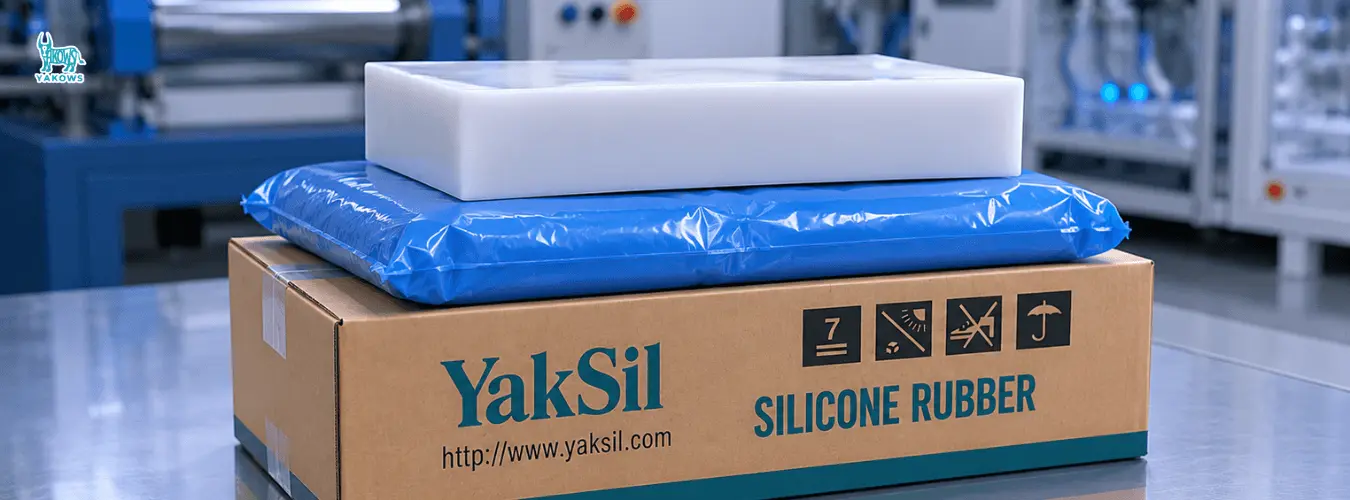
Les étapes de fabrication du caoutchouc silicone
Caoutchouc de silicone est fabriqué selon un processus chimique et technique complexe qui transforme la silice naturelle en l'un des élastomères haute performance les plus polyvalents au monde. La production du caoutchouc silicone comprend plusieurs étapes, notamment l'extraction du silicium, la synthèse du chlorosilane, la polymérisation, le mélange, la vulcanisation et le post-durcissement. Bien que tous les caoutchoucs de silicone proviennent de la même composition chimique silicium-oxygène, des méthodes de fabrication différentes sont utilisées pour produire le caoutchouc de silicone HTV et le caoutchouc de silicone liquide (LSR), chacun étant conçu pour des applications industrielles spécifiques. Le caoutchouc silicone HTV est généralement produit sous forme de matériau solide à haute consistance destiné au moulage par extrusion et par compression, tandis que le caoutchouc silicone liquide est formulé comme un système bicomposant à faible viscosité, optimisé pour le moulage par injection de précision. Comprendre comment le caoutchouc silicone est fabriqué permet non seulement d’expliquer ses propriétés exceptionnelles de résistance à la chaleur, de souplesse, de résistance aux intempéries et d’isolation électrique, mais aussi de comprendre pourquoi il est devenu indispensable dans les secteurs de l’automobile, du médical, de l’électronique, de l’aérospatiale, de l’énergie et de la fabrication industrielle à l’échelle mondiale.
Les principes fondamentaux de la chimie du caoutchouc de silicone
Avant de comprendre comment le caoutchouc de silicone est fabriqué, il est important de comprendre sa structure moléculaire. Contrairement aux caoutchoucs organiques traditionnels, qui reposent sur des chaînes moléculaires carbone-carbone, le caoutchouc de silicone est constitué d’un squelette silicium-oxygène appelé polysiloxane. C’est grâce à cette structure que le caoutchouc de silicone possède une stabilité thermique, une résistance aux UV et aux produits chimiques, ainsi qu’une souplesse exceptionnelles, même à des températures extrêmes.
La liaison silicium-oxygène présente dans le caoutchouc silicone est nettement plus résistante que les liaisons carbone que l'on retrouve dans de nombreux élastomères classiques. De ce fait, le caoutchouc silicone conserve son élasticité et ses performances mécaniques dans des environnements difficiles où les caoutchoucs ordinaires ne résistent pas. Cette stabilité moléculaire permet au caoutchouc silicone de fonctionner en continu à des températures comprises entre -60 °C et plus de 250 °C.
La principale matière première utilisée pour la fabrication du caoutchouc de silicone est la silice, qui est principalement extraite du sable de quartz. Au terme d'une série de réactions chimiques et d'étapes de purification, ce minéral naturel est transformé en polymères de silicone de pointe adaptés aux applications industrielles.
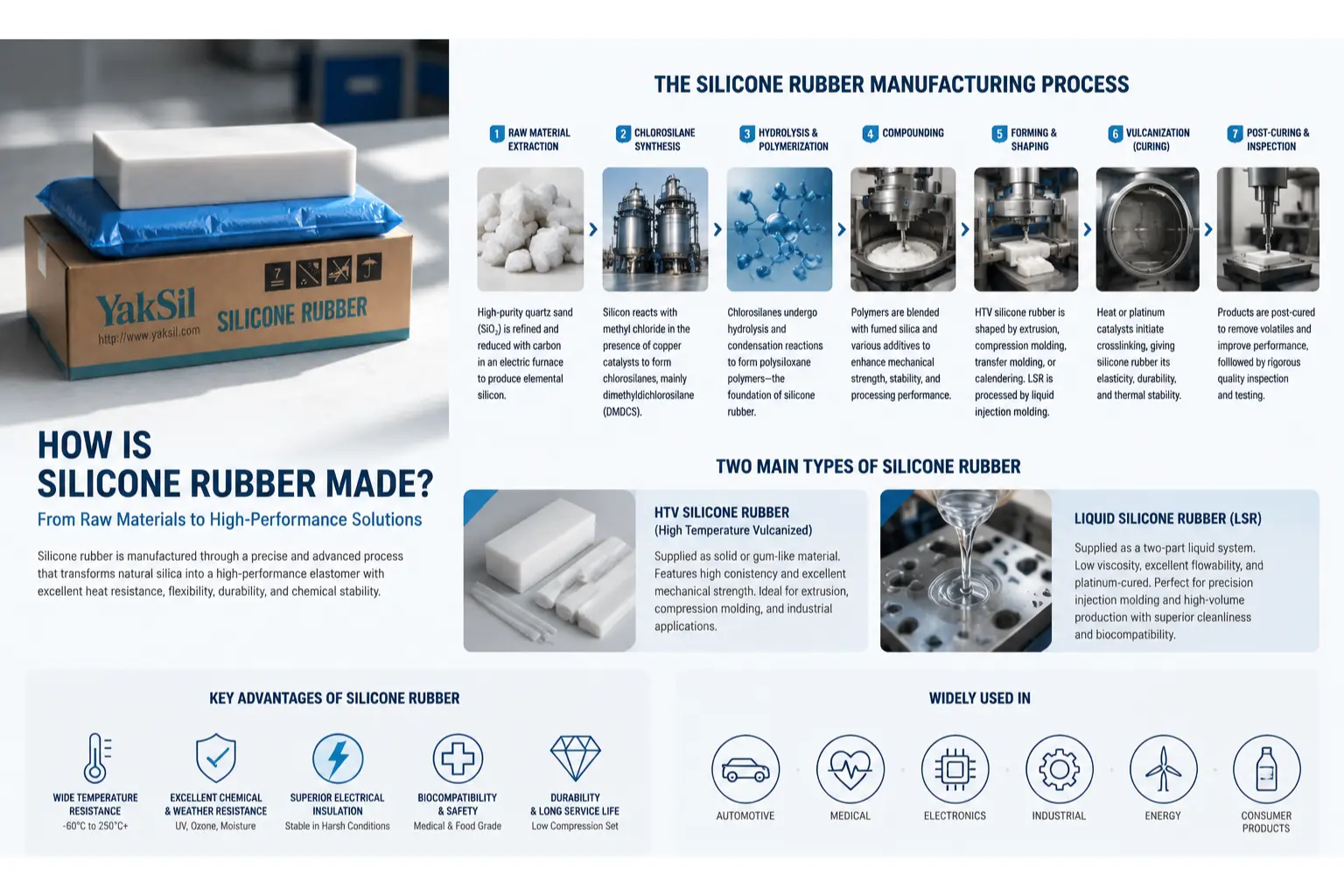
Étape 1 : Extraction du silicium à partir du sable de quartz
Le processus de fabrication du caoutchouc de silicone commence par le sable de quartz, un matériau naturel riche en dioxyde de silicium (SiO₂). Le quartz de haute pureté est soigneusement sélectionné, car les impuretés peuvent nuire aux performances finales du caoutchouc de silicone.
Le quartz est soumis à des opérations de nettoyage, de concassage et de broyage avant d'être introduit dans un four à arc électrique. À l'intérieur du four, la silice réagit avec des matières carbonées telles que le charbon ou le coke à des températures supérieures à 1 900 °C. Cette réaction de réduction à haute température élimine les atomes d'oxygène de la silice, produisant ainsi du silicium de qualité métallurgique.
La réaction peut être simplifiée comme suit :
SiO₂ + 2C → Si + 2CO
Cette étape est extrêmement gourmande en énergie et nécessite un contrôle précis de la température du four et des proportions de carbone. La pureté du silicium obtenu a une incidence directe sur la qualité, la transparence et la stabilité des produits finis en caoutchouc de silicone.
Une fois extrait, le silicium est refroidi, broyé et préparé pour l'étape suivante de la fabrication du caoutchouc de silicone.
Étape 2 : Production de chlorosilanes par le procédé direct
L'étape suivante dans la fabrication du caoutchouc de silicone consiste à transformer le silicium élémentaire en intermédiaires chimiques réactifs appelés chlorosilanes. Ce procédé, connu sous le nom de « procédé de Rochow » ou « procédé direct », est considéré comme l'une des étapes les plus cruciales de la chimie du silicone.
De la poudre de silicium finement broyée est mise à réagir avec du chlorure de méthyle gazeux (CH₃Cl) en présence de catalyseurs à base de cuivre, à des températures comprises entre 250 °C et 350 °C. Au cours de cette réaction, plusieurs composés chlorosilanes se forment, mais le plus important est le diméthyldichlorosilane (DMDCS), qui sert de composant de base principal pour les polymères de caoutchouc silicone.
Les conditions de réaction doivent être soigneusement contrôlées, car l'efficacité du catalyseur, la température de réaction et la pression déterminent le rendement et la pureté des chlorosilanes. Même une contamination minime peut affecter l'uniformité et les performances des caoutchoucs de silicone à un stade ultérieur du processus.
Les chlorosilanes sont ensuite séparés par distillation fractionnée. Le diméthyldichlorosilane de haute pureté est isolé en vue d'une hydrolyse et d'une polymérisation ultérieures.
Étape 3 : Hydrolyse et formation de polymères de silicone
Une fois purifiés, les chlorosilanes subissent une hydrolyse par réaction avec l'eau. Au cours de cette étape, les atomes de chlore sont remplacés par des groupes hydroxyles, formant ainsi des intermédiaires silanols. Ces groupes silanols se condensent ensuite entre eux pour former des polymères polysiloxanes à longue chaîne.
Cette étape marque la véritable naissance de la chimie du caoutchouc de silicone, car c'est à ce moment-là que commence à se former la chaîne principale silicium-oxygène. Le poids moléculaire et la structure de ces polymères déterminent si le matériau deviendra finalement du caoutchouc de silicone HTV ou du caoutchouc de silicone liquide.
Pour le caoutchouc silicone HTV, les fabricants produisent des polymères à très haut poids moléculaire présentant une consistance épaisse, semblable à celle de la gomme. Ces polymères offrent une excellente résistance mécanique et une excellente résistance à la déchirure.
Pour le caoutchouc de silicone liquide, on produit des polymères de faible poids moléculaire dont la viscosité est rigoureusement contrôlée. Ces polymères restent fluides et sont spécialement conçus pour les systèmes de moulage par injection de liquide.
La capacité à concevoir la structure moléculaire à ce stade offre aux fabricants de caoutchouc silicone une grande flexibilité pour adapter la dureté, l'élasticité, la transparence, la déformation rémanente après compression et les performances thermiques.
Étape 4 : Formulation des matériaux à base de caoutchouc silicone
Une fois la polymérisation terminée, le polymère de silicone brut n'est pas encore adapté aux applications industrielles. Il doit subir un processus de compoundage, au cours duquel des charges et des additifs de performance sont incorporés afin d'améliorer les propriétés physiques du caoutchouc de silicone.
La silice pyrogénée est l'une des charges de renforcement les plus importantes utilisées dans la fabrication du caoutchouc silicone. Sans ce renforcement à base de silice, le caoutchouc silicone présenterait une très faible résistance mécanique. Les particules de silice interagissent avec les chaînes polymères, ce qui augmente considérablement la résistance à la traction, la résistance à la déchirure et la durabilité.
Parmi les autres additifs couramment utilisés dans la formulation des caoutchoucs de silicone, on peut citer :
- Stabilisateurs thermiques pour une résistance aux hautes températures
- Retardateurs de flamme destinés aux applications de sécurité incendie
- Pigments destinés à la coloration
- Auxiliaires de transformation pour une meilleure efficacité de production
- Additifs améliorant la conductivité électrique
- Agents anti-jaunissement
- Agents de durcissement et catalyseurs
Le processus de formulation diffère considérablement entre le caoutchouc silicone HTV et le caoutchouc silicone liquide.
Formulation de caoutchouc silicone HTV
Le caoutchouc silicone HTV est fabriqué à partir d'une gomme de silicone à haute consistance et à très haute viscosité. Ce matériau est mélangé à l'aide de malaxeurs internes à usage intensif ou de broyeurs à deux cylindres. Lors du mélange, les charges et les additifs sont incorporés au polymère de silicone dans des conditions de cisaillement et de température contrôlées.
Cette étape nécessite une expertise considérable, car une mauvaise dispersion de la charge peut entraîner l'apparition de points de faiblesse, un mauvais fini de surface ou un comportement de durcissement irrégulier dans le produit final en caoutchouc silicone.
Le composé de caoutchouc silicone HTV ainsi obtenu présente une consistance pâteuse qui se prête à l'extrusion, au moulage par compression et au calandrage.
Formulation de caoutchouc de silicone liquide
La formulation du caoutchouc de silicone liquide est bien plus délicate, car les matériaux LSR sont conçus pour le moulage par injection automatisé de haute précision.
Le LSR est généralement préparé sous forme d'un système à deux composants :
- La partie A contient le polymère de silicone, la charge et le catalyseur au platine
- La partie B contient l'agent de réticulation et l'inhibiteur
Les deux composants sont mélangés séparément sous vide afin d'éviter toute incorporation d'air. Il est essentiel de maintenir des conditions de traitement ultra-propres, car le caoutchouc de silicone liquide vulcanisé au platine peut être altéré par des contaminants tels que le soufre, les amines ou les composés d'étain.
Le caoutchouc de silicone liquide final doit présenter une viscosité stable, une excellente fluidité et des caractéristiques de durcissement constantes.
Étape 5 : Moulage et mise en forme du caoutchouc silicone
Une fois le mélange effectué, le caoutchouc de silicone passe à l'étape du moulage, au cours de laquelle il est transformé en produits industriels prêts à l'emploi.
Traitement du caoutchouc silicone HTV
Le caoutchouc silicone HTV est fabriqué à l'aide de plusieurs techniques traditionnelles de fabrication du caoutchouc.
Extrusion
Dans le processus d'extrusion, le caoutchouc silicone HTV est poussé à travers une filière afin de créer des profilés continus tels que des tuyaux, des joints d'étanchéité et des isolants de câbles. Le matériau doit conserver sa stabilité dimensionnelle tout au long de son passage dans le système d'extrusion.
Moulage par compression
Le moulage par compression consiste à placer du caoutchouc silicone dosé au préalable dans des moules chauffés, sous pression. Cette méthode est largement utilisée pour la fabrication de pièces industrielles en caoutchouc silicone épaisses ou de forme complexe.
Moulage par transfert
Le moulage par transfert permet au caoutchouc silicone HTV de remplir plus efficacement les cavités complexes des moules. Ce procédé améliore la précision dimensionnelle et réduit le gaspillage de matière.
Calandrage
Lors du calandrage, le caoutchouc silicone passe entre des rouleaux afin de former des feuilles ou des tissus enduits. Les textiles enduits de silicone sont couramment utilisés dans les domaines de l'isolation, de l'aérospatiale et des systèmes de convoyage industriels.
Traitement du caoutchouc de silicone liquide
Le caoutchouc de silicone liquide est principalement mis en œuvre par moulage par injection de liquide (LIM). Ce procédé hautement automatisé offre une précision et une efficacité exceptionnelles.
Les pompes doseuses mélangent avec précision les composants A et B du système de caoutchouc de silicone liquide juste avant l'injection. Le matériau mélangé est injecté sous pression dans des moules en acier chauffés.
Le caoutchouc de silicone liquide présentant d'excellentes propriétés d'écoulement, il permet de remplir des moules aux géométries très complexes et microscopiques. Le LSR est donc la solution idéale pour les dispositifs médicaux, les microcomposants, les joints d'étanchéité électroniques et les produits de puériculture.
Étape 6 : Vulcanisation et durcissement du caoutchouc silicone
Le durcissement, également appelé vulcanisation, est l'une des étapes les plus importantes de la fabrication du caoutchouc de silicone. Au cours du durcissement, les chaînes polymères forment des réseaux réticulés qui confèrent au caoutchouc de silicone son élasticité, sa durabilité et sa stabilité thermique.
Durcissement du caoutchouc silicone HTV
Le caoutchouc silicone HTV utilise généralement des systèmes de vulcanisation au peroxyde. Les agents de vulcanisation à base de peroxyde organique se décomposent sous l'effet de la chaleur, générant des radicaux qui déclenchent des réactions de réticulation.
Le processus de durcissement s'effectue généralement entre 170 °C et 200 °C sous pression. Il est essentiel de respecter un temps de durcissement adéquat, car un durcissement insuffisant réduit la résistance mécanique, tandis qu'un durcissement excessif peut entraîner une fragilité du matériau.
De nombreux produits en caoutchouc silicone HTV subissent un post-durcissement secondaire à des températures pouvant atteindre 250 °C. Le post-durcissement permet d'éliminer les sous-produits volatils et d'améliorer la résistance à la chaleur, la déformation rémanente après compression et la stabilité au vieillissement à long terme.
Durcissement du caoutchouc de silicone liquide
Le caoutchouc de silicone liquide utilise généralement des systèmes de durcissement par addition catalysés au platine. Ce processus chimique de durcissement permet d'obtenir une réticulation extrêmement propre et efficace, sans générer de sous-produits à base de peroxyde.
Lorsqu'il est chauffé à l'intérieur du moule, le polymère de silicone à fonction vinylique réagit avec des agents de réticulation à base d'hydrure en présence de catalyseurs au platine. Le processus de durcissement se déroule rapidement, souvent en quelques secondes.
Cette vitesse de durcissement élevée est l'une des raisons pour lesquelles le caoutchouc de silicone liquide est privilégié pour la fabrication automatisée à grand volume.
Le caoutchouc silicone vulcanisé au platine offre également une excellente transparence, une faible odeur et une biocompatibilité supérieure, ce qui en fait un matériau idéal pour les applications médicales et alimentaires.
Étape 7 : Post-durcissement et contrôle qualité
Après la vulcanisation, de nombreux produits en caoutchouc silicone font l'objet de traitements de finition supplémentaires.
Le post-durcissement améliore la stabilité du caoutchouc silicone en éliminant les résidus chimiques et les composés volatils. Ce processus revêt une importance particulière pour le caoutchouc silicone de qualité médicale, le caoutchouc silicone de qualité alimentaire et les applications à haute température.
Les composants en caoutchouc silicone peuvent également subir :
- Découpe
- Traitement de surface
- Impression ou marquage
- Collage sur du métal ou du plastique
- Stérilisation
Un contrôle qualité exhaustif garantit que les produits en caoutchouc silicone répondent à des normes industrielles rigoureuses. Parmi les méthodes d'essai courantes, on peut citer :
- Essais de résistance à la traction
- Essai d'allongement
- Mesure de la dureté
- Analyse de la déformation rémanente après compression
- Évaluation du vieillissement thermique
- Essais de rigidité diélectrique
- Essais de résistance chimique
Ces essais garantissent que les produits en caoutchouc silicone conservent des performances stables dans des conditions d'utilisation exigeantes.
Pourquoi le caoutchouc silicone HTV est-il si largement utilisé ?
Le caoutchouc silicone HTV reste l'un des élastomères industriels les plus importants en raison de ses propriétés mécaniques exceptionnelles et de sa grande durabilité.
La structure à haut poids moléculaire du caoutchouc silicone HTV lui confère une résistance à la déchirure, une résistance à l'abrasion et une stabilité dimensionnelle exceptionnelles. Ces propriétés font du caoutchouc silicone HTV un matériau idéal pour les environnements industriels exigeants.
Parmi les applications courantes du caoutchouc silicone HTV, on peut citer :
- Flexibles automobiles et systèmes de turbocompresseurs
- Isolation des câbles haute tension
- Joints et garnitures industriels
- Composants aérospatiaux
- Rouleaux résistants à la chaleur
- Systèmes d'étanchéité pour le bâtiment
Le caoutchouc silicone HTV est particulièrement apprécié dans les environnements extérieurs, car il résiste aux rayons UV, à la dégradation par l'ozone, à l'humidité et aux conditions météorologiques extrêmes.
Pourquoi le caoutchouc de silicone liquide connaît-il une croissance rapide ?
Le caoutchouc de silicone liquide a connu une croissance rapide en raison de la demande croissante en matière de fabrication automatisée et de technologies de moulage de précision.
Le caoutchouc de silicone liquide s'écoulant facilement dans les cavités complexes des moules, il permet aux fabricants de produire des pièces d'une grande précision avec un minimum de déchets.
Le caoutchouc de silicone liquide est largement utilisé dans :
- Dispositifs médicaux
- Tétines de biberon et tétines
- Électronique portable
- Joints de précision
- Connecteurs électroniques
- Produits destinés à entrer en contact avec les denrées alimentaires
Grâce à son processus de vulcanisation propre et à sa biocompatibilité, le caoutchouc de silicone liquide figure parmi les élastomères les plus sûrs disponibles pour les applications médicales et grand public.
L'avenir de la fabrication du caoutchouc de silicone
Alors que les secteurs industriels exigent toujours plus de performances et de durabilité, la technologie du caoutchouc silicone ne cesse d'évoluer.
Les fabricants actuels de caoutchouc silicone investissent dans :
- Systèmes de durcissement à faibles émissions
- Technologies liées au caoutchouc silicone recyclable
- Matériaux en caoutchouc silicone conducteurs
- Composés de caoutchouc silicone thermoconducteurs
- Systèmes en caoutchouc silicone auto-réparateurs
L'essor des véhicules électriques, des systèmes d'énergie renouvelable, des dispositifs médicaux de pointe et de l'électronique intelligente stimule la demande mondiale tant pour le caoutchouc silicone HTV que pour le caoutchouc silicone liquide.
Les futurs matériaux à base de caoutchouc silicone allieront probablement une durabilité accrue, une conception légère, des fonctionnalités intelligentes et des procédés de fabrication respectueux de l'environnement.
Conclusion
La fabrication du caoutchouc de silicone est un processus de pointe qui fait appel à la chimie, à la science des matériaux et à l'ingénierie de précision. Du sable de quartz et du silicium élémentaire à la polymérisation, en passant par le mélange, le durcissement et le contrôle final, chaque étape influe sur les performances finales des produits en caoutchouc de silicone.
Le caoutchouc silicone HTV et le caoutchouc silicone liquide présentent chacun des avantages spécifiques adaptés à différents besoins industriels. Le caoutchouc silicone HTV offre une résistance mécanique et une durabilité thermique exceptionnelles pour les applications industrielles à usage intensif, tandis que le caoutchouc silicone liquide permet une fabrication ultraprécise, propre et automatisée pour les produits médicaux, électroniques et de grande consommation.
Alors que les industries du monde entier continuent de rechercher des matériaux capables de résister à des environnements extrêmes tout en garantissant sécurité, flexibilité et fiabilité, le caoutchouc silicone restera l'un des élastomères techniques les plus importants dans l'industrie manufacturière moderne.