
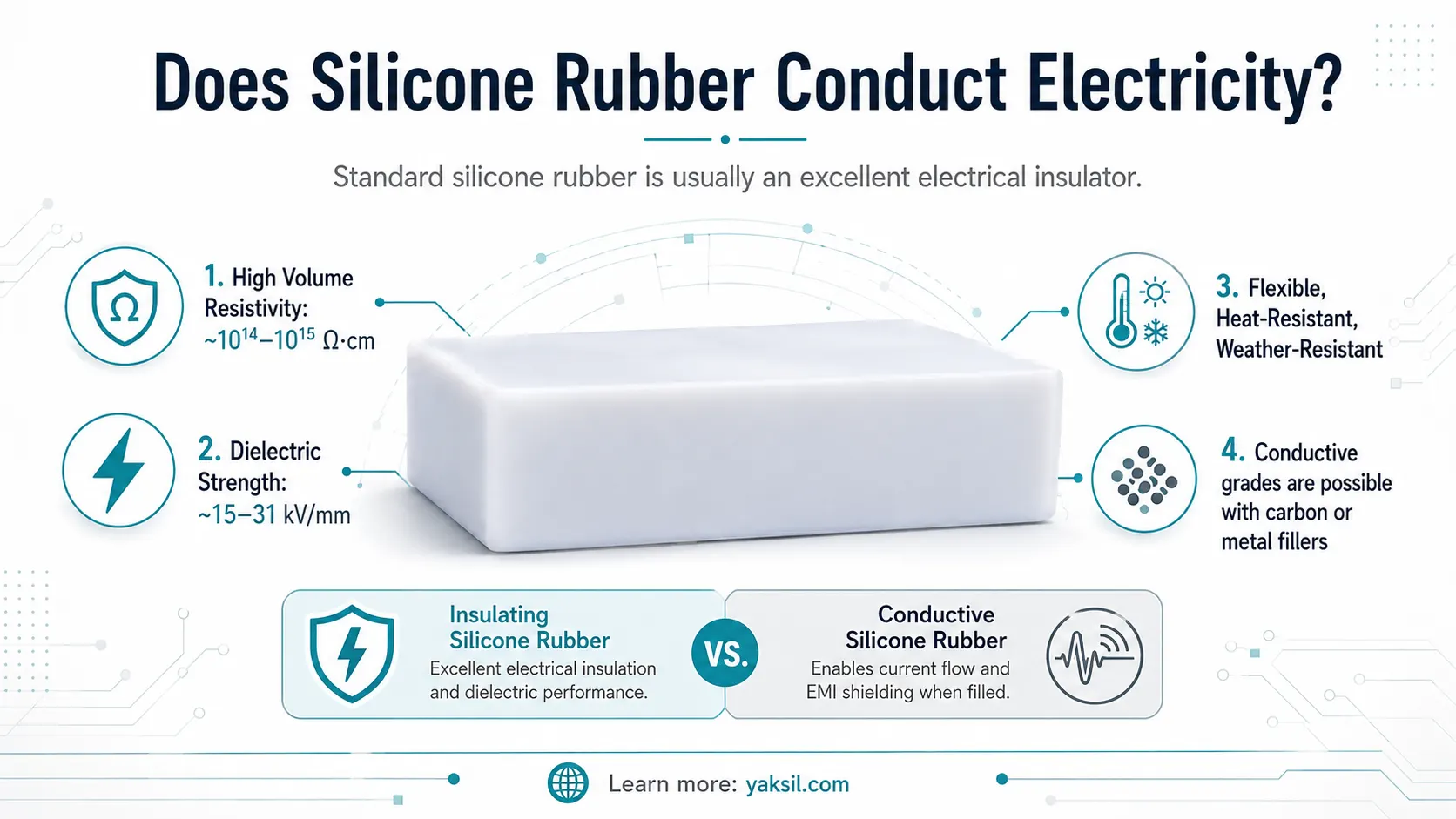
Le caoutchouc de silicone est-il conducteur d'électricité ?
caoutchouc de silicone is widely used in electrical, electronic, automotive, appliance, lighting, and industrial sealing applications because it is normally an excellent flexible insulator. In standard grades, silicone rubber does not conduct electricity in the way metals, carbon-filled elastomers, or conductive polymers do. Instead, it resists current flow, protects energized parts, and helps maintain electrical separation even when the part must bend, seal, compress, or survive heat.
The more precise answer is this: ordinary silicone rubber is not electrically conductive, but conductive silicone rubber can be manufactured by adding conductive fillers. This distinction matters for engineers, buyers, and product designers. A cable boot, connector seal, battery-pack gasket, or appliance insulation part usually needs high electrical resistance. An EMI shielding gasket, antistatic pad, grounding button, or flexible electrode may need controlled conductivity. Both products may be called silicone rubber, but their electrical behavior is completely different.
Why Standard Silicone Rubber Is an Electrical Insulator
Silicone rubber is based on a silicon-oxygen polymer backbone with organic side groups. This molecular structure gives the material flexibility, thermal stability, weather resistance, and low electrical loss. In an insulating grade, there is no continuous path for free electrons to move through the rubber. When voltage is applied, only a very small leakage current passes through the material unless the electric field becomes high enough to cause dielectric breakdown.
Electrical insulation performance is usually judged by several key properties. Volume resistivity shows how strongly the material resists current through its body. Dielectric strength shows how much electric field the material can withstand before puncture or breakdown. Dielectric constant shows how much electrical energy the material stores in an electric field. Together, these values help determine whether a silicone rubber part is suitable for electrical insulation, high-voltage sealing, connector protection, or electronic encapsulation.
Many insulating liquid silicone rubber and RTV silicone rubber grades report volume resistivity in the range of about 1014 to 1015 ohm-centimeter. Dielectric strength commonly appears in the high teens to around 30 kV/mm, depending on formulation, sample thickness, electrode geometry, cure condition, aging, and test method. These are strong insulating values, but they should never be treated as universal guarantees for every silicone rubber compound.
| Electrical Property | Typical Value or Range | What It Means | Design Note |
|---|---|---|---|
| Volume resistivity | About 1014–1015 Ω·cm for many insulating grades | Higher values mean lower leakage current through the material. | Check the exact grade and temperature condition. |
| Dielectric strength | Often about 15–31 kV/mm for many LSR and RTV grades | Higher values indicate better resistance to electrical puncture. | Real part geometry can reduce practical breakdown voltage. |
| Dielectric constant | Commonly about 2.7–4.0, depending on compound and frequency | Affects capacitance and signal behavior around the material. | Important for connectors, sensors, and high-frequency designs. |
| Conductive silicone rubber resistivity | Commercial conductive grades may be around 0.01–10 Ω·m | Conductive grades are engineered to pass current or dissipate charge. | Do not use conductive grades as electrical insulators. |
What Makes Silicone Rubber Conductive?
Conductive silicone rubber is made by adding conductive fillers into the silicone elastomer matrix. Common filler systems include carbon black, graphite, nickel-coated graphite, silver-coated aluminum, silver-coated glass, and other metal-based particles. These fillers create conductive pathways inside the rubber while the silicone matrix still provides elasticity, sealing ability, compression recovery, and environmental resistance.
The key concept is the percolation threshold. At low filler levels, conductive particles remain separated, so the compound still behaves mostly like an insulator. As filler loading increases, particles begin to touch or nearly touch. Once enough connections form, current can move through the material and resistance drops sharply. This is how an insulating elastomer becomes a conductive elastomer.
Conductive silicone rubber is useful, but it is more complex than standard insulating silicone rubber. Small differences in filler type, filler loading, mixing quality, cure condition, compression, and part geometry can change resistance. A conductive gasket may perform well when compressed between two flat metal surfaces, but the same material may show higher resistance if the flange is uneven, oxidized, painted, or contaminated.
Common Applications of Insulating Silicone Rubber
Insulating silicone rubber is chosen when the design goal is to prevent current flow while maintaining flexibility and environmental sealing. It is common in wire and cable insulation, connector boots, electrical grommets, appliance seals, switch covers, LED lighting gaskets, sensor seals, potting compounds, and battery-pack protection parts. In these applications, silicone rubber helps block leakage current, protect components from dust and moisture, and absorb movement or vibration.
One reason silicone rubber is valued in electrical applications is its broad service temperature range. It can remain flexible at low temperatures and maintain useful performance under heat better than many organic rubbers. It also has strong resistance to ozone, UV exposure, and weathering. These properties make it attractive for outdoor electrical equipment, lighting systems, renewable-energy components, transportation systems, and industrial controls.
However, the material name alone is not enough for electrical design. A drawing that only says “silicone rubber” may leave too much uncertainty. Engineers should specify the grade, hardness, cure system, color, post-cure requirement, operating temperature, electrical properties, flame rating if needed, and acceptance tests. For high-voltage or safety-critical applications, the final molded part should be tested, not just the raw material sheet.
Common Applications of Conductive Silicone Rubber
Conductive silicone rubber is selected when the part must provide electrical contact, grounding, shielding, sensing, or static dissipation. The most common use is EMI shielding. A conductive silicone gasket compressed between two metal housings can close small gaps that might otherwise allow electromagnetic interference to escape or enter. This is valuable in communication devices, medical electronics, control cabinets, automotive electronics, aerospace equipment, and rugged industrial enclosures.
Conductive silicone rubber can also be used in antistatic pads, conductive keypads, soft grounding contacts, flexible electrodes, wearable sensor interfaces, and heating elements. In these cases, conductivity is intentional. The material is not being used to isolate electricity; it is being used to manage electricity in a controlled way.
The trade-off is that conductive fillers can change mechanical properties. Higher filler loading may increase hardness, raise density, reduce elongation, reduce tear strength, and increase cost. Metal-filled compounds may also raise galvanic compatibility concerns when placed against certain metals. For EMI shielding, the finished assembly matters as much as the compound: compression force, gasket shape, flange flatness, surface finish, and contact pressure all influence performance.
Factors That Affect Electrical Performance
Formulation is the first and most important factor. Pure or silica-reinforced silicone rubber is usually insulating. Carbon-filled or metal-filled silicone rubber may be conductive or static dissipative. Flame-retardant, thermally conductive, colored, or specialty grades may have different dielectric behavior because fillers and additives can influence electrical properties.
Temperature is another major factor. Silicone rubber is known for heat resistance, but leakage current can increase as temperature rises. Long-term thermal aging may also affect hardness, elongation, compression set, and insulation reliability. A datasheet value measured at room temperature should not be assumed to apply at 150°C or 200°C unless the supplier provides supporting data.
Moisture and surface contamination also matter. Silicone rubber itself is hydrophobic, but dust, salt, ionic residues, processing oils, cleaning chemicals, and conductive pollution can create surface leakage paths. In high-voltage designs, tracking and arcing often begin at surfaces, edges, voids, or contaminated interfaces rather than through the clean bulk material.
Thickness and geometry are equally important. A thicker silicone part can usually withstand a higher absolute voltage than a thin film, but dielectric strength is expressed per unit thickness. Sharp metal edges, trapped air bubbles, uneven compression, poor bonding, and thin spots can concentrate electric fields and reduce real-world breakdown voltage.
How to Specify Silicone Rubber for Electrical Use
Before selecting silicone rubber, define the electrical role of the part. Is it supposed to insulate, dissipate static, provide EMI shielding, create a grounding path, or act as a sensor interface? After that, request the exact datasheet and review the relevant properties. For insulating applications, focus on volume resistivity, dielectric strength, dielectric constant, dissipation factor, arc resistance, temperature range, and aging data. For conductive applications, focus on volume resistivity, surface resistance, compression resistance, shielding effectiveness, filler type, and resistance stability after aging.
- Confirm whether the part needs insulating silicone rubber or conductive silicone rubber.
- Ask whether electrical values are typical values or guaranteed specification limits.
- Check test methods such as ASTM D257 for resistance or resistivity and ASTM D149 or IEC 60243 for dielectric strength.
- Test molded production parts because cure, geometry, contamination, and compression affect results.
- For high-voltage use, design adequate creepage, clearance, thickness, and edge protection.
Common Misconceptions
One common misconception is that all silicone rubber is waterproof, so it must be electrically safe in wet environments. Water resistance helps, but electrical safety also depends on voltage, contamination, part geometry, material thickness, aging, and certification. Another misconception is that white or transparent silicone rubber is always insulating. Color is not a reliable indicator. Fillers and additives can change performance without making the difference obvious to the eye.
It is also wrong to assume that silicone rubber blocks any voltage. If the electric field is high enough, if the wall section is too thin, or if defects are present, dielectric breakdown can occur. The better engineering question is not simply “Does silicone rubber conduct electricity?” but “Can this exact silicone rubber grade and part design meet the electrical stress, environment, and lifetime of the application?”
Conclusion
Silicone rubber usually does not conduct electricity. Standard grades are excellent flexible insulators with very high volume resistivity and strong dielectric strength. This makes silicone rubber valuable for cable insulation, connector protection, gaskets, seals, boots, electronic encapsulation, and many electrical safety applications.
At the same time, silicone rubber can be engineered to conduct electricity when conductive fillers are added. Conductive silicone rubber is useful for EMI shielding, grounding, antistatic control, flexible electrodes, and conductive keypads. Therefore, the correct answer depends on the formulation. If you need insulation, choose an insulating silicone rubber grade and verify dielectric data. If you need conductivity, choose a conductive silicone rubber designed for that purpose and test it under real compression and environmental conditions.
References
- MatWeb: Liquid Silicone Rubber Electrical Properties
- Shin-Etsu Silicone: Silicone Rubber Compounds
- Elkem: Silicone Rubber Applications and Properties
- ASTM D257: DC Resistance or Conductance of Insulating Materials
- ASTM D149: Dielectric Breakdown Voltage and Dielectric Strength
- IEC 60243-1: Electric Strength of Insulating Materials