
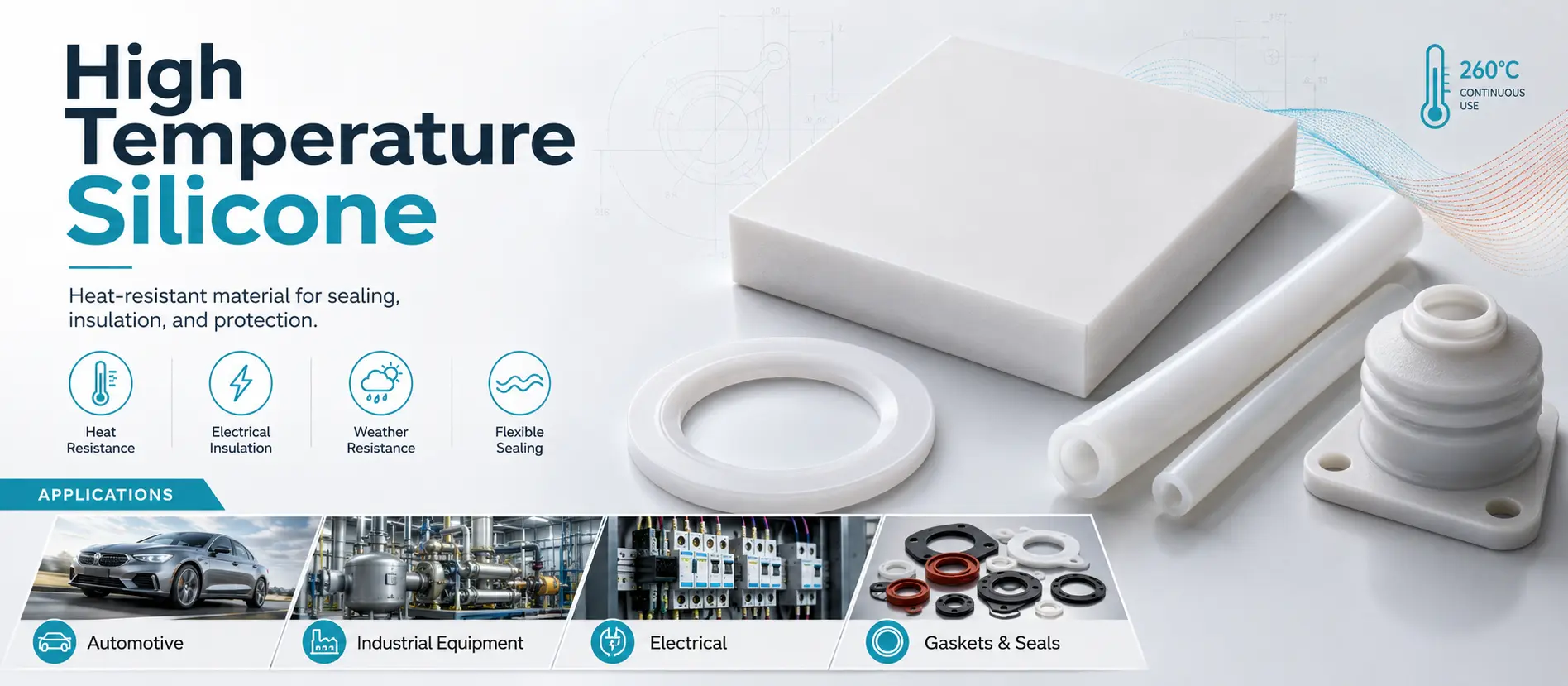
Silicone résistant aux hautes températures
High temperature silicone is a heat-resistant elastomer material designed for sealing, insulation, protection, molding, and fabrication in demanding thermal environments. Compared with many common rubber materials, high temperature silicone can remain flexible, stable, and functional when exposed to elevated temperatures. This makes it widely used in automotive systems, electrical equipment, industrial machinery, ovens, heaters, gaskets, seals, tubing, insulation pads, and custom molded components.
In many applications, heat is not the only challenge. Components may also face compression, vibration, moisture, UV exposure, ozone, steam, electrical stress, or repeated temperature cycling. A properly selected high temperature silicone rubber can provide reliable performance under these combined conditions. That is why engineers often choose heat resistant silicone rubber when ordinary elastomers become hard, cracked, brittle, or permanently deformed.
However, not every silicone product is suitable for high heat service. The right solution depends on the grade, hardness, thickness, curing system, additives, reinforcement, certification requirements, and application environment. Whether you need a high temperature silicone sheet, high temperature silicone gasket, high temperature silicone sealant, high temp silicone tubing, or custom molded silicone part, understanding the material’s characteristics is essential for long-term reliability.
What Is High Temperature Silicone?
High temperature silicone is a silicone-based rubber material formulated to withstand higher operating temperatures than many traditional elastomers. It is made from silicone polymers combined with fillers, curing agents, pigments, and performance additives. The result is a flexible material that can be produced as sheets, rolls, strips, tubing, cords, gaskets, seals, O-rings, profiles, adhesive sealants, and molded parts.
Standard silicone rubber already provides good temperature resistance, but high temperature grades are designed for more demanding thermal performance. Depending on the formulation, many high temperature silicone rubber products can work in continuous heat environments around 200°C, while certain specialty grades may tolerate higher short-term exposure. Actual performance depends on the specific product, temperature duration, mechanical load, chemical exposure, and application design.
The main advantage of heat resistant silicone is not only that it survives heat, but that it maintains useful elasticity. In sealing applications, this is extremely important. A gasket that becomes hard or loses recovery can leak. A tubing material that becomes brittle can crack. An insulation pad that deforms can expose sensitive components. High temperature silicone helps reduce these risks by maintaining flexibility and stability under heat.
Why High Temperature Silicone Resists Heat
The heat resistance of high temperature silicone comes from its silicone-oxygen molecular backbone. This structure is more thermally stable than the carbon-based backbone found in many organic rubbers. As a result, silicone rubber can resist thermal aging, oxidation, and hardening better than many conventional elastomers.
This does not mean high temperature silicone is indestructible. Prolonged exposure to extreme heat can still reduce mechanical strength, elasticity, and surface quality over time. The key is to select a grade that matches the real working temperature, not only the peak temperature. Continuous service temperature, short-term temperature spikes, compression load, air circulation, and contact media all influence service life.
For example, a high temperature silicone gasket used in a static oven door seal may perform differently from a silicone part exposed to hot oil, steam pressure, vibration, and repeated compression. Therefore, temperature resistance should always be considered together with mechanical and environmental conditions.
Key Properties of High Temperature Silicone
High temperature silicone is selected because it offers a balanced combination of heat resistance, flexibility, sealing ability, insulation, and weather stability. In many industries, this combination is more valuable than temperature resistance alone.
| Propriété | Performance Benefit | Typical Application Value |
|---|---|---|
| High heat resistance | Maintains flexibility and function under elevated temperatures | Useful for ovens, heaters, engines, and industrial equipment |
| Low temperature flexibility | Remains soft where many rubbers become stiff | Suitable for temperature cycling and outdoor environments |
| Compression recovery | Helps gaskets and seals return after being compressed | Important for long-term sealing performance |
| Isolation électrique | Provides dielectric protection in electrical applications | Used for cable insulation, pads, sleeves, and protective covers |
| Weather and ozone resistance | Resists UV, moisture, ozone, and aging | Suitable for outdoor seals, lighting, solar, and power equipment |
| Clean and flexible surface | Can be formulated for food, medical, or hygienic applications | Used for certified tubing, seals, and processing components |
Common Types of High Temperature Silicone Products
High temperature silicone can be supplied in many forms. Each form is designed for a different processing method and final use. Selecting the correct product form helps improve installation efficiency, sealing reliability, and production quality.
High Temperature Silicone Sheet
A high temperature silicone sheet is commonly used for cutting gaskets, pads, insulation layers, protective liners, and sealing strips. Silicone sheets are available in different thicknesses, hardness levels, colors, and surface finishes. They can be cut by knife, die cutting, waterjet cutting, CNC cutting, or laser cutting depending on the required precision.
High Temperature Silicone Gasket
A high temperature silicone gasket is designed to seal between two surfaces exposed to heat. It may be used in ovens, boilers, lighting systems, heat exchangers, electrical cabinets, engine compartments, and industrial doors. Good gasket performance depends on material grade, compression level, surface flatness, and correct installation.
High Temperature Silicone Sealant
High temperature silicone sealant is applied as a paste and cures into a flexible rubber-like seal. It is commonly used for gap filling, joint sealing, repair, and assembly work. RTV high temperature silicone sealant is especially useful where a preformed gasket is difficult to install or where irregular surfaces must be sealed.
High Temp Silicone Tubing
High temp silicone tubing is used for transferring air, water, steam, food liquids, laboratory fluids, and other compatible media. It is valued for flexibility, cleanliness, and temperature resistance. For food or medical use, the tubing should be selected according to the required certification and purity level.
Custom Molded High Temperature Silicone Parts
Custom molded silicone components include O-rings, plugs, caps, boots, diaphragms, connectors, cable sleeves, vibration dampers, and protective covers. These parts are often made by compression molding, transfer molding, or liquid silicone rubber injection molding. Custom molded high temperature silicone parts are ideal when standard sheet or tubing products cannot meet design requirements.
Industrial Applications of High Temperature Silicone
High temperature silicone is used across many industries because it can solve sealing, insulation, and protection problems in hot environments. In the automotive industry, it is used for engine area seals, grommets, hoses, ignition wire insulation, vibration pads, and protective boots. These parts must withstand heat, movement, fluids, and long operating cycles.
In electrical and power equipment, high temperature silicone is used for insulation pads, cable accessories, busbar covers, connector seals, protective sleeves, and outdoor electrical components. Its electrical insulation and weather resistance make it useful in power distribution, electrical cabinets, solar equipment, lighting systems, and electronic assemblies.
In industrial machinery, heat resistant silicone rubber is used for oven seals, furnace door gaskets, heater pads, conveyor components, thermal insulation strips, and equipment protection parts. In food processing, food grade high temperature silicone may be used for baking mats, food-contact gaskets, tubing, and hygienic seals when the material has the required certification.
High temperature silicone also plays a role in aerospace, laboratory equipment, medical devices, packaging machinery, HVAC systems, and chemical processing. In these applications, the material is often chosen because it combines heat resistance with flexibility, sealing performance, and long-term stability.
How to Choose High Temperature Silicone
Choosing the right high temperature silicone begins with the actual working environment. The first factor is temperature. Users should consider continuous operating temperature, peak temperature, exposure time, and whether the material will face repeated heating and cooling cycles. A short high-temperature spike is different from constant exposure over thousands of hours.
The second factor is mechanical performance. A soft silicone rubber may seal well on uneven surfaces, while a harder silicone rubber may provide better dimensional stability. For gaskets and seals, compression set is especially important because the material must recover after being compressed. For tubing and flexible parts, elongation and tear resistance may be more important.
Chemical compatibility must also be checked. High temperature silicone performs well in many environments, but it is not suitable for every oil, fuel, solvent, acid, or concentrated chemical. If the material will contact aggressive media, a compatibility test or material data review is recommended before production.
Certification requirements should not be ignored. Food grade high temperature silicone, medical grade silicone, flame-retardant silicone, and electrically insulating silicone may have different compliance requirements. Buyers should confirm the required standards before ordering material or custom parts.
Processing, Cutting, Molding, and Installation
High temperature silicone is easy to process when the correct method is used. Sheets can be cut into gaskets, strips, pads, and insulation parts. Extruded silicone profiles can be installed around doors, panels, equipment housings, and pipe openings. Tubing can be cut to length and connected using compatible fittings.
For molded parts, the mold design should consider shrinkage, parting line position, wall thickness, and demolding requirements. Liquid silicone rubber can be used for high-precision components, while solid silicone rubber is suitable for compression molded parts, seals, and thicker components.
When installing a high temperature silicone gasket, the sealing surfaces should be clean, dry, and properly aligned. Over-compression should be avoided because it can reduce service life. Under-compression can lead to leakage. Fasteners should be tightened evenly to distribute pressure across the gasket surface.
When using high temperature silicone sealant, surface preparation is critical. Oil, dust, moisture, rust, and release agents can reduce adhesion. The sealant should be applied in a continuous bead and allowed to cure fully before heat, pressure, or fluid exposure. Cure time depends on product formulation, thickness, temperature, and humidity.
High Temperature Silicone vs. Other Rubber Materials
Compared with natural rubber, high temperature silicone offers much better heat resistance and aging stability. Natural rubber may provide excellent elasticity, but it is not the best choice for long-term heat exposure. Compared with nitrile rubber, silicone usually performs better at high and low temperatures, while nitrile is often better for oil and fuel resistance.
EPDM rubber provides strong weather and ozone resistance and is often used in outdoor seals, but silicone generally offers better high-temperature flexibility. Fluororubber materials can provide excellent chemical and heat resistance, especially in oil and fuel environments, but they are usually more expensive and may be less flexible at low temperatures than silicone.
Therefore, high temperature silicone is often selected when the application requires heat resistance, flexibility, sealing ability, electrical insulation, and weather stability at the same time. It may not be the best solution for every chemical environment, but it is one of the most versatile elastomers for high heat applications.
Maintenance and Storage Tips
High temperature silicone products require limited maintenance, but regular inspection helps prevent unexpected failure. Gaskets and seals should be checked for cracks, permanent deformation, hardening, tearing, contamination, or loss of elasticity. Tubing should be inspected for discoloration, wall thinning, swelling, blockage, or surface damage.
Cleaning should be done with compatible mild cleaners. Strong solvents, sharp tools, and abrasive cleaning methods should be avoided unless the silicone grade is confirmed to tolerate them. For food, medical, or laboratory applications, cleaning and sterilization procedures should follow the required application standards.
Storage conditions also affect product life. High temperature silicone sheets, gaskets, tubing, and molded parts should be stored in a clean, cool, dry environment. Avoid heavy compression, sharp edges, direct contamination, and contact with incompatible chemicals. Sheets should be stored flat or rolled without excessive tension.
Conclusion
High temperature silicone is a versatile heat resistant material used for sealing, insulation, molding, tubing, protection, and custom component manufacturing. It is valued for its ability to remain flexible under heat, resist weathering, provide electrical insulation, and perform reliably in demanding environments.
The best high temperature silicone solution depends on the application. A high temperature silicone sheet may be ideal for cut gaskets and pads. High temperature silicone sealant may be better for irregular joints and repairs. High temp silicone tubing can serve fluid transfer and air handling applications. Custom molded high temperature silicone parts can solve more complex design problems. By selecting the correct grade, form, hardness, and processing method, users can achieve safer, longer-lasting, and more reliable performance in high heat applications.