
Liquid Silicone Rubber (LSR) vs High Consistency Rubber (HCR)
Liquid silicone rubber (LSR) and high consistency rubber (HCR) are two of the most important silicone rubber material systems used in industrial manufacturing. Both can provide excellent heat resistance, flexibility, electrical insulation and long-term durability, but they are processed very differently and are suited to different production requirements.
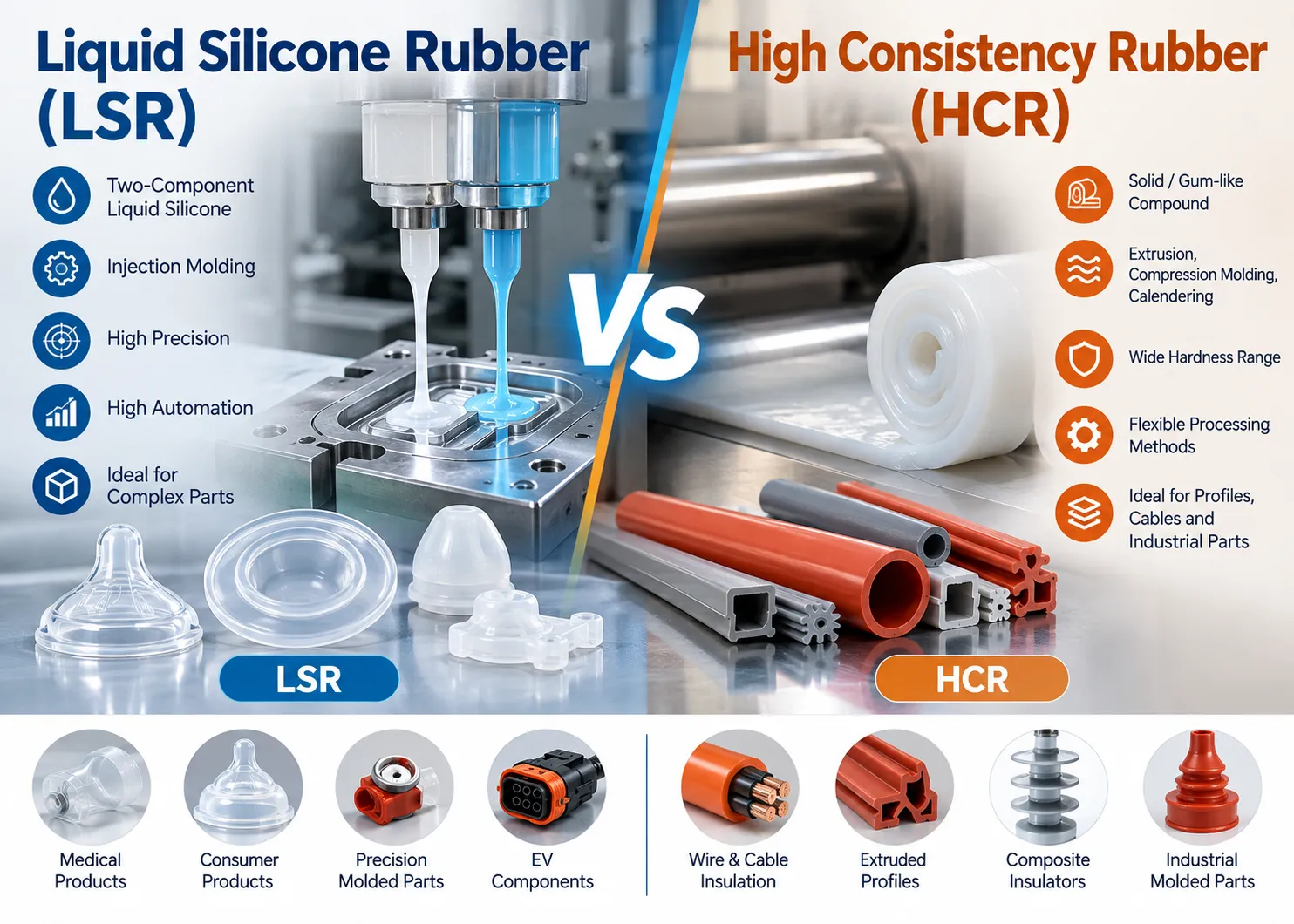
LSR is a flowable two-component silicone designed mainly for automated liquid injection molding. HCR is a high-viscosity, gum-like silicone compound commonly processed by extrusion, compression molding, transfer molding and calendering.
The right choice depends on production volume, equipment, part geometry, hardness, mechanical requirements, electrical performance and cost structure. This guide compares LSR and HCR from a practical engineering and purchasing perspective.
What Is Liquid Silicone Rubber (LSR)?
Liquid silicone rubber is typically supplied as a two-component material, commonly referred to as Part A and Part B. The components are metered, mixed and injected into a heated mold where the silicone cures into the final elastomeric component.
LSR is widely used in automated production because the material can be pumped and precisely metered without manual preforming.
What Is High Consistency Rubber (HCR)?
High consistency rubber is a solid, gum-like silicone rubber compound with much higher viscosity than LSR.
HCR is normally based on high-molecular-weight silicone gum reinforced with silica and combined with functional fillers, processing aids, pigments and a curing system.
It is widely used for extrusion, compression molding, transfer molding and calendering, making it particularly important in wire and cable, composite insulators, seals, profiles and industrial molded components.
LSR vs HCR at a Glance
| Characteristic | LSR | HCR |
|---|---|---|
| Formulaire de matériel | Flowable liquid | Solid / gum-like |
| Typical Processing | Moulage par injection de liquide | Extrusion, compression molding, transfer molding, calendering |
| Automation | Very high | Depends on process |
| Labor Requirement | Generally lower in automated lines | Can require more handling |
| Complex Precision Parts | Excellent | Good depending on molding method |
| Continuous Extrusion | Not the normal route | Major advantage |
| Material Handling | Pumped and metered | Milled, preformed, extruded or molded |
| Typical Cure System | Platinum | Peroxide or platinum |
The Biggest Difference Is Processing
The most important difference between LSR and HCR is not simply viscosity. It is the complete manufacturing process.
LSR production uses a closed metering and injection system. Part A and Part B are pumped into a mixer and then injected into a heated mold.
HCR behaves more like a traditional high-consistency rubber compound. It may be processed on two-roll mills, extruders, compression presses or calendering equipment.
LSR
Pump → Meter → Mix → Inject → Cure
HCR
Mill / Prepare → Extrude or Mold → Vulcanize
LSR Is Strong for Automated High-Volume Production
One of the biggest advantages of liquid silicone rubber is automation.
Once the production cell is configured correctly, material handling, mixing and injection can be highly automated. This can reduce manual labor and improve repeatability in large-volume production.
LSR is therefore especially attractive for precision components produced in large quantities.
HCR Is Strong for Extrusion and Traditional Rubber Processing
HCR has a major advantage when the product must be extruded continuously.
Wire insulation, tubing, profiles, cords and similar products can be produced using HCR extrusion lines. The uncured silicone is fed through an extruder, shaped through a die and then vulcanized.
HCR can also be compression molded into seals, grommets, insulator housings and industrial components.
Which Is Better for Complex Molded Parts?
LSR generally has an advantage for very small, intricate and high-volume molded parts because its low viscosity allows it to fill complex cavities efficiently.
Fine features, thin sections and complex geometries can often be molded effectively using LSR when tooling and process control are well designed.
HCR can also produce complex molded components, but the material requires greater force to flow through the mold before curing.
Which Is Better for Extrusion?
For continuous extrusion, HCR is generally the more suitable silicone rubber system.
Its high consistency allows the material to maintain shape after leaving the die, which is important for cable insulation, tubing and profiles.
Important HCR extrusion factors include plasticity, feed stability, die swell, surface quality and compatibility with the chosen vulcanization process.
| Extrusion Requirement | Pourquoi est-ce important ? |
|---|---|
| Feed Stability | Maintains consistent output and pressure |
| Die Swell | Affects final profile dimensions |
| Surface Quality | Important for cable and visible profiles |
| Shape Retention | Helps the uncured profile maintain geometry before vulcanization |
LSR vs HCR Hardness Range
Both LSR and HCR can be formulated across a wide range of Shore A hardness values.
Hardness alone should not determine whether LSR or HCR is selected. A 50 Shore A LSR and a 50 Shore A HCR may have similar cured firmness but completely different processing behavior.
For more detail, see Silicone Rubber Shore A: 30A vs 40A vs 50A vs 60A vs 70A.
Mechanical Properties Can Differ Even at the Same Hardness
A common sourcing mistake is assuming that two silicone grades with the same Shore A hardness are equivalent.
Silicone mechanical performance depends on polymer structure, reinforcing silica, filler system, crosslink density and formulation.
| Propriété | Pourquoi est-ce important ? |
|---|---|
| Résistance à la traction | Resistance to pulling force |
| Allongement | Ability to stretch before breaking |
| Résistance à la déchirure | Resistance to growth of cuts and tears |
| Déformation rémanente après compression | Important for long-term sealing |
| Heat Aging | Shows performance retention after prolonged thermal exposure |
Which Has Better Tear Strength?
Neither LSR nor HCR automatically has better tear strength.
High-tear formulations exist in both material systems. Tear performance depends on the specific polymer and filler design rather than simply whether the material is liquid or high consistency.
For thin components, seals, bellows, boots and parts that experience stretching during demolding, actual tear data should be compared.
Which Is Better for High Temperature?
Both LSR and HCR are silicone elastomers and can provide excellent heat resistance when formulated correctly.
The better material depends more on the specific grade than on the processing category.
High-temperature HCR is widely used in cable, industrial seals and electrical components, while LSR can also be formulated for high-temperature molded parts.
LSR vs HCR for Electrical Insulation
Both systems can be formulated as electrical insulating silicone rubber, but HCR has an especially important role in applications such as cable extrusion and composite insulator housings.
Electrical-grade HCR may be designed around dielectric strength, volume resistivity, hydrophobicity, tracking resistance and erosion resistance.
LSR is widely used for molded electrical components, connector seals, insulating parts and other precision applications.
LSR vs HCR for Wire and Cable
For continuous cable insulation, HCR is generally the more established material choice because it can be extruded directly around the conductor.
HCR cable compounds can combine heat resistance, flexibility, dielectric performance and stable extrusion.
LSR can still appear in molded cable accessories, connectors, boots and seals, but it is not normally used in the same continuous extrusion process.
LSR vs HCR for Composite Insulators
Composite insulator housings are commonly associated with specialized HTV/HCR silicone rubber.
The material needs to mold around the FRP core and sheds while providing hydrophobicity, electrical insulation, tracking resistance, erosion resistance and long-term outdoor durability.
High filler loadings, including ATH-based systems, are often used in electrical HCR compounds, and these formulations need a careful balance between electrical performance, mechanical properties and moldability.
See How Silicone Rubber Improves Composite Insulator Performance.
LSR vs HCR for EV Components
Electric vehicles use both liquid silicone rubber and high consistency rubber depending on the component.
The decision should be based on manufacturing process and component function rather than treating one material as universally better for EV applications.
LSR vs HCR for Food-Contact Applications
Both LSR and HCR can be formulated for food-contact applications.
LSR is commonly used for precision molded kitchenware, seals and consumer products, while HCR is used for extruded tubing, gaskets, profiles and compression-molded components.
Food-contact suitability must be verified for the exact compound and target market.
Depending on the project, documentation may involve applicable FDA 21 CFR, LFGB, BfR or other requirements.
LSR vs HCR for Medical Applications
LSR is widely associated with medical-grade silicone because automated closed-system injection molding can provide clean and repeatable production for small precision components.
HCR is also used in medical tubing, seals and other components where extrusion or high-consistency molding is required.
Medical suitability depends on the exact silicone grade, manufacturing controls, cleanliness requirements and regulatory or biocompatibility requirements of the finished device.
Material Waste and Flash
LSR molding systems can use highly controlled injection and cold-runner tooling to reduce material waste in large production programs.
HCR compression molding may generate more flash depending on mold design and process conditions, although optimized tooling and preform control can reduce waste significantly.
For extrusion, HCR can be extremely efficient because continuous profiles can be produced with relatively low material waste once the line is stable.
Tooling Cost and Equipment Investment
LSR production generally requires specialized metering, pumping and injection-molding equipment. Tooling can also be sophisticated, especially for multi-cavity precision parts.
This higher initial investment can make sense when production volume is high enough to benefit from automation and short cycle times.
HCR production can often use more conventional rubber-processing equipment such as mills, extruders and compression presses.
| Cost Factor | LSR | HCR |
|---|---|---|
| Equipment Investment | Generally higher for complete automated systems | Depends on existing rubber-processing equipment |
| Labor | Can be lower after automation | May require more material handling |
| Tooling | Often sophisticated for precision injection molding | Can range from simple compression molds to complex tooling |
| High-Volume Efficiency | Major advantage | Process dependent |
Which Is Better for Low-Volume Production?
HCR can be attractive for many lower-volume industrial molded products because compression molding may require less complex automation than LSR injection systems.
However, very small or highly detailed parts may still favor LSR even at lower volumes if component geometry and quality requirements justify the tooling.
The decision should therefore consider total production economics rather than material price alone.
Which Is Better for High-Volume Production?
LSR often becomes highly competitive in large-volume precision molding because automatic metering, injection and fast molding cycles can reduce labor per part.
HCR can also support very high production volumes, especially in continuous extrusion. Cable and profile lines can operate continuously with high throughput.
High volume therefore does not automatically mean LSR. The geometry and process remain decisive.
Color and Pigment Differences
Both LSR and HCR can be colored using compatible pigment systems.
LSR often uses liquid color dosing or compatible pigment pastes in automated processing. HCR color can be introduced using masterbatch or pigment during milling or compounding.
Color selection should be checked carefully for electrical, food-contact, medical and other regulated applications because pigment systems become part of the complete formulation.
LSR and HCR Cure Systems
LSR is most commonly associated with platinum-catalyzed addition curing.
HCR is widely available in peroxide-cure systems and can also be formulated for platinum curing depending on the application.
| Système de durcissement | LSR | HCR |
|---|---|---|
| Platinum Addition Cure | Very common | Available in selected grades |
| Peroxide Cure | Not typical | Widely used |
| Post-Curing | Depends on application | Can be required depending on cure system and specification |
Processing Problems Are Different
Because the production systems are different, LSR and HCR also experience different manufacturing problems.
Common LSR Concerns
Mix ratio control, contamination, cure inhibition, flash, injection balance and cold-runner performance.
Common HCR Concerns
Roll tack, plasticity variation, die swell, extrusion instability, mold flow, flash and uneven cure.
Choosing a material supplier that understands the actual production process can therefore be more important than simply comparing physical-property tables.
LSR vs HCR: Which Has Better Production Consistency?
Both can provide excellent consistency when manufacturing controls are strong.
LSR benefits from automated metering and closed-system processing, which can reduce operator variation.
HCR consistency depends heavily on compound manufacturing, filler dispersion, batch control, plasticity and final processing conditions.
For industrial HCR users, stable rheology from batch to batch can be just as important as stable hardness.
How to Choose Between LSR and HCR
A Practical LSR vs HCR Selection Guide
| Candidature | Typical Starting Choice | Main Reason |
|---|---|---|
| Precision Small Molded Parts | LSR | High automation and complex cavity filling |
| High-Volume Injection Molded Parts | LSR | Automated metering and molding |
| Wire & Cable | HCR | Continuous extrusion |
| Extruded Tubing & Profiles | HCR | Strong shape retention during extrusion |
| Composite Insulators | Electrical-grade HCR | Specialized molding and high-voltage performance |
| Connector Seals | Often LSR | Precision automated molding |
| Industrial Compression-Molded Parts | Often HCR | Flexible molding options |
What Should Buyers Include in an RFQ?
LSR and HCR Silicone Rubber from Yakows
Yakows supplies both liquid silicone rubber and HTV/HCR silicone compounds for industrial applications.
LSR can be evaluated for precision injection-molded components, while HCR is available for extrusion, compression molding, electrical insulation, wire and cable, composite insulators, EV components and other industrial applications.
Material selection can be based on production process, Shore A hardness, tensile strength, tear resistance, thermal aging, electrical performance, cure system and application-specific requirements.
The correct choice is not simply LSR or HCR. It is the silicone system that provides the most reliable combination of processing efficiency and finished-part performance for the actual production line.
Foire aux questions
What is the main difference between LSR and HCR?
LSR is a flowable two-component silicone typically used for liquid injection molding, while HCR is a solid high-consistency silicone used for extrusion, compression molding and other conventional rubber processes.
Is LSR better than HCR?
No. LSR is often better for automated precision injection molding, while HCR is better suited to extrusion, cable, profiles and many industrial molding applications.
Is HCR the same as HTV silicone?
HCR describes high consistency rubber, while HTV refers to high-temperature vulcanizing silicone. The terms frequently overlap because HCR silicone is commonly heat cured.
Can LSR and HCR have the same hardness?
Yes. Both can be formulated at similar Shore A hardness levels, but their uncured processing behavior is completely different.
Which is better for extrusion?
HCR is generally the preferred material for continuous extrusion of cable, tubing and silicone profiles.
Which is better for high-volume molding?
LSR is often highly efficient for automated high-volume injection molding, particularly for small and complex precision parts.
Which is used for composite insulators?
Composite insulator housings commonly use specialized electrical-grade HTV/HCR silicone rubber.
Which is used for wire and cable?
HCR is widely used for continuous silicone cable extrusion, while LSR may be used in molded cable accessories and connector components.
Which has better heat resistance?
Both can offer excellent heat resistance. Actual performance depends on the specific formulation and heat-aging properties rather than whether the material is LSR or HCR.
How should I choose between LSR and HCR?
Start with the manufacturing process, part geometry, production volume and equipment, then compare mechanical, thermal, electrical and compliance requirements.