
Silicone Rubber Shore A: 30A vs 40A vs 50A vs 60A vs 70A
When choosing silicone rubber, Shore A hardness is usually one of the first specifications buyers compare. But what is the real difference between 30A, 40A, 50A, 60A and 70A silicone rubber? Does a higher Shore A value mean better silicone? And which hardness is suitable for seals, cable, electrical insulation, composite insulators or industrial molded parts?
The short answer is that Shore A tells you how soft or firm the cured silicone feels, but it does not define the complete performance of the material. A 30A silicone is generally softer and easier to deform, while a 70A compound is firmer and provides greater resistance to indentation. However, tensile strength, tear resistance, elongation, compression set, electrical properties, heat aging and processing behavior can still be very different between compounds with similar hardness.
This guide compares the most common silicone rubber Shore A levels from 30A to 70A and explains how hardness affects flexibility, sealing, molding, extrusion and industrial material selection.
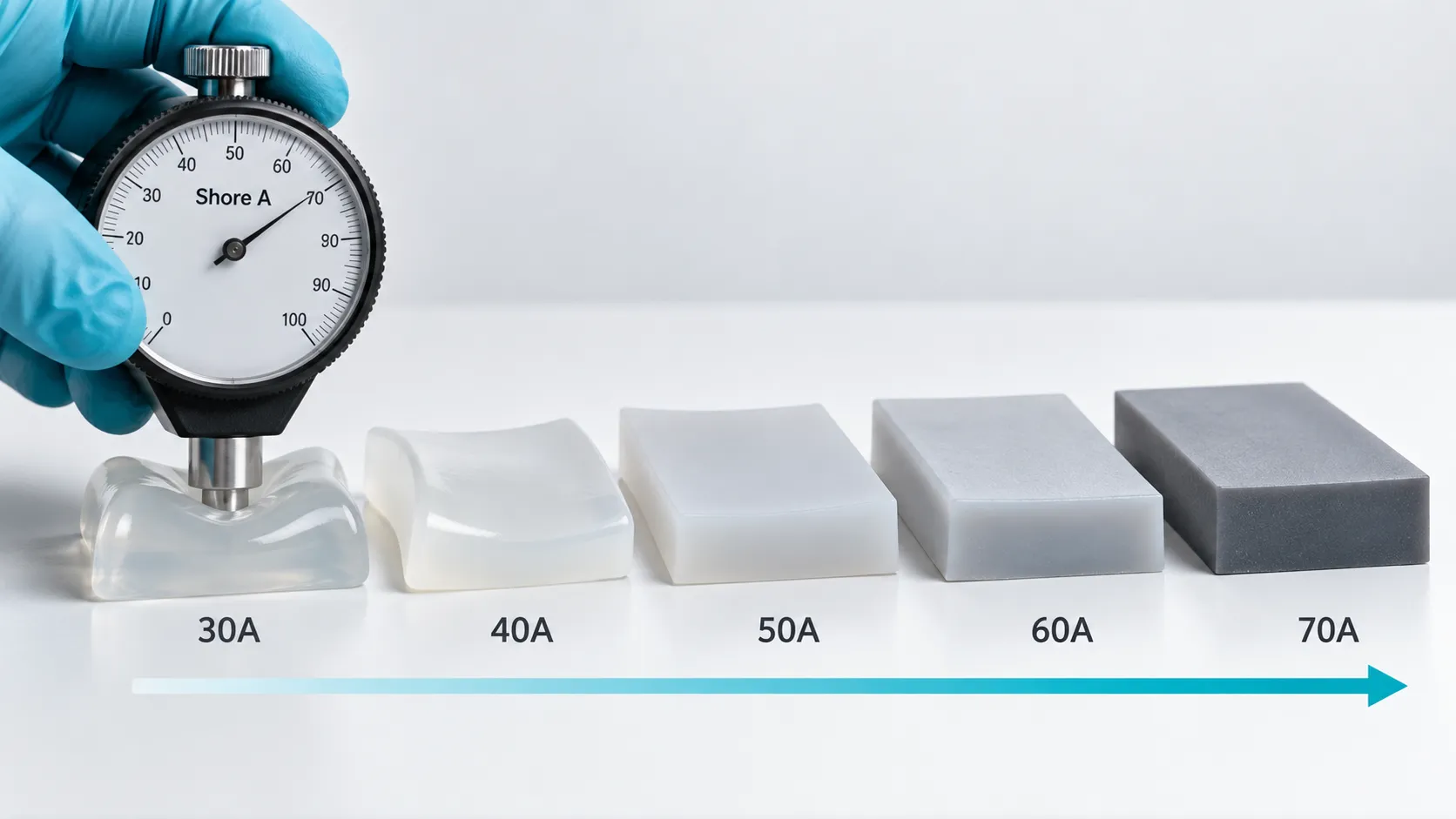
What Does Shore A Mean for Silicone Rubber?
Shore hardness is a method used to measure the resistance of an elastomer surface to indentation. For flexible rubber materials such as silicone rubber, the Shore A scale is commonly used.
A lower Shore A value indicates a softer material that can be compressed or deformed more easily. A higher Shore A value indicates a firmer elastomer with greater resistance to indentation.
Very Soft
Soft
Medium Soft
Medium Firm
Firm
Shore A should be treated as a comparative hardness measurement rather than a complete description of the silicone compound. Two different silicone rubber formulations can both measure 60 Shore A while having very different tear strength, elongation, rheology and electrical performance.
30A vs 40A vs 50A vs 60A vs 70A at a Glance
| Rive A | General Feel | Flexibility | Typical Direction |
|---|---|---|---|
| 30A | Very soft | Very high | Soft seals, flexible molded parts, cushioning components |
| 40A | Soft | Élevé | Gaskets, bellows, flexible seals and soft molded components |
| 50A | Balanced | Medium-high | General industrial molding, seals, profiles and flexible parts |
| 60A | Medium firm | Medium | Electrical components, cable, industrial molded parts and insulator compounds |
| 70A | Firm | Inférieur | More rigid seals, structural molded parts and components requiring greater firmness |
What Is 30 Shore A Silicone Rubber?
30 Shore A silicone rubber is relatively soft and easy to compress. It can deform around irregular surfaces and is useful where flexibility and conformability are more important than structural stiffness.
Soft silicone can work well in sealing components that need to conform to low clamping forces or in molded parts that need significant flexibility.
Very High
Faible
Faible
Soft & Conformable
However, softer does not automatically mean better sealing. A very soft compound may deform too easily in a high-pressure application or lack the structural support required for certain molded geometries.
The silicone formulation must still provide adequate tensile strength, tear resistance and compression recovery.
Where Is 30A Silicone Rubber Used?
30A silicone can be considered where the finished component must remain very soft and flexible.
Soft Seals
Useful where relatively low compression force is required to create surface contact.
Flexible Molded Parts
Suitable for components that need substantial deformation during assembly or service.
Cushioning Components
Can provide a softer contact surface or vibration-damping function.
Flexible Boots
May be used where movement and conformability are more important than rigidity.
What Is 40 Shore A Silicone Rubber?
40 Shore A silicone remains soft but provides more structural support than a 30A compound. It is often useful when a component needs high flexibility while maintaining a clearer molded or extruded shape.
This hardness range can be suitable for seals, flexible gaskets, bellows and molded components where repeated movement is expected.
Compared with 30A silicone, 40A silicone normally feels firmer under finger pressure while still being relatively easy to bend and compress.
Where Is 40A Silicone Rubber Used?
Flexible Gaskets
Combines conformability with somewhat greater dimensional support.
Bellows
Can accommodate movement while maintaining a defined molded shape.
Protective Boots
Useful for flexible covers around electrical or mechanical interfaces.
Soft Extruded Profiles
Suitable where an extruded seal needs relatively low compression force.
What Is 50 Shore A Silicone Rubber?
50 Shore A sits near the middle of many industrial silicone rubber hardness ranges and offers a practical balance between flexibility and structural firmness.
It is neither extremely soft nor particularly hard. For this reason, 50A is commonly considered for general-purpose molded and extruded silicone parts where the design needs both elastic deformation and dimensional stability.
The actual performance of a 50A compound can still vary significantly. A high-tear 50A silicone and a general-purpose 50A silicone may behave very differently during both processing and service.
Where Is 50A Silicone Rubber Used?
General Industrial Seals
A balanced hardness for many gasket and sealing geometries.
Extruded Profiles
Can combine flexibility with sufficient dimensional stability.
Molded Components
Suitable for a broad range of general industrial silicone parts.
Flexible Electrical Parts
Can be formulated for electrical applications where moderate hardness is required.
What Is 60 Shore A Silicone Rubber?
60 Shore A silicone rubber provides noticeably greater firmness while still retaining elastomeric flexibility. It is a common hardness range for industrial HCR/HTV silicone compounds.
For electrical, cable and industrial molded applications, a medium-firm compound can provide a useful balance between mechanical integrity, processing stability and flexibility.
However, 60 Shore A alone does not indicate whether the material is suitable for high-voltage insulation, cable extrusion or another specialized application.
Where Is 60A Silicone Rubber Used?
Electrical Components
Electrical-grade formulations may combine medium firmness with dielectric performance.
Composite Insulators
Specialized HTV silicone can use a medium-firm hardness while also providing hydrophobicity and tracking resistance.
Wire & Cable
Extrusion grades can be designed for electrical insulation, heat aging and stable processing.
Industrial Molded Parts
Useful where greater dimensional firmness is required without moving to a very hard elastomer.
What Is 70 Shore A Silicone Rubber?
70 Shore A silicone is relatively firm compared with lower-hardness silicone compounds. It resists indentation more strongly and can provide greater shape stability in applications where excessive deformation would be undesirable.
Harder silicone may be suitable for molded components, firmer seals and industrial parts that require more structural support.
However, increasing hardness usually reduces how easily a component bends or compresses. The optimum hardness therefore depends on the geometry and function of the finished part.
Where Is 70A Silicone Rubber Used?
Firm Seals
Useful where greater resistance to deformation is required.
Structural Molded Parts
Provides more rigidity while retaining silicone rubber characteristics.
Industrial Components
Can be selected where lower-hardness silicone would deform too easily.
High-Hardness Profiles
Suitable for profiles requiring greater dimensional stability.
How Does Shore A Affect Flexibility?
As Shore A hardness increases, silicone rubber generally becomes more resistant to deformation. Lower-hardness compounds are easier to bend, squeeze and compress, while higher-hardness compounds provide more resistance.
But Shore hardness should not be confused with modulus or tensile strength. Two compounds with the same Shore A value can respond differently under stretching, compression or repeated mechanical loading.
Does Higher Shore A Mean Stronger Silicone Rubber?
No. A higher Shore A value means greater resistance to indentation, not automatically greater tensile strength, tear strength or durability.
A 50A high-tear silicone compound can potentially provide better tear resistance than a 70A general-purpose compound.
| Propriété | Does Higher Shore A Automatically Improve It? |
|---|---|
| Firmness | Generally yes |
| Résistance à la traction | No |
| Résistance à la déchirure | No |
| Résistance à la chaleur | No |
| Isolation électrique | No |
| Suivi de la résistance | No |
| Weather Resistance | No |
Hardness is therefore one specification among many, not an overall quality score.
Does Higher Shore A Mean Better Tear Strength?
Not necessarily. Tear strength depends heavily on polymer molecular weight, reinforcing silica, filler dispersion, crosslink structure and the overall formulation.
A silicone rubber manufacturer can formulate compounds with similar hardness but substantially different tear performance.
This matters for bellows, thin seals, boots, composite-insulator sheds and other components where a small cut can grow during demolding, installation or service.
How Shore A Affects Silicone Sealing
Seal hardness influences how easily the rubber conforms to mating surfaces and how much clamping force is required.
Softer silicone generally compresses more easily, which can help seal uneven surfaces. Harder silicone resists deformation and may provide more support under mechanical load.
The correct seal hardness also depends on gasket thickness, compression percentage, pressure, flange design, temperature and compression-set requirements.
Shore A and Compression Set Are Different Properties
A common mistake is assuming that a harder silicone automatically has better compression-set resistance.
Compression set measures how much permanent deformation remains after a material has been compressed for a defined period and then released.
Hardness influences how a seal deforms initially, but compression-set performance depends on the compound formulation, cure state, temperature and aging conditions.
For long-term seals, buyers should therefore specify both hardness and compression behavior where appropriate.
How Shore A Affects Extrusion
Hardness and extrusion behavior are related through formulation, but Shore A does not directly tell you how easily an uncured HCR silicone will pass through an extruder.
Two 60A compounds can have different uncured plasticity, extrusion pressure, die swell and surface quality.
| Extrusion Factor | Why Shore A Alone Cannot Predict It |
|---|---|
| Feed Stability | Depends on uncured rheology and material consistency |
| Extrusion Pressure | Influenced by polymer and filler system |
| Die Swell | Depends on elastic recovery of the uncured compound |
| Surface Quality | Influenced by dispersion, rheology and processing conditions |
| Shape Retention | Depends on uncured strength and cure conditions |
How Shore A Affects Compression Molding
In compression molding, the silicone compound needs to flow through the cavity before curing progresses too far.
A finished hardness of 70A does not necessarily mean the uncured compound will have poor mold flow, just as 40A does not guarantee easy flow.
Polymer molecular weight, reinforcing filler, processing aids and curing system all influence the way HTV/HCR silicone behaves under heat and pressure.
This is why a new hardness grade should ideally be validated on the actual mold rather than selected from hardness alone.
Which Shore A Is Best for Electrical Silicone Rubber?
There is no universal Shore A hardness for electrical silicone rubber.
The correct hardness depends on the electrical component, processing method and mechanical design. Composite insulator housings, cable insulation, connector boots and molded electrical parts can all require different hardness levels.
More importantly, electrical silicone needs properties that hardness does not measure.
What Shore A Is Used for Composite Insulators?
Composite-insulator silicone rubber is commonly formulated in a medium hardness range, but the exact Shore A specification depends on the manufacturer, insulator design and material system.
Hardness is only one element of a composite-insulator compound. Electrical-grade HTV silicone also needs an appropriate balance of hydrophobicity, tracking and erosion resistance, dielectric performance, tear strength and molding behavior.
A harder compound should not be assumed to provide better high-voltage performance.
For a deeper explanation, see How Silicone Rubber Improves Composite Insulator Performance.
Which Shore A Is Better for Wire and Cable?
Cable insulation needs enough flexibility to bend with the cable while maintaining dimensional and electrical stability.
The best hardness depends on cable diameter, wall thickness, bending requirements and the intended environment.
An extrusion-grade silicone should also be evaluated for die swell, surface quality, electrical insulation and heat aging. Simply requesting “60 Shore A silicone” does not provide enough information for accurate cable material selection.
Does Shore A Affect Heat Resistance?
Shore A hardness does not directly determine how much heat silicone rubber can withstand.
A 40A silicone specifically formulated for thermal stability can potentially provide better heat-aging retention than a 70A general-purpose silicone.
For high-temperature applications, evaluate properties such as:
Does Shore A Affect Flame Resistance?
No direct relationship should be assumed between Shore A hardness and flame resistance.
Flame-retardant silicone rubber relies on specialized formulation and must be evaluated using the relevant flammability test. A harder silicone is not automatically more flame resistant.
If UL 94 or another flame requirement applies, buyers should specify the actual classification and test conditions rather than only the required hardness.
Does Shore A Affect Silicone Color?
No. Silicone rubber hardness and color are separate formulation variables.
30A, 50A or 70A silicone can potentially be produced in a range of colors depending on the compound and pigment system.
Natural, translucent, gray, red, black and orange silicone are all possible in various industrial applications.
However, pigment systems should still be checked for compatibility with electrical, food-contact or other specialized requirements.
Why Two 60A Silicone Rubber Grades Can Feel Different
Even when two compounds test at approximately the same Shore A hardness, they may not feel identical during real deformation.
Hardness testing measures indentation under a defined method. It does not fully describe modulus, rebound, stress-strain behavior or dynamic response.
The two compounds may also have different polymer molecular weights, silica systems, crosslink densities and filler packages.
Both are 60A, but they are not necessarily interchangeable.
How Is Silicone Rubber Shore A Tested?
Shore A hardness is measured using a durometer that presses a standardized indenter into the rubber surface. The resistance to indentation produces the hardness reading.
Testing conditions matter. Specimen thickness, surface condition, temperature, cure state and test method can influence the result.
Standards such as ASTM D2240 and ISO Shore hardness methods are commonly referenced for elastomer hardness testing.
Shore A Is Not a Perfectly Linear Scale
The numerical difference between 30A and 40A should not be interpreted as the material being simply “33% harder,” and 60A is not exactly twice as hard as 30A.
Shore A is an indentation hardness scale. The practical change in feel and deformation depends on both the reading and the complete stress-strain behavior of the compound.
This is why prototype testing is valuable when changing substantially between hardness levels.
How to Choose the Right Silicone Rubber Shore A
The best hardness starts with the function of the finished component.
A Practical Silicone Rubber Shore A Selection Table
| Requirement | Possible Starting Range | What Else to Check |
|---|---|---|
| Very Soft & Conformable | 30A–40A | Tear strength, compression set, deformation |
| Flexible General-Purpose Part | 40A–50A | Tensile, elongation, molding behavior |
| Balanced Industrial Component | 50A–60A | Processing, heat aging, mechanical properties |
| Electrical / Industrial Grade | Application-specific, often medium hardness | Dielectric, tracking, erosion and processing |
| Firm Molded Component | 60A–70A | Tear strength, deformation and mold flow |
These ranges should be used as starting points rather than fixed design rules. Final selection should be confirmed using the actual product geometry and operating conditions.
What Should Buyers Include in a Silicone Rubber RFQ?
Instead of asking only for “60 Shore A silicone rubber,” provide the supplier with the complete application requirements.
Silicone Rubber Shore A Options from Yakows
Yakows supplies HTV/HCR silicone rubber compounds across different Shore A hardness levels for electrical insulation, composite insulators, wire and cable, EV systems, food-contact products, high-temperature components and industrial molding.
Hardness selection can be combined with other requirements such as tensile strength, elongation, tear resistance, dielectric performance, tracking and erosion resistance, heat aging and processing behavior.
For customers replacing an existing material, it is useful to provide the current Shore A hardness together with information about any production or performance problems. A material may need to remain at the same hardness while improving extrusion, mold flow, tear strength or electrical performance.
The objective is therefore not simply to select 30A, 40A, 50A, 60A or 70A silicone rubber, but to choose a complete compound that provides the correct hardness and the performance required by the finished application.
Foire aux questions
What does Shore A mean in silicone rubber?
Shore A measures the resistance of cured silicone rubber to indentation. Lower Shore A values represent softer materials, while higher values indicate greater firmness.
Is 30A silicone rubber soft?
Yes. 30 Shore A silicone is relatively soft and flexible and may be suitable for conformable seals, cushioning parts and highly flexible molded components.
Is 50A silicone rubber considered medium hardness?
50A is commonly considered a balanced medium-soft range for many industrial silicone applications, although the complete mechanical properties still depend on formulation.
Is 60A silicone rubber hard?
60A silicone is medium-firm rather than extremely hard. It is widely used in industrial applications where both flexibility and structural firmness are required.
Is 70A silicone rubber flexible?
Yes. It remains an elastomer, but it is noticeably firmer and more resistant to deformation than 30A, 40A or 50A silicone.
Does higher Shore A mean stronger silicone?
No. Higher Shore A means greater indentation hardness. Tensile strength, tear resistance, heat resistance and electrical performance must be evaluated separately.
What Shore A silicone is best for seals?
There is no universal value. Seal hardness depends on compression force, pressure, gasket geometry, temperature, surface condition and compression-set requirements.
What Shore A silicone is used for composite insulators?
Composite-insulator compounds are often designed in medium hardness ranges, but the exact value depends on the manufacturer and design. Hydrophobicity, tracking, erosion and mechanical properties are more important than hardness alone.
Can two 60A silicone compounds perform differently?
Yes. They can have different polymer systems, reinforcing fillers, tear strength, elongation, processing rheology, heat aging and electrical properties.
Does harder silicone resist heat better?
Not automatically. Heat resistance depends on polymer structure, filler system, stabilizers and curing chemistry rather than Shore A hardness alone.