
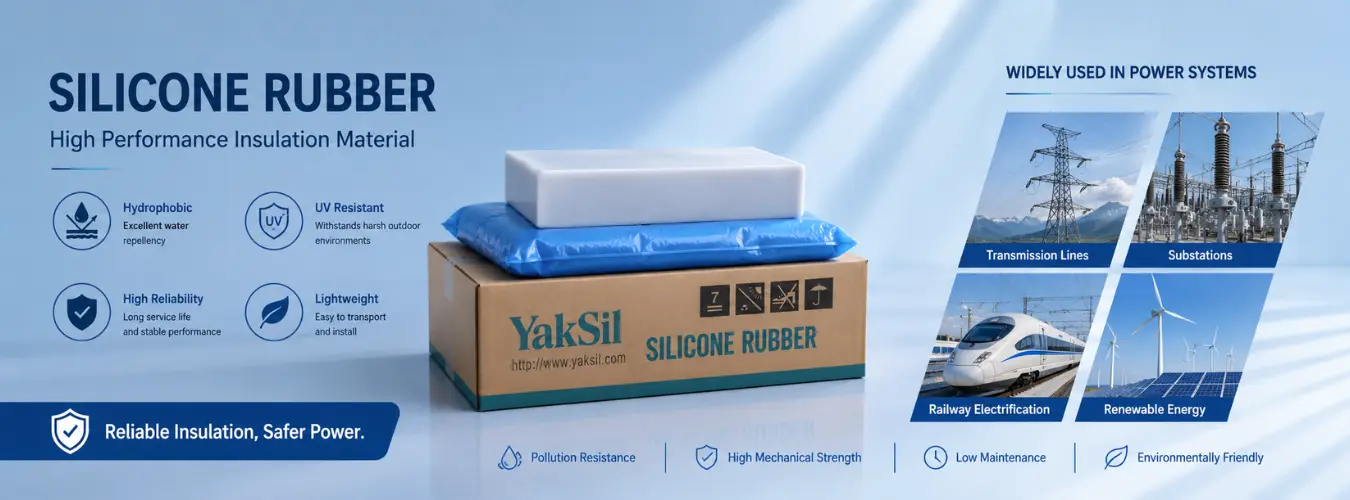
Silicone Rubber Has Become the Preferred Material for Modern Insulators
In today's power transmission and distribution systems, the performance of an insulator directly affects electrical safety, grid reliability, and maintenance costs. While traditional materials such as porcelain and glass have served the industry for decades, silicone rubber has emerged as one of the most advanced and widely adopted materials for modern electrical insulators.
Thanks to its exceptional hydrophobicity, superior weather resistance, lightweight structure, and long service life, silicone rubber insulators are increasingly replacing conventional alternatives in transmission lines, substations, rail systems, renewable energy facilities, and industrial power networks worldwide.
Understanding what an insulator is, how it works, and what materials are used in its construction is essential for engineers, procurement specialists, utility operators, and project managers seeking reliable electrical insulation solutions. This article explores the definition of insulators, the materials used to manufacture them, the advantages of caoutchouc de silicone, common applications, and key selection criteria for choosing the right insulator.
What Is an Insulator?
An insulator is a material or device designed to prevent the flow of electrical current between conductive components. Its primary function is to support electrical conductors while isolating them from grounded structures, equipment, or other conductive elements.
In electrical power systems, insulators play a critical role in maintaining safe separation between energized conductors and supporting structures such as towers, poles, transformers, and switchgear. Without effective insulation, electrical leakage, flashovers, short circuits, and equipment failures can occur, leading to power outages, safety hazards, and significant operational costs.
From a scientific perspective, insulators are characterized by high electrical resistivity. Unlike conductors such as copper or aluminum, insulating materials have very few free electrons available to carry electrical current. This property allows them to withstand high voltages while minimizing current leakage, making them essential components in modern transmission and distribution networks. According to IEEE Power & Energy Society, reliable insulation systems are fundamental to maintaining electrical safety, grid stability, and long-term power system performance.
Electrical insulators are commonly used in:
- Overhead transmission lines
- Distribution networks
- Substations
- Transformers
- Circuit breakers
- Renewable energy installations
- Railway electrification systems
- Industrial electrical equipment
The effectiveness of an insulator depends not only on its electrical properties but also on its ability to withstand environmental stress, mechanical loads, ultraviolet radiation, moisture, contamination, and temperature fluctuations.
What Are Insulators Made Of?
The performance and lifespan of an electrical insulator largely depend on the material used in its construction. Over the past century, insulator technology has evolved from traditional ceramic-based materials to advanced polymer composites. Today, the most common materials used in electrical insulators are porcelain, glass, and silicone rubber.
Each material offers unique advantages and limitations in terms of electrical insulation, mechanical strength, environmental resistance, and maintenance requirements. Understanding these differences is essential when selecting the most suitable solution for a specific application.
Comparison of Common Insulator Materials
| Matériau | Electrical Performance | Mechanical Strength | Poids | Weather Resistance | Exigences en matière d'entretien | Applications typiques |
|---|---|---|---|---|---|---|
| Porcelain | Excellent dielectric properties | Élevé | Lourd | Good | Medium to High | Transmission lines, substations, switchgear |
| Glass | High dielectric strength and easy visual inspection | Moderate to High | Lourd | Good | Medium | High-voltage transmission systems |
| Caoutchouc de silicone | Excellent insulation and hydrophobic performance | High (with FRP core) | Léger | Outstanding | Faible | Transmission lines, distribution networks, railways, renewable energy facilities |
While porcelain and glass have been widely used for decades, silicone rubber insulators have become increasingly popular in modern electrical infrastructure. Their ability to maintain stable performance under pollution, moisture, UV exposure, and harsh weather conditions makes them a preferred choice for utilities and industrial operators worldwide.
Why Silicone Rubber Has Become the Preferred Insulator Material
| Key Property | Practical Benefit |
|---|---|
| Hydrophobicité | Repels water and prevents conductive moisture films from forming on the surface |
| Résistance à la pollution | Maintains insulation performance in coastal, desert, and industrial environments |
| Résistance aux UV | Withstands long-term sunlight exposure without significant degradation |
| Lightweight Construction | Reduces transportation, installation, and structural support costs |
| High Mechanical Strength | Handles conductor tension, wind loads, and ice loads effectively |
| Low Maintenance Requirements | Minimizes cleaning and inspection frequency |
| Long Service Life | Improves asset reliability and lowers lifecycle costs |
| Excellent Aging Resistance | Maintains performance even after years of outdoor operation |
A typical silicone rubber insulator consists of a fiberglass reinforced polymer (FRP) core rod, silicone rubber housing and sheds, and metal end fittings. This composite design combines strong mechanical performance with superior electrical insulation, offering significant advantages over conventional porcelain and glass alternatives.
As power grids continue to modernize and renewable energy installations expand, silicone rubber insulators are increasingly recognized as the most reliable and cost-effective solution for ensuring long-term electrical safety and operational efficiency.
Applications of Silicone Rubber Insulators
The versatility of silicone rubber has enabled its widespread adoption across numerous industries and electrical infrastructures.
Power Transmission Lines
High-voltage transmission networks require insulators capable of operating under extreme electrical and environmental conditions.
Silicone rubber suspension and tension insulators are commonly installed on transmission towers to support conductors while maintaining electrical isolation.
Their lightweight design reduces structural requirements and simplifies installation.
Electrical Distribution Networks
Distribution systems frequently encounter contamination from dust, industrial emissions, agricultural activities, and vehicle pollution.
The hydrophobic performance of silicone rubber insulators helps maintain reliability under these challenging conditions.
Many utilities have adopted composite insulators as part of grid modernization initiatives.
Substations
Substations contain numerous components that require reliable insulation, including disconnect switches, busbars, transformers, and circuit breakers.
Silicone rubber insulators provide dependable performance while reducing maintenance requirements.
Their compact design also supports space-efficient substation layouts.
Railway Electrification Systems
Modern railway networks rely on overhead catenary systems operating at high voltages.
Silicone rubber insulators are widely used in railway applications because they withstand vibration, pollution, and varying climatic conditions while maintaining stable electrical performance.
Renewable Energy Facilities
Wind farms and solar power plants often operate in remote and environmentally challenging locations.
Silicone rubber insulators offer excellent resistance to UV exposure, salt contamination, moisture, and temperature fluctuations, making them ideal for renewable energy infrastructure.
As renewable energy deployment continues to expand globally, demand for high-performance silicone rubber insulation solutions is expected to increase significantly.
How to Choose the Right Silicone Rubber Insulator
Selecting the appropriate insulator requires careful consideration of both electrical and environmental factors.
Rather than focusing solely on voltage ratings, engineers should evaluate the complete operating environment and project requirements.
Evaluate System Voltage
The first step is determining the operating voltage and insulation coordination requirements.
Higher voltage applications require increased creepage distance, greater insulation strength, and optimized shed profiles to prevent flashover.
The selected insulator should comply with relevant IEC, ANSI, or IEEE standards.
Consider Environmental Conditions
Environmental contamination is often one of the most critical selection factors.
Projects located in coastal regions, industrial zones, deserts, or areas with heavy pollution typically benefit most from silicone rubber technology.
Hydrophobic performance becomes increasingly important as contamination severity increases.
Verify Mechanical Requirements
Mechanical loads vary significantly depending on installation type.
Engineers should evaluate:
- Tensile strength
- Cantilever strength
- Compression loads
- Wind loading
- Ice loading
- Seismic requirements
Proper mechanical sizing ensures long-term operational reliability.
Assess Material Quality
Not all silicone rubber compounds are manufactured to the same standards.
High-quality silicone rubber should provide:
- Stable hydrophobicity
- UV resistance
- Suivi de la résistance
- Résistance à l'érosion
- Long-term aging performance
Selecting products from experienced manufacturers with proven testing records helps ensure consistent performance.
Review Industry Certifications
Reliable suppliers typically provide products tested according to international standards, including IEC and IEEE requirements.
Third-party testing and certification demonstrate product quality and compliance with industry expectations.
When evaluating suppliers, buyers should request technical documentation, test reports, and project references.
The Future of Insulation Technology
The electrical power industry is undergoing rapid transformation driven by grid modernization, renewable energy integration, electrification, and increasing reliability requirements.
As utilities seek solutions that reduce maintenance costs and improve system resilience, silicone rubber insulators are expected to play an even greater role in future infrastructure projects.
Advancements in polymer chemistry, manufacturing technologies, and material engineering continue to enhance the performance of composite insulation systems.
Future generations of silicone rubber insulators will likely deliver improved aging resistance, enhanced pollution performance, and greater sustainability benefits.
Conclusion
An insulator is a critical component that prevents unwanted electrical current flow while supporting energized conductors and equipment. Although traditional materials such as porcelain and glass remain in use, silicone rubber has become the leading material for modern composite insulators.
Its unique combination of hydrophobicity, weather resistance, lightweight construction, mechanical strength, and low maintenance requirements makes it particularly well suited for today's demanding electrical environments.
From transmission lines and substations to railway systems and renewable energy facilities, silicone rubber insulators provide a reliable and cost-effective solution for ensuring long-term electrical safety and operational efficiency. When selecting an insulator, engineers should carefully consider voltage requirements, environmental conditions, mechanical loads, material quality, and compliance standards to achieve optimal performance throughout the asset's service life.
By understanding what insulators are made of and why silicone rubber has become the material of choice, organizations can make more informed decisions that enhance reliability, reduce maintenance costs, and support the future of modern power infrastructure.