
Composite Insulator Material Guide
シリコーンゴムは複合絶縁体に適しているか?
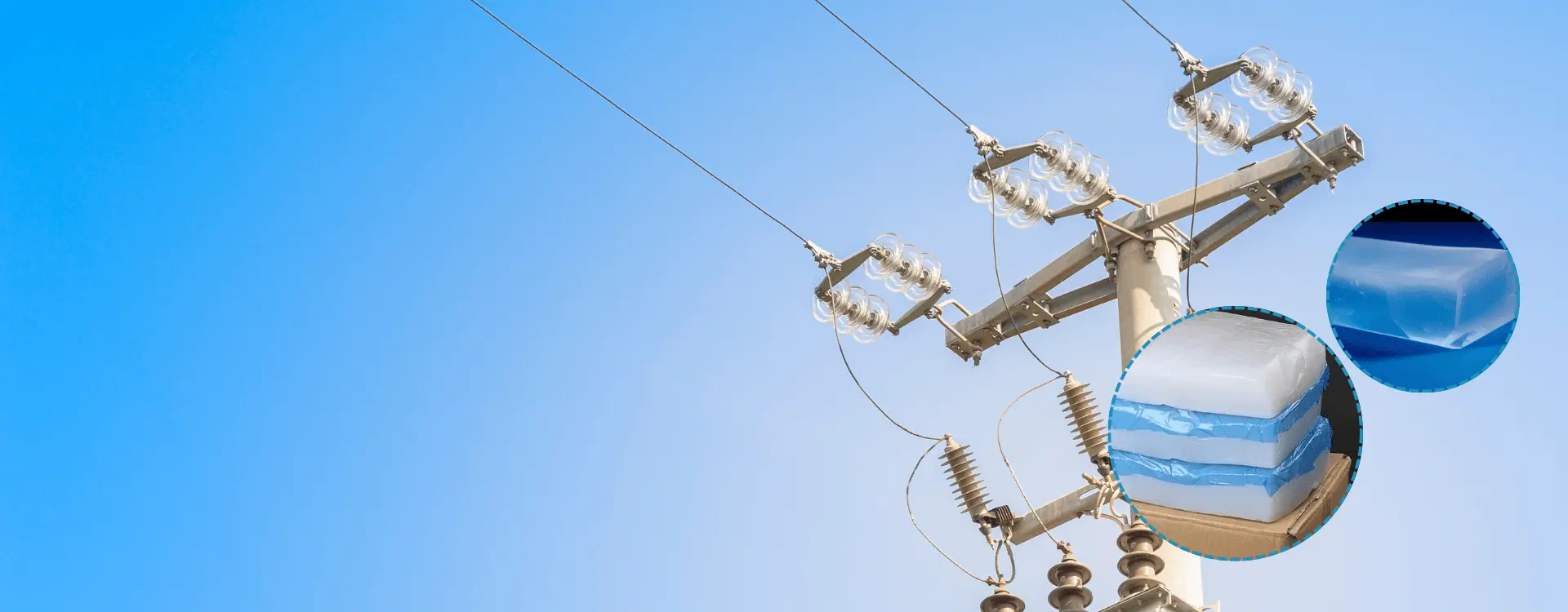
Silicone rubber is widely used as the external housing material of composite insulators because it combines electrical insulation, hydrophobicity, weather resistance and mechanical flexibility. However, good composite insulator performance depends on the complete silicone formulation, housing design, fiberglass core interface and manufacturing process.
シリコーンゴムは複合絶縁体に適しているか?
Yes. Silicone rubber is an excellent housing material for composite insulators when a suitable high-voltage grade is selected and the complete insulator is correctly designed and manufactured.
The silicone rubber housing performs several important functions. It provides the external electrical insulation surface, protects the fiberglass-reinforced polymer core from moisture and weather exposure, forms the weather sheds and helps reduce leakage current under wet or contaminated conditions.
One of the most important advantages of silicone rubber is its hydrophobic surface. Instead of allowing water to spread easily into a continuous film, properly formulated silicone tends to form separate water droplets. This behavior can help reduce surface leakage current on outdoor insulators.
Silicone rubber is also resistant to ultraviolet radiation, ozone and outdoor aging. High-voltage silicone compounds can additionally be formulated for resistance to electrical tracking and erosion.
Silicone rubber is highly suitable for composite insulator housings, but the material should be an insulator-grade formulation rather than ordinary general-purpose silicone rubber.
What Does Silicone Rubber Do in a Composite Insulator?
A typical composite insulator contains three major material systems: a fiberglass-reinforced resin core, a polymer housing with weather sheds and metal end fittings.
The fiberglass core carries the mechanical load. The metal fittings connect the insulator to the conductor and supporting structure. The silicone rubber housing provides the external insulation surface and protects the core from environmental exposure.
This means silicone rubber is not simply a protective cover. Its surface properties directly influence the electrical performance of the complete insulator.
| Composite insulator component | Main function | Important requirement |
|---|---|---|
| FRP core | Carries tensile or mechanical load | Mechanical strength, moisture resistance and stress-corrosion resistance |
| Silicone rubber housing | Provides external insulation and environmental protection | Hydrophobicity, tracking resistance, erosion resistance and weather stability |
| Weather sheds | Increase creepage distance and improve wet-condition insulation | Correct profile, spacing and mechanical durability |
| 金属製端部継手 | Transfer mechanical load and connect the insulator | Reliable attachment, corrosion protection and electric-field control |
| Core-housing interface | Prevents moisture penetration along the core | Strong and durable adhesion |
Why Silicone Rubber Works Well for Composite Insulators
1. Hydrophobic Surface
Hydrophobicity is one of the most important reasons silicone rubber is widely used in outdoor high-voltage insulation.
A hydrophobic surface encourages water to form droplets rather than a continuous film. This can make it more difficult for conductive contamination and moisture to create a continuous leakage-current path across the insulator surface.
This characteristic is particularly useful in coastal, industrial, humid and heavily polluted environments.
2. Hydrophobicity Recovery
Electrical discharge, severe contamination or surface aging can temporarily reduce the hydrophobicity of silicone rubber. Suitable high-voltage formulations can gradually recover hydrophobic behavior after the stress is removed.
This recovery capability is an important difference between silicone rubber and many other external insulation surfaces.
3. Hydrophobicity Transfer
Low-molecular-weight silicone species can migrate toward the surface and into certain contamination layers. As a result, part of the water-repellent behavior of the silicone can be transferred to contamination deposited on the housing.
This does not eliminate the need for correct creepage distance and shed design, but it can contribute to better performance under polluted outdoor conditions.
4. Electrical Insulation
Properly formulated silicone rubber provides high electrical resistance and useful dielectric performance. This makes it suitable for high-voltage housings, cable accessories, surge arresters and other power-system insulation components.
Electrical performance should still be evaluated on the finished insulator because housing thickness, metal fittings, interfaces, air gaps and electric-field distribution influence the complete system.
5. Tracking and Erosion Resistance
Outdoor high-voltage insulators can experience leakage current and dry-band arcing when their surfaces become wet and contaminated.
Repeated electrical discharges generate localized heat and can damage polymeric insulation. High-voltage silicone rubber therefore requires suitable resistance to tracking and erosion.
Insulator-grade formulations may contain specially selected mineral fillers and additives to improve resistance to these electrical surface stresses.
6. UV and Ozone Resistance
Composite insulators remain outdoors for long periods and may be continuously exposed to sunlight, ozone, temperature changes and weather.
Silicone rubber has strong resistance to ultraviolet radiation and ozone compared with many conventional organic elastomers. This contributes to its suitability for overhead transmission and distribution applications.
7. Temperature Flexibility
Silicone rubber retains useful flexibility across a broad temperature range. This is beneficial for composite insulators installed in regions with hot summers, cold winters or large day-to-night temperature changes.
Low-temperature flexibility also helps the housing accommodate dimensional changes between the silicone rubber, FRP core and metal components.
Typical Properties of High-Voltage Silicone Rubber
There is no single material specification that represents every composite insulator silicone compound. Different HCR, HTV and LSR grades may have substantially different hardness, strength and processing characteristics.
The following values are an example from a commercially available high-voltage silicone rubber molding compound. They are shown to illustrate the type of data that should be reviewed rather than to define universal acceptance limits.
| 物件 | Example typical value | その重要性 |
|---|---|---|
| 密度 | 1.57 g/cm³ | Influences compound formulation and finished-product weight |
| Shore A hardness | 72 | Affects shed stiffness, demolding and mechanical handling |
| 引張強度 | 5.5 MPa | Indicates resistance to bulk mechanical failure |
| Elongation at break | 250% | Shows the ability of the housing to deform before rupture |
| 引裂強度 | 16 N/mm | Important for sheds, mold lines and damaged edges |
| 体積抵抗率 | 1 × 10¹⁵ Ω・cm | Indicates high resistance to current through the material |
| Dielectric constant at 50 Hz | 3.6 | Relevant to electric-field behavior and insulation design |
| Dissipation factor at 50 Hz | 0.02 | Describes dielectric losses under AC electrical stress |
| Tracking resistance | IEC 60587 Class 1A4.5 | Supports evaluation of resistance to tracking and erosion |
Data note:
The values above are supplier-published typical values for one high-voltage silicone rubber grade and should not be treated as compulsory values for every composite insulator. Final specifications should be based on the selected compound and completed insulator qualification.
Why Hydrophobicity Matters So Much
Outdoor insulators frequently operate under rain, fog, condensation and contamination. A clean dry surface may provide excellent insulation, but surface conductivity can increase dramatically when pollution becomes wet.
Salt, industrial pollution, dust and other deposits can create a conductive layer. Leakage current then flows along the insulator surface.
Heating caused by leakage current can dry small regions of the surface. These dry regions can interrupt the conductive path and develop a high local voltage gradient. Electrical discharge across the dry region is known as dry-band arcing.
Repeated dry-band arcing can gradually damage polymer housing materials. Silicone rubber's hydrophobicity helps reduce the formation of continuous conductive water films and therefore contributes to pollution performance.
Hydrophobicity is an advantage, not a substitute for proper insulator design. Creepage distance, shed profile, pollution severity and electric-field control must still be evaluated.
Silicone Rubber in Polluted Environments
Composite insulators are often installed in environments where pollution performance is a major concern.
| Environment | Typical challenge | Important silicone property |
|---|---|---|
| Coastal areas | Salt contamination combined with moisture | Hydrophobicity and tracking resistance |
| Industrial areas | Conductive dust, smoke and chemical pollution | Hydrophobicity transfer and erosion resistance |
| Desert regions | Dust, sand, intense sunlight and large temperature changes | UV resistance, tear strength and hydrophobic performance |
| Tropical climates | High humidity, rain and biological contamination | Water repellency and weather resistance |
| Cold climates | Ice, freezing rain and thermal cycling | Low-temperature flexibility and interface durability |
| High altitude | Reduced air-insulation strength | Correct insulator dimensioning and electric-field design |
HTV Silicone Rubber for Composite Insulators
HTV silicone rubber, also known as HCR or high-consistency silicone rubber, is widely used for manufacturing composite insulator housings.
Before curing, HTV silicone has a firm, gum-like consistency. It can be processed by compression molding, transfer molding, extrusion or specialized high-consistency rubber injection molding.
High-voltage HTV silicone compounds can be formulated with the mechanical properties, electrical resistance, hydrophobicity and tracking resistance required for outdoor insulation.
HTV processing requires careful control of compound preparation, mold filling, temperature, curing time and surface preparation of the FRP core.
HTV may be attractive for manufacturers that already operate high-consistency rubber processing equipment or require a relatively firm housing compound.
Liquid Silicone Rubber for Composite Insulators
Liquid silicone rubber, or LSR, can also be formulated for high-voltage insulation applications.
LSR is typically supplied as two pumpable components. The components are accurately metered, mixed and injected into a heated mold where curing takes place.
Its relatively low uncured viscosity allows the material to fill detailed mold regions and complex shed profiles. LSR processing can also support high levels of automation and consistent material mixing.
Platinum-cured LSR systems require contamination control because certain substances can inhibit curing. Metering ratio, mold sealing, injection pressure and venting must also be carefully controlled.
HTV vs LSR for Composite Insulator Housing
| 特集 | HTV / HCR | LSR |
|---|---|---|
| 未硬化の状態 | 高濃度ガム | 移送可能な液体 |
| Material feeding | Preforms, strips or mechanical feeding | Metering pumps |
| Flow behavior | Requires higher pressure to fill the mold | Flows easily into detailed geometry |
| Curing | Heat activated | Normally platinum-cured by heat |
| 自動化 | Depends on molding system | Well suited to automated injection molding |
| Typical concern | Compound mixing, preform consistency and mold filling | Metering accuracy and cure inhibition |
| Final material | Solid silicone elastomer | Solid silicone elastomer |
Neither HCR nor LSR is automatically better for every composite insulator. The choice depends on housing geometry, molding equipment, production volume, material formulation and interface requirements.
Silicone Rubber Must Resist Tracking and Erosion
Tracking and erosion performance should be treated as one of the main material-selection criteria for composite insulators.
Tracking refers to the development of a permanent electrically conductive path across an insulating surface. Erosion describes gradual material loss caused by electrical discharge, heat and chemical attack.
The housing can experience repeated surface discharges when moisture and conductive pollution produce leakage current.
A general silicone rubber may provide good dielectric insulation but still be unsuitable if its resistance to tracking and erosion is insufficient for outdoor high-voltage service.
This is why dedicated high-voltage silicone compounds should be evaluated rather than selecting a material simply because it is described as silicone rubber.
The FRP Core Interface Is Just as Important as the Silicone
Excellent silicone rubber properties cannot compensate for a poor housing-to-core interface.
The silicone housing must adhere reliably to the fiberglass-reinforced polymer core. If a gap forms along the interface, moisture may penetrate internally and create conditions for electrical discharge or core degradation.
Reliable bonding depends on core surface condition, cleaning, primer chemistry, silicone formulation, mold temperature and processing time.
Qualification should therefore use the actual silicone, primer and FRP core combination intended for production.
IEC 61109:2025 further emphasizes the relevance of interfaces and includes mechanical evaluation of adhesion between the core and housing within its updated framework.
Housing material and interface design must be qualified as one system.
Silicone Rubber and End-Fitting Sealing
The areas where the silicone housing meets metal end fittings are also critical.
Moisture should not be allowed to penetrate toward the FRP core. The housing geometry, molding process and sealing design should maintain a reliable barrier during temperature cycling, mechanical loading and long-term outdoor aging.
These areas can also experience relatively high electric fields. Poor geometry or inadequate grading hardware may increase corona or localized electrical stress.
Material selection should therefore be combined with electric-field analysis and complete insulator testing.
Is Silicone Rubber Better Than Other Polymer Housing Materials?
Silicone rubber is not the only polymer that can be used in electrical insulation, but it offers a particularly useful combination of hydrophobicity, weather resistance, electrical performance and temperature flexibility.
| 選定基準 | シリコーンゴム | Why it matters for composite insulators |
|---|---|---|
| 疎水性 | Strong | Helps reduce continuous wet conductive films |
| Hydrophobicity recovery | Important characteristic of suitable grades | Supports long-term polluted-environment performance |
| UV resistance | Strong | Important for decades of outdoor exposure |
| Ozone resistance | Strong | Supports outdoor electrical applications |
| 低温下での柔軟性 | Good | Useful in cold climates and thermal cycling |
| Tracking resistance | Can be excellent with high-voltage formulation | Critical under pollution and dry-band arcing |
| 処方の柔軟性 | 高い | Allows HCR and LSR grades for different manufacturing processes |
The final comparison should always use actual qualified grades rather than comparing only generic polymer names.
When Can Silicone Rubber Perform Poorly?
Silicone rubber is a strong material choice, but it can still fail when the wrong compound or manufacturing process is used.
Using General-Purpose Silicone
Ordinary silicone compounds may not provide sufficient tracking, erosion or long-term high-voltage performance.
Poor Compound Formulation
Incorrect filler levels, unstable additives or unsuitable pigments can affect mechanical strength, curing and electrical performance.
Insufficient Tear Strength
Thin sheds and mold-line regions can be damaged during demolding, transportation or installation if tear resistance is inadequate.
Poor Core Adhesion
Weak bonding between the silicone housing and FRP core can create internal moisture paths even when the silicone itself has excellent properties.
Incorrect Shed Design
Hydrophobic silicone cannot correct a poorly designed external profile. Shed spacing, overhang, orientation and creepage distance must match the application.
Excessive Electric Field
High electric-field concentration around metal fittings can accelerate corona activity and housing aging. Grading hardware may be necessary depending on the design and voltage level.
Manufacturing Contamination
Oil, dust, moisture, mold release agents and incompatible chemicals can interfere with curing or interface adhesion.
How to Choose Silicone Rubber for a Composite Insulator
- Confirm that the compound is designed for high-voltage insulation.
Do not qualify a material only because it is silicone rubber. - Review hydrophobicity performance.
Consider initial hydrophobicity, recovery and transfer behavior where relevant. - Check tracking and erosion resistance.
Request the test method, classification and test conditions. - Review electrical properties.
Consider volume resistivity, dielectric behavior and application-specific electrical requirements. - Check mechanical properties.
Compare hardness, tensile strength, elongation and tear resistance together. - Evaluate temperature performance.
Include minimum temperature, maximum temperature and repeated thermal cycling. - Select the manufacturing system.
Determine whether HTV/HCR or LSR better matches the factory equipment and insulator geometry. - Verify FRP core adhesion.
Test the actual silicone, primer and core surface combination. - Check end-fitting sealing.
Ensure moisture cannot enter the housing-core interface. - Evaluate pollution conditions.
Include coastal salt, industrial pollution, dust, humidity and rainfall. - Review electric-field distribution.
Pay particular attention to housing regions near metal fittings. - Complete finished-insulator testing.
Material data alone cannot qualify the complete composite insulator.
Important Tests for Silicone Rubber Composite Insulators
| Test area | What it evaluates | その重要性 |
|---|---|---|
| 追跡と浸食 | Resistance to electrical surface degradation | Important for contaminated outdoor insulation |
| 疎水性 | Water-repellent surface behavior | Influences wet pollution performance |
| Hydrophobicity transfer | Transfer of water repellency into contamination | Important for silicone housing materials with HTM behavior |
| Tensile and elongation | Bulk mechanical properties | Supports housing durability evaluation |
| 引裂強度 | Resistance to crack growth | Important for sheds and molded edges |
| 熱老化 | Property changes during thermal exposure | Supports long-term material evaluation |
| Interface adhesion | Bonding between housing and FRP core | Helps prevent internal moisture penetration |
| Water diffusion | Moisture-related behavior of the core and housing system | Important for long-term internal insulation reliability |
| Electrical type tests | Complete insulator electrical performance | Validates finished-product design |
| Mechanical testing | Load capability of the complete insulator | Confirms core and end-fitting performance |
Relevant Composite Insulator Standards
Silicone rubber material testing should be combined with the standards applicable to the complete composite insulator.
IEC 62217:2025
IEC 62217:2025 provides common definitions, test methods and acceptance criteria for polymeric high-voltage insulators. The current edition addresses composite insulators used on overhead lines and in substations and includes requirements related to housing materials, hydrophobicity-transfer materials, core materials, interfaces and electric-field control.
IEC 61109:2025
IEC 61109:2025 applies to composite suspension and tension insulators for overhead lines. It covers insulators consisting of a fiber-reinforced resin core, polymer housing and metal end fittings.
The 2025 edition also emphasizes interface quality and includes updated provisions relating to hydrophobicity transfer, environmental conditions, electric-field control and adhesion between the core and housing.
IEC 60587
IEC 60587 is commonly used for evaluating tracking and erosion resistance of electrical insulating materials under severe accelerated conditions.
Questions to Ask a Silicone Rubber Supplier
- Is the silicone specifically designed for outdoor high-voltage insulators?
- Is the compound HTV/HCR or LSR?
- What molding process is recommended?
- What are the Shore A hardness, tensile strength and elongation values?
- What is the tear strength?
- What tracking and erosion test data are available?
- How does the material recover hydrophobicity after surface stress?
- Does it demonstrate hydrophobicity transfer?
- What electrical-resistivity and dielectric data are available?
- Which pigments are approved?
- Which primer is recommended for the FRP core?
- Has the material been evaluated with the intended core resin system?
- What curing temperature and cure time are required?
- Is post-curing required?
- What storage conditions and shelf life apply?
- What batch data are provided on the certificate of analysis?
よくある質問
Is silicone rubber good for high-voltage insulators?
Yes. High-voltage silicone rubber can provide electrical insulation, hydrophobicity, weather resistance and tracking and erosion resistance when properly formulated.
Why is silicone rubber used in composite insulators?
Silicone rubber is used because it combines electrical insulation with a hydrophobic surface, UV and ozone resistance, temperature flexibility and outdoor weathering performance.
What type of silicone rubber is used for composite insulators?
High-voltage HTV/HCR silicone rubber and specially formulated liquid silicone rubber can both be used, depending on the manufacturing process and insulator design.
Is ordinary silicone rubber suitable for composite insulators?
Not necessarily. Composite insulator housing requires a formulation with suitable electrical, hydrophobic, weathering, tracking and erosion performance.
Is HTV silicone rubber better than LSR for insulators?
Neither system is universally better. HTV and LSR use different processing technologies and can both provide suitable high-voltage housing performance when correctly formulated.
What is the most important property of silicone insulator housing?
No single property is sufficient. Hydrophobicity, tracking and erosion resistance, electrical insulation, mechanical durability, weather resistance and interface adhesion should be evaluated together.
Does silicone rubber lose hydrophobicity?
Severe electrical or environmental stress can temporarily reduce surface hydrophobicity. Suitable silicone formulations can demonstrate hydrophobicity recovery after the stress is removed.
Why is FRP core bonding important?
Poor housing-to-core bonding can allow moisture to penetrate along the internal interface, potentially reducing the long-term reliability of the composite insulator.
Can silicone rubber resist coastal pollution?
High-voltage silicone rubber is widely used in polluted environments because its hydrophobic surface can help reduce continuous wet conductive films. The complete insulator still requires suitable creepage distance and profile design.
How do I choose silicone rubber for a composite insulator?
Start with an insulator-grade compound and evaluate hydrophobicity, tracking and erosion resistance, mechanical properties, electrical properties, temperature range, processing method and adhesion to the actual FRP core.