
Rubber Insulation for Electrical Systems: Materials, Properties and Uses
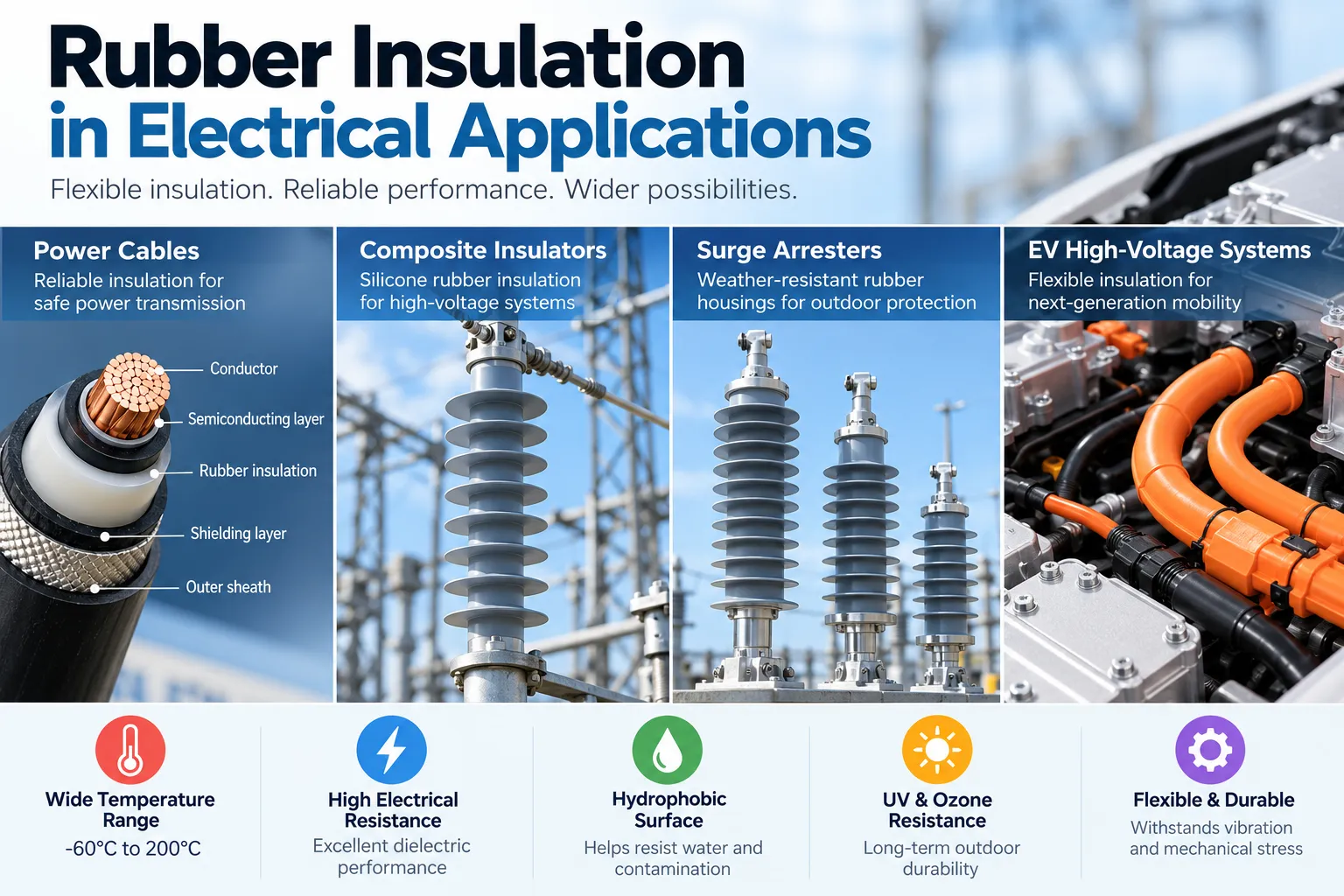
Rubber insulation is a flexible dielectric material used to reduce unwanted electrical current while providing mechanical flexibility, environmental protection and long-term insulation performance. It is widely used in wire and cable, electrical connectors, composite insulators, surge arresters, high-voltage equipment and other industrial electrical systems.
Unlike rigid insulating materials, rubber can bend, stretch and recover while maintaining electrical separation. This makes elastomeric insulation particularly useful in applications exposed to vibration, temperature cycling, mechanical movement and complex component geometry.
However, not every rubber compound is designed for electrical insulation. Polymer chemistry, filler system, curing system, moisture, temperature and processing quality all influence dielectric strength, volume resistivity, tracking resistance and long-term reliability.
This guide explains how rubber insulation works, the electrical properties that matter, where silicone rubber is used, common failure mechanisms and how manufacturers can select the right insulating compound for electrical applications.
What Is Rubber Insulation?
Rubber insulation is an elastomeric material formulated to resist the movement of electrical charge between conductive components.
Its purpose is not only to block current. In many electrical systems, the insulation must also remain flexible, protect internal parts from the environment and maintain performance after repeated thermal and mechanical stress.
This combination allows rubber insulation to conform around cables, connectors, housings and complex molded electrical components where rigid materials may be less suitable.
Why Is Rubber Used for Electrical Insulation?
Most insulating rubber compounds contain very few freely moving electrical charge carriers. As a result, current does not pass through them easily under normal operating conditions.
This high electrical resistance can be combined with several practical mechanical advantages.
What Materials Are Used for Rubber Insulation?
Electrical rubber insulation can be produced from several elastomer systems, but the exact material must be selected according to voltage, temperature, environment and processing method.
For demanding applications, silicone rubber is particularly important because it combines electrical resistance with heat resistance, low-temperature flexibility, UV and ozone resistance and, in specialized outdoor grades, hydrophobic surface behavior.
| Material Category | Main Function | Typical Application Direction |
|---|---|---|
| 電気用シリコーンゴム | Flexible insulation with thermal and environmental resistance | Composite insulators, cable, surge arresters |
| High-Temperature Silicone | Electrical insulation under elevated temperatures | Heat-resistant cable and electrical components |
| Tracking-Resistant Silicone | Improved performance under surface electrical stress | Outdoor high-voltage insulation |
| Flexible Elastomeric Insulation | Mechanical flexibility and dielectric separation | Cables, seals and molded electrical parts |
Why Silicone Rubber Is Used for Electrical Insulation
Silicone rubber is widely used in electrical systems because its polymer structure provides a useful balance of electrical, thermal and environmental properties.
Suitable formulations can retain flexibility at low temperatures and remain stable under temperatures that would accelerate deterioration in many conventional elastomers.
Electrical-grade silicone rubber can also provide high volume resistivity and useful dielectric strength.
Key Electrical Properties of Rubber Insulation
Electrical insulation performance cannot be described by one specification alone. Several properties must be evaluated together.
What Is Dielectric Strength?
Dielectric strength describes how much electric field an insulating material can withstand before electrical breakdown occurs.
It is commonly expressed as voltage per unit thickness, such as kV/mm.
Electrical-grade silicone rubber can provide useful dielectric strength, but the actual value depends on formulation, thickness, temperature and test method.
What Is Volume Resistivity in Rubber Insulation?
Volume resistivity describes how strongly a material resists current flowing through its internal structure.
Insulating silicone rubber generally has very high volume resistivity compared with conductive materials.
The exact result can change according to temperature, humidity, formulation, filler system and aging conditions.
This makes test conditions important when comparing electrical rubber materials from different suppliers.
Surface Resistivity vs Volume Resistivity
This distinction becomes particularly important in outdoor high-voltage insulation.
The internal silicone rubber may remain highly resistive while rain, salts and contamination reduce resistance along the external surface.
How Temperature Affects Rubber Insulation
Temperature influences both the electrical and mechanical performance of rubber insulation.
At low temperature, many elastomers gradually become harder and less flexible. At elevated temperature, prolonged exposure can accelerate changes in hardness, elongation, tensile strength and dielectric properties.
Silicone rubber is especially useful where insulation must remain flexible over a broad temperature range.
Many industrial silicone rubber grades operate roughly from the -50°C to -60°C region through approximately 180°C to 200°C, while specialized formulations may support higher temperatures under appropriate operating conditions.
Does Water Affect Rubber Insulation?
The internal rubber material may remain electrically insulating when wet, but moisture can change surface electrical behavior.
Rainwater, industrial moisture and coastal contamination can contain dissolved ions. These contaminants can reduce surface resistance when they become wet.
→
→
→
This is one reason outdoor high-voltage insulation requires more than simply high bulk electrical resistance.
Hydrophobicity in Silicone Rubber Insulation
Hydrophobicity refers to the tendency of a surface to repel water.
On hydrophobic silicone rubber, water tends to form individual droplets rather than spreading easily into a continuous film.
This can make it more difficult for a continuous conductive path to form across an outdoor insulating surface.
Hydrophobicity is therefore an important property of silicone rubber used in composite insulators and other outdoor high-voltage components.
Rubber Insulation Under High Voltage
High-voltage insulation is exposed to electrical stresses that do not occur in ordinary low-voltage applications.
Surface contamination, moisture, air gaps, sharp geometry and material defects can concentrate electric fields and increase the risk of insulation degradation.
What Is Electrical Tracking?
Electrical tracking is progressive surface degradation that can eventually create a conductive path across an insulating material.
It commonly develops when contamination, moisture and electrical stress act together.
Leakage current may cause localized heating. Some areas dry faster than others, producing dry bands where voltage becomes concentrated.
Repeated arcing across these regions can gradually damage the insulation surface.
Tracking resistance is therefore an important requirement for silicone rubber used in exposed high-voltage environments.
What Is Electrical Erosion?
Electrical erosion is the physical loss of insulating material caused by repeated electrical discharge and thermal stress.
Severe dry-band arcing can generate intense localized heating that damages the surface.
Over time, the material can become rough, pitted or thinner.
High-voltage silicone rubber compounds are therefore often developed to provide both tracking resistance and erosion resistance.
Why ATH Is Used in Electrical Silicone Rubber
Aluminum trihydrate, commonly known as ATH, is widely used in silicone rubber compounds developed for high-voltage electrical insulation.
ATH can improve resistance to electrical tracking and erosion.
When exposed to intense localized heating, ATH releases chemically bound water and absorbs thermal energy.
This can help reduce thermal degradation during electrical arcing.
Rubber Insulation for Wire and Cable
Wire and cable are major applications for flexible electrical insulation.
The insulation separates conductive cores while protecting them from environmental and mechanical exposure.
Silicone rubber is particularly useful for cables exposed to high temperature, low temperature or demanding thermal cycling.
| 物件 | Importance in Cable Insulation |
|---|---|
| 絶縁耐力 | Helps resist electrical breakdown |
| 体積抵抗率 | Helps restrict current through insulation |
| 柔軟性 | Supports installation and cable movement |
| 熱老化 | Important for long-term high-temperature operation |
| 引裂強さ | Supports durability during production and installation |
| Extrusion Performance | Supports consistent wall thickness and surface quality |
Rubber Insulation for Composite Insulators
Composite insulators are one of the most demanding applications for electrical silicone rubber.
A typical composite insulator consists of an FRP core, metal end fittings and a silicone rubber housing with multiple weather sheds.
The FRP core carries mechanical load while the silicone housing protects the core and provides the external insulating surface.
| Silicone Property | Function in Composite Insulators |
|---|---|
| 疎水性 | Helps interrupt continuous water films |
| Dielectric Performance | Supports electrical insulation |
| Tracking Resistance | Helps resist conductive path formation |
| Erosion Resistance | Helps withstand electrical surface stress |
| 耐紫外線性・耐オゾン性 | Supports long outdoor service |
| 引裂強さ | Supports shed integrity during molding and operation |
Why Composite Insulators Use Silicone Rubber Sheds
The shed profile increases the creepage distance between energized and grounded regions along the insulation surface.
A longer creepage path helps reduce the risk of surface flashover in wet and polluted conditions.
The shed profile also influences water drainage and contamination accumulation.
Reliable composite-insulator performance therefore depends on both the electrical silicone compound and the geometry of the finished housing.
Rubber Insulation for Surge Arresters
Silicone rubber is also widely used as an external housing material for surge arresters.
The housing provides electrical insulation while protecting internal components from rain, pollution, UV radiation and environmental exposure.
Important material properties include hydrophobicity, dielectric performance, tracking resistance, erosion resistance and stable molding behavior.
Rubber Insulation in EV High-Voltage Systems
Electric vehicles contain increasingly complex high-voltage systems that require reliable insulation alongside thermal and mechanical performance.
Silicone rubber can be used around HV cables, battery components, connectors and electrical sealing systems.
In these environments, the material may need to withstand heat, vibration, temperature cycling and electrical stress simultaneously.
Selection should therefore consider the complete component environment rather than electrical properties alone.
Rubber Insulation for Electrical Connectors
Electrical connectors often require both dielectric isolation and environmental sealing.
Flexible silicone components can surround terminals, cable interfaces and high-voltage connection points while accommodating dimensional movement.
Depending on the application, engineers may need to evaluate dielectric strength, compression set, tear strength, temperature resistance and flame behavior.
Rubber Insulation vs Rigid Electrical Insulation
Rubber insulation is not intended to replace every rigid dielectric material.
Instead, elastomers provide advantages where flexibility and elastic deformation are required.
| 物件 | Rubber Insulation | Rigid Insulation |
|---|---|---|
| 柔軟性 | 高い | Low to moderate |
| Elastic Recovery | 高い | 数量限定 |
| Sealing Capability | 素晴らしい | Usually limited |
| Structural Rigidity | 低 | 高い |
| Vibration Accommodation | 素晴らしい | Material dependent |
What Causes Rubber Insulation to Fail?
Electrical insulation failures are often caused by several stresses acting together rather than one isolated factor.
Why Manufacturing Quality Matters
The performance of rubber insulation depends not only on compound formulation but also on how the material is processed.
Air entrapment, contamination, incomplete curing or inconsistent mold filling can introduce local weaknesses.
In high-voltage applications, even small defects can become important because electric fields may concentrate around voids or interfaces.
This makes consistent rheology, cure behavior and batch quality important characteristics of an electrical silicone supplier.
Injection Molding of Electrical Silicone Rubber
HTV/HCR silicone rubber can be injection molded into complex electrical components such as composite-insulator housings and sheds.
The material must flow sufficiently to fill long and detailed mold cavities without creating excessive trapped air or incomplete sections.
Processing behavior depends on plasticity, filler loading, compound formulation, mold temperature and injection parameters.
This means two silicone compounds with similar cured hardness can behave very differently during production.
Extrusion of Silicone Rubber Insulation
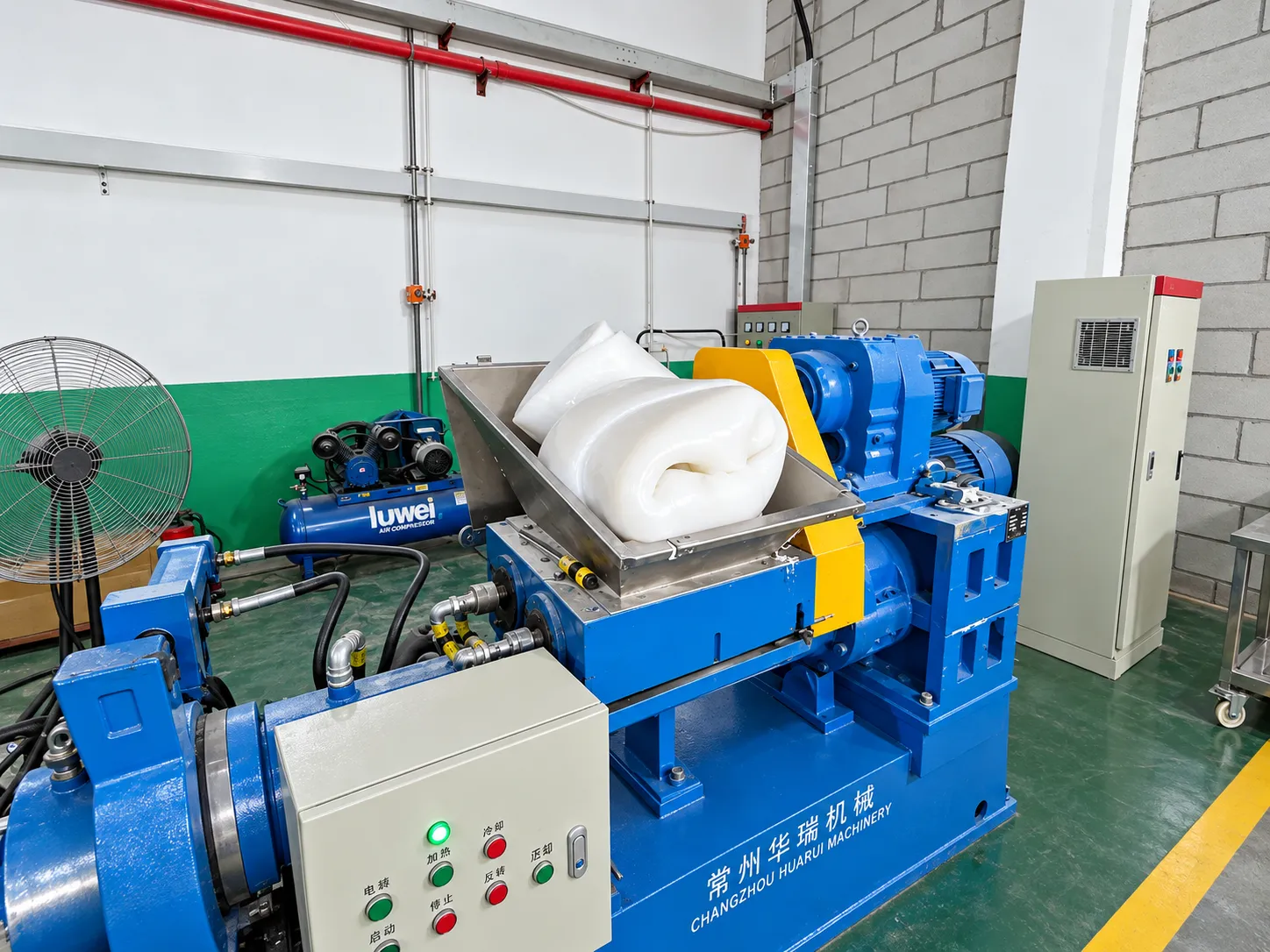
Extrusion is widely used to apply silicone rubber insulation around wire and cable.
The uncured compound must feed consistently, maintain dimensional stability and produce a smooth surface around the conductor.
After extrusion, the silicone is cured to form the final elastic insulation layer.
Stable extrusion performance can be just as important as final dielectric properties for cable manufacturers operating continuous production lines.
Does Shore A Hardness Determine Insulation Performance?
No. Shore A hardness measures resistance to indentation, not electrical insulation capability.
A harder silicone rubber does not automatically have higher dielectric strength or volume resistivity.
Two compounds with identical Shore A hardness may have different filler systems, tear strength, electrical properties and processing behavior.
How to Choose Rubber Insulation
The correct rubber insulation should be selected according to the complete operating environment.
How to Select Silicone Rubber for High-Voltage Insulation
High-voltage silicone rubber should be treated as a specialized electrical material rather than a general-purpose elastomer.
In addition to basic Shore A hardness and tensile properties, important parameters can include hydrophobicity, dielectric strength, volume resistivity, tracking resistance, erosion resistance and outdoor aging performance.
For composite insulator manufacturing, the material must also process reliably during injection or compression molding.
OEMs should therefore evaluate both finished electrical properties and production behavior before approving a new silicone grade.
Rubber Insulation Applications
What Should OEMs Include in a Rubber Insulation RFQ?
Electrical Silicone Rubber from Yakows
Yakows supplies HTV/HCR silicone rubber and other silicone compounds for electrical insulation applications including composite insulators, surge arrester housings, wire and cable and EV high-voltage components.
Electrical silicone materials can be evaluated according to dielectric strength, volume resistivity, hydrophobicity, tracking and erosion resistance, tear strength, thermal aging and processing requirements.
For composite-insulator manufacturers, material selection can also consider ATH filler systems, mold flow, cure behavior and batch-to-batch processing consistency.
Manufacturers can provide their existing material specification, application, processing method and current production or field-performance problem for material comparison.
よくある質問
What is rubber insulation?
Rubber insulation is a flexible dielectric material used to restrict electrical current while providing elasticity, sealing and environmental protection.
Why is rubber used for electrical insulation?
Insulating rubber has high electrical resistance while remaining flexible enough for cables, connectors and molded electrical components.
Is silicone rubber a good electrical insulator?
Yes. Properly formulated silicone rubber can provide high electrical resistance, useful dielectric strength and strong thermal and environmental performance.
What is dielectric strength in rubber insulation?
Dielectric strength describes the electric field the material can withstand before electrical breakdown occurs.
What is volume resistivity?
Volume resistivity measures resistance to electrical current passing through the bulk material.
Does water reduce rubber insulation performance?
Moisture and dissolved contamination can reduce surface resistance and increase leakage current even when the bulk rubber remains insulating.
Why is silicone rubber used for composite insulators?
Silicone rubber combines electrical insulation with hydrophobicity, weather resistance and specialized tracking and erosion resistance.
What rubber is used for high-temperature cable insulation?
Silicone rubber is widely used where cable insulation requires electrical performance together with high-temperature resistance and flexibility.
Does harder rubber provide better electrical insulation?
Not necessarily. Shore A hardness and electrical properties are separate characteristics.
What causes electrical rubber insulation to fail?
Common causes include excessive heat, electrical overstress, moisture, contamination, tracking, mechanical damage and processing defects.
What properties matter for high-voltage silicone rubber?
Important properties include dielectric strength, volume resistivity, hydrophobicity, tracking and erosion resistance, mechanical strength and long-term weather aging.
How should an OEM select rubber insulation?
Selection should consider voltage, temperature, environment, electrical properties, mechanical requirements, processing method and expected service life.