
Rubber & Silicone Material Guide
What Is Vulcanized Rubber?
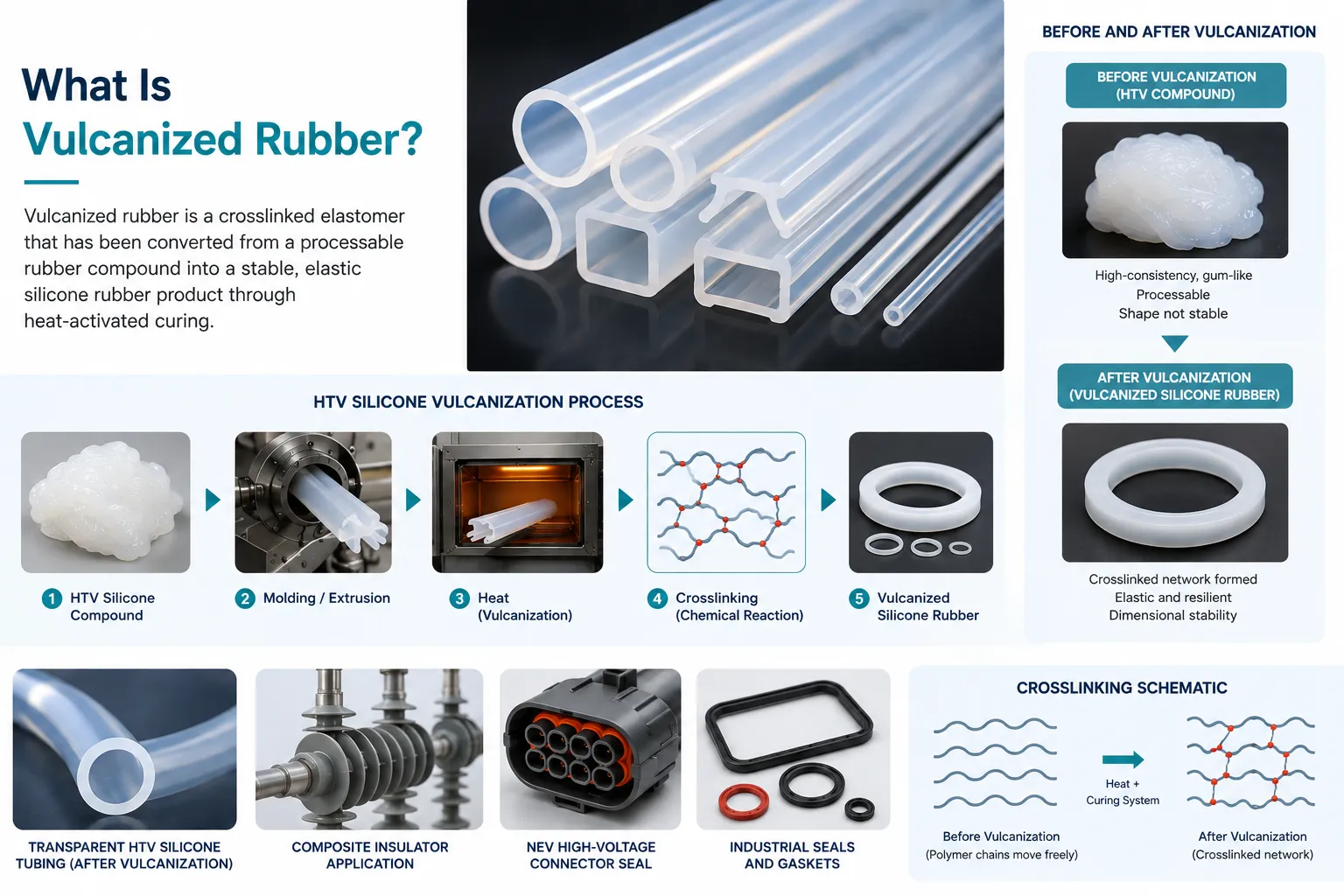
Vulcanized rubber is rubber that has been chemically crosslinked through a curing process, converting a processable rubber compound into a stable elastic material. In HTV silicone rubber manufacturing, vulcanization transforms a high-consistency silicone compound into finished rubber with controlled hardness, elasticity, mechanical strength, temperature resistance and electrical performance.
What Is Vulcanized Rubber?
Vulcanized rubber is an elastomer whose polymer chains have been chemically connected to form a three-dimensional network.
Before vulcanization, a rubber compound is primarily a manufacturing material. It can be mixed, extruded, molded, calendered or otherwise shaped, but it has not yet developed all of the mechanical and elastic properties expected from the finished product.
During vulcanization, a curing system creates chemical crosslinks between polymer chains. These crosslinks reduce permanent molecular movement while still allowing the rubber to stretch, compress and recover.
After curing, the material becomes vulcanized rubber with improved elastic recovery, dimensional stability and resistance to permanent deformation.
HTV silicone rubber provides a useful example. Before curing, HTV silicone normally has a high-consistency, gum-like form. After molding or extrusion and heat curing, it becomes vulcanized silicone rubber suitable for seals, tubing, cable insulation, electrical components, NEV systems and composite insulator housings.
vulcanization converts a processable rubber compound into a crosslinked, elastic and dimensionally stable rubber product.
What Does Vulcanization Mean?
Vulcanization is the curing process used to develop the crosslinked network inside rubber.
Traditional rubber technology is often associated with sulfur vulcanization, but vulcanization does not always require sulfur. Different elastomers use different crosslinking chemistry.
In HTV silicone rubber, for example, the material is commonly vulcanized using organic peroxide systems or platinum-catalyzed addition curing.
The curing chemistry may be different, but the objective is similar: convert a processable polymer compound into a stable elastic network.
| Material System | Typical Curing Approach | Final Result |
|---|---|---|
| Conventional unsaturated rubber | Sulfur-based systems may be used | Vulcanized rubber |
| HTV/HCRシリコーン | Peroxide or platinum curing | Vulcanized silicone rubber |
| LSR | Usually heat-activated addition curing | Crosslinked silicone elastomer |
| RTVシリコーン | 室温硬化 | Crosslinked silicone rubber |
Why Does Rubber Need to Be Vulcanized?
A rubber compound must remain processable during manufacturing, but the finished component must remain stable during service.
Before vulcanization, polymer chains can move much more freely. This allows the compound to flow or deform during extrusion and molding.
A finished gasket, cable insulation layer, tube or composite insulator housing cannot continue behaving like an uncured compound. It must retain its shape and recover after deformation.
Vulcanization creates the molecular network required for this transition.
As a result, vulcanized rubber can provide better dimensional stability, elastic recovery and resistance to creep than the uncured compound from which it was produced.
Unvulcanized Rubber vs Vulcanized Rubber
The difference between unvulcanized and vulcanized rubber is easiest to understand by looking at HTV silicone before and after curing.
| 物件 | Unvulcanized HTV Silicone | Vulcanized HTV Silicone Rubber |
|---|---|---|
| Material state | Processable compound | Finished elastic rubber |
| 物理的な形態 | High-consistency, gum-like material | Stable solid elastomer |
| Crosslinked network | Final network not developed | Crosslinked network formed |
| Shape retention | 数量限定 | 高い |
| 弾力的な回復 | Not fully developed | 高い |
| Mechanical properties | Not representative of the finished product | Developed after curing |
| 処理 | Can be molded or extruded | Finished thermoset elastomer |
| Remelting | Still processable before final cure | Cannot simply be remelted like a thermoplastic |
| Typical role | Manufacturing material | Finished rubber component |
How Does HTV Silicone Become Vulcanized Rubber?
HTV means High Temperature Vulcanizing. The term describes silicone rubber systems that require elevated temperature to develop the final crosslinked elastomer network.
HTV silicone generally begins as a high-consistency compound. It can be shaped by extrusion, compression molding, transfer molding or specialized injection molding.
Heat then activates the curing system and converts the shaped compound into vulcanized rubber.
- Compound preparation.
The required HTV or HCR silicone formulation is selected and prepared. - Forming.
The uncured compound is extruded, molded or otherwise shaped. - Heat application.
The material reaches the temperature required by the curing system. - Crosslink formation.
Chemical connections develop between silicone polymer chains. - Property development.
Hardness, elastic recovery and dimensional stability develop as curing progresses. - Final vulcanized rubber.
The silicone becomes a stable thermoset elastomer.
HTV and HCR in Vulcanized Rubber Manufacturing
HTV and HCR are closely related terms in silicone rubber manufacturing.
HCR means High Consistency Rubber. It primarily describes the thick, gum-like consistency of the uncured silicone material.
HTV emphasizes the high-temperature vulcanization process used to convert the compound into finished rubber.
In practice, the same general family of silicone materials may be called HCR when discussing material form and HTV when discussing vulcanization and processing.
| Term | Meaning | Main Focus |
|---|---|---|
| HCR | High Consistency Rubber | Uncured material consistency |
| HTV | High Temperature Vulcanizing | Heat-activated curing |
| Vulcanized rubber | Crosslinked finished elastomer | Final material condition |
What Happens Inside Rubber During Vulcanization?
Uncured rubber contains long polymer chains with significant freedom to move relative to one another.
During vulcanization, selected points along these chains become chemically connected.
The result is a three-dimensional polymer network.
When vulcanized rubber is stretched or compressed, sections of this network can temporarily move. When the load is removed, the crosslinks help guide the polymer structure back toward its original configuration.
This network is responsible for much of the elastic recovery and dimensional stability associated with vulcanized rubber.
How Crosslinking Affects Vulcanized Rubber Properties
Crosslink density influences how vulcanized rubber behaves.
A relatively low level of crosslinking generally allows greater molecular movement and softer behavior.
A controlled network can provide a useful balance between elasticity, mechanical strength and recovery.
Excessively restrictive crosslinking can reduce flexibility and elongation.
| Crosslink Condition | Possible Rubber Behavior |
|---|---|
| Lower crosslink density | Softer behavior and greater polymer-chain mobility |
| Controlled crosslink density | Balanced elasticity, strength and shape retention |
| Higher crosslink density | Greater deformation resistance but potentially lower elongation |
Crosslink density is only one part of the final performance. Polymer structure, silica reinforcement, functional fillers and other additives also affect the properties of vulcanized rubber.
Peroxide-Cured Vulcanized Silicone Rubber
Organic peroxide curing is widely used for HTV and HCR silicone rubber.
During heating, the peroxide decomposes and generates reactive species that initiate crosslinking within the silicone polymer system.
As crosslinking develops, the silicone compound loses its original processable form and becomes vulcanized rubber.
Peroxide-cured HTV silicone is commonly used for extrusion and molding.
代表的な用途
- Silicone tubing
- Extruded profiles
- Industrial gaskets
- Seals
- 電線・ケーブルの絶縁体
- Electrical components
- Automotive silicone parts
- Selected high-voltage silicone products
Platinum-Cured Vulcanized Silicone Rubber
Platinum-catalyzed addition curing is another important method for producing vulcanized silicone rubber.
In this system, reactive silicone functional groups form crosslinks through a platinum-catalyzed addition reaction.
Platinum curing is widely associated with LSR and is also available in selected high-consistency silicone systems.
One important production consideration is cure inhibition. Certain contaminants can interfere with platinum-catalyzed crosslinking.
Processing tools, additives, gloves, mold-release products and other materials that contact the compound should therefore be compatible with the curing system.
Peroxide vs Platinum Vulcanization
| 特集 | Peroxide-Cured Silicone | Platinum-Cured Silicone |
|---|---|---|
| Curing chemistry | Organic peroxide system | Platinum-catalyzed addition system |
| Heat requirement | Heat activated | Heat activated in HTV and LSR processing |
| 代表的な材料 | HTV / HCR | LSR and selected HCR |
| 一般的な処理 | 押出成形および成形 | Injection molding and selected extrusion or molding |
| 後硬化 | May be used depending on compound | Application dependent |
| Cure inhibition | Depends on formulation and process | Requires careful contamination control |
Neither curing system is automatically better. The best choice depends on manufacturing method, product requirements, regulatory needs and the specific silicone formulation.
Does Vulcanized Rubber Always Contain Sulfur?
No. Vulcanized rubber does not necessarily contain sulfur.
Sulfur vulcanization is an important technology for many traditional rubbers, but vulcanization is a broader concept describing the formation of a crosslinked elastomer network.
HTV silicone rubber commonly uses peroxide or platinum-catalyzed curing instead of conventional sulfur vulcanization.
vulcanization describes the development of a crosslinked rubber network. The chemistry used to create that network depends on the elastomer.
Vulcanization Temperature of HTV Silicone Rubber
There is no single vulcanization temperature that applies to every HTV silicone rubber compound.
Required process temperature depends on the silicone formulation, curing agent, molding method, part thickness, heat transfer and required cycle time.
A peroxide-cured extrusion compound may require different processing conditions from a platinum-cured molding compound.
Manufacturers should therefore use the processing recommendations provided for the exact silicone grade.
Cure temperature and time should be established for the actual compound and component geometry.
How Vulcanization Time Affects Rubber
Time is as important as temperature during vulcanization.
The compound must remain under suitable curing conditions long enough for the required crosslinked network to develop.
Thin components can generally reach the required internal temperature faster than thick sections.
A thick silicone component may therefore require a longer mold cycle even when the mold temperature remains the same.
Mold temperature alone cannot confirm that the complete component has reached the required cure state.
What Is Under-Cured Vulcanized Rubber?
Under-curing occurs when the rubber has not developed the intended crosslinked network.
The result may look like rubber but may not yet provide the required mechanical and elastic performance.
Possible Causes
- Insufficient curing time
- Low mold or process temperature
- Incorrect curing-agent concentration
- Poor mixing or dispersion
- Excessively thick sections
- Uneven mold heating
- Cure inhibition in sensitive catalyst systems
Possible Signs of Under-Cure
- Lower-than-expected hardness
- Abnormal or tacky surface
- Poor elastic recovery
- Weak mechanical properties
- Poor dimensional stability
- High compression set
- Weak molded edges
Exact symptoms depend on the compound, geometry and degree of under-curing.
Can Vulcanized Rubber Be Over-Cured?
Excessive cure time or excessive thermal exposure can also create problems.
More curing does not automatically mean better rubber.
Depending on the silicone formulation, unnecessary thermal exposure can affect hardness, elongation, mechanical properties, color and long-term aging behavior.
Severe heat exposure can eventually cause polymer degradation.
Manufacturing should therefore target the required cure state instead of simply maximizing temperature or curing time.
What Is Post-Curing of Vulcanized Rubber?
後硬化 is an additional thermal treatment performed after the initial vulcanization stage.
Post-curing is particularly relevant to certain peroxide-cured HTV silicone products.
Depending on the formulation and application, post-curing may be used to further stabilize properties or reduce selected volatile residues.
It is normally performed under controlled temperature and airflow conditions.
| Stage | Main Function |
|---|---|
| Initial vulcanization | Develops the primary crosslinked elastomer network |
| 後硬化 | Further conditions the vulcanized rubber where required by the material and application |
Hardness of Vulcanized Rubber
Hardness is one of the most commonly measured properties of vulcanized rubber.
Flexible silicone rubber is normally specified using Shore A hardness.
Final hardness depends on the silicone polymer, reinforcing fillers, additives, curing system and developed crosslink network.
Proper vulcanization is therefore important when comparing hardness against a material specification.
Hardness should not be used alone to judge material quality. Two vulcanized silicone compounds with the same Shore A value can have significantly different tensile strength, tear resistance, elongation or compression set.
Tensile Strength of Vulcanized Rubber
Tensile strength measures the stress a vulcanized rubber specimen can withstand before breaking under defined test conditions.
The property develops through a combination of polymer network formation and reinforcement from fillers such as silica.
Under-cured silicone may not reach the tensile properties intended by the compound formulation.
Tensile strength is useful for evaluating bulk mechanical performance but should be considered together with elongation and tear resistance.
Elongation of Vulcanized Rubber
Elongation at break describes how far vulcanized rubber can stretch before rupture.
Silicone rubber can provide high elongation while still returning toward its original shape after lower levels of deformation.
Crosslink density influences this property. A network that becomes too restrictive can reduce elongation, while inadequate curing can prevent the material from developing the intended elastic response.
The correct balance depends on the component.
Tear Strength of Vulcanized Rubber
Tear strength measures resistance to propagation of an existing cut or defect.
This property is particularly important for silicone parts with thin sections, holes, sharp transitions or flexible edges.
Applications where tear resistance is important include:
- Composite insulator weather sheds
- Connector seals
- Thin gaskets
- Silicone membranes
- Extruded profiles
- Flexible molded components
Compression Set of Vulcanized Rubber
Compression set is one of the most important properties for seals and gaskets.
A rubber seal normally works because it is compressed between two surfaces and continuously applies recovery force.
If the rubber permanently loses too much thickness, sealing pressure decreases.
Vulcanization helps develop the elastic network required for recovery, but compression-set performance also depends on formulation, temperature, compression level and exposure time.
Heat Resistance of Vulcanized Silicone Rubber
Silicone rubber is widely selected when vulcanized rubber must operate across a broad temperature range.
Heat resistance is influenced by polymer chemistry, additives, curing system and exposure duration.
The maximum temperature shown for a silicone family should not automatically be used as the continuous operating temperature of every compound.
Long-term heat exposure may change hardness, tensile strength, elongation and compression set even when the material remains physically intact.
High-temperature applications should therefore review heat-aging data for the actual vulcanized rubber grade.
Is Vulcanized Silicone Rubber a Thermoset?
Yes. Fully vulcanized silicone rubber behaves as a thermoset elastomer.
Permanent chemical crosslinks connect the polymer network, preventing the finished rubber from melting and flowing like a normal thermoplastic.
Heating the finished part does not simply return it to the original uncured HTV compound.
At excessive temperatures, the rubber eventually ages or degrades rather than undergoing ordinary thermoplastic remelting.
Can Vulcanized Rubber Be Remolded?
Conventional vulcanized rubber cannot simply be melted and reshaped in the same way as a thermoplastic material.
This is because the polymer chains are permanently connected through chemical crosslinks.
Manufacturing scrap from vulcanized silicone therefore requires different recycling or reuse strategies from uncured silicone compound.
This difference is important when designing production processes and evaluating material waste.
HTV vs LSR Vulcanized Rubber
HTV silicone and liquid silicone rubber can both become crosslinked silicone elastomers, but their processing methods are very different.
| 特集 | HTV/HCRシリコーン | LSR |
|---|---|---|
| 未硬化の状態 | 高濃度ガム | 移送可能な液体 |
| Typical curing | Peroxide or addition cure | Usually platinum addition cure |
| Primary processing | Extrusion and high-consistency molding | 液体射出成形 |
| 連続プロファイル | 非常に適している | Not the main application |
| Complex small molded parts | Possible | 非常に適している |
| 硬化後 | Vulcanized silicone rubber | Crosslinked silicone elastomer |
HTV vs RTV Vulcanized Silicone Rubber
RTV silicone is another crosslinking technology, but it differs significantly from HTV processing.
| 特集 | HTVシリコーン | RTVシリコーン |
|---|---|---|
| Meaning | High Temperature Vulcanizing | Room Temperature Vulcanizing |
| 未硬化の状態 | 高濃度ガム | 液体またはペースト |
| Curing | Elevated temperature | At or near room temperature |
| 代表的な処理 | 押出成形および成形 | Dispensing, casting or sealing |
| Typical application | Manufactured rubber components | Sealants, adhesives, potting and coatings |
HTV is generally more relevant when the goal is to manufacture a defined vulcanized rubber part in volume.
Electrical Properties of Vulcanized Rubber
Vulcanized silicone rubber is widely used in electrical applications because suitable formulations can provide high electrical resistance while remaining flexible.
Important electrical properties may include:
- 体積抵抗率
- 表面抵抗率
- 絶縁耐力
- 誘電率
- 散逸係数
- Tracking resistance
- Erosion resistance
These properties should be measured on properly vulcanized material because the finished crosslinked state represents the actual service condition.
It is also important to remember that not every silicone compound is electrically insulating. Conductive and semiconductive silicone formulations are also available.
Vulcanized Rubber for Wire and Cable
Wire and cable are important applications for vulcanized HTV silicone rubber.
During production, the uncured silicone compound is continuously extruded around a conductor or through a profile die.
The material then passes through a controlled heating process where vulcanization develops the final crosslinked insulation layer.
Proper curing is important for maintaining dimensional stability, electrical insulation and mechanical flexibility.
Silicone cable compounds are particularly useful where temperature resistance and flexible electrical insulation are both important.
Vulcanized Rubber for Silicone Tubing
Silicone tubing is another common HTV application.
The high-consistency silicone compound is pushed through an extrusion die that defines the tube diameter and wall thickness.
Immediately after forming, the material still requires curing.
It passes through a heating process where the silicone is vulcanized and gains the elastic recovery and dimensional stability required by the finished tube.
Depending on the application and compound, post-curing may follow the initial vulcanization stage.
Vulcanized Rubber for Industrial Seals and Gaskets
Seals and gaskets are among the most common uses of vulcanized rubber.
An uncured compound is molded into the required geometry and then crosslinked to produce the finished elastic sealing component.
Important properties include:
- Shore A hardness
- 圧縮永久ひずみ
- 引張強度
- 伸び
- 耐引裂性
- Temperature resistance
- Chemical compatibility
Vulcanization must be properly controlled because the crosslinked network directly influences long-term elastic recovery.
Vulcanized Rubber in NEV Applications
Vulcanized HTV silicone rubber is increasingly relevant in new energy vehicle systems.
NEV components may experience high voltage, heat, vibration, moisture and repeated thermal cycling at the same time.
Silicone rubber is useful because appropriate formulations can combine elastic recovery, electrical insulation and broad temperature capability.
| NEV Application | Role of Vulcanized Rubber | Important Properties |
|---|---|---|
| Battery enclosure seal | Environmental sealing | Compression set, heat aging and flexibility |
| High-voltage connector | Sealing and electrical protection | Electrical insulation and elastic recovery |
| Charging interface | Environmental sealing | Weather and temperature resistance |
| HV cable | 電気絶縁 | Dielectric performance and flexibility |
| パワーエレクトロニクス | Protection or flexible insulation | Electrical and thermal stability |
Why Vulcanization Matters in NEV Seals
Battery and connector seals must maintain their shape and sealing force during repeated changes in temperature.
The crosslinked structure of vulcanized rubber provides the elastic recovery needed for this function.
However, good vulcanization alone does not guarantee a good seal.
Seal geometry, compression ratio, surface finish, chemical compatibility and long-term compression set must also be considered.
Vulcanized Rubber in Composite Insulators
One important high-voltage application of vulcanized HTV silicone rubber is the housing and weather sheds of composite insulators.
A typical composite insulator includes a fiberglass-reinforced polymer core, silicone rubber housing and metal end fittings.
During manufacturing, an uncured HTV silicone compound is molded around the prepared FRP core.
Heat activates the curing system and converts the compound into a vulcanized silicone rubber housing.
The finished housing protects the FRP core from environmental exposure while also forming the external electrical insulation surface.
Why Vulcanized Rubber Is Used for Composite Insulator Housings
Composite insulators require the silicone housing to remain flexible while resisting outdoor environmental and electrical stress.
Vulcanization develops the mechanical network required for the silicone sheds and housing to maintain their geometry.
The finished compound must also provide specialized properties beyond ordinary rubber elasticity.
- 疎水性
- Hydrophobicity recovery
- 電気絶縁
- Tracking resistance
- Erosion resistance
- UV resistance
- Ozone resistance
- 引裂強度
- Temperature flexibility
- Reliable interface bonding
properly vulcanized general-purpose silicone rubber is not automatically suitable for high-voltage composite insulators. A dedicated electrical-insulation formulation is required.
Vulcanized Rubber and FRP Core Bonding
Vulcanization is only one part of manufacturing a reliable composite insulator.
The silicone housing must also maintain a reliable interface with the FRP core.
Important process factors can include:
- FRP surface condition
- Surface cleaning
- Primer system
- Silicone formulation
- Molding pressure
- Vulcanization temperature
- Curing time
A silicone housing can be properly vulcanized but still have poor interface adhesion.
If gaps develop along the core-housing interface, moisture can potentially enter areas that should remain protected.
Tracking and Erosion Resistance of Vulcanized Rubber
High-voltage silicone housings can be exposed to pollution, moisture and surface leakage current.
Under severe conditions, dry-band electrical discharges can generate localized heating and surface degradation.
A suitable composite insulator compound therefore requires resistance to tracking and erosion.
This performance comes from the complete high-voltage silicone formulation rather than from vulcanization alone.
Fillers, polymer system, additives, cure state and housing design all contribute to final performance.
Hydrophobicity of Vulcanized Silicone Rubber
Hydrophobicity is another important property of vulcanized silicone rubber used in outdoor electrical insulation.
A hydrophobic surface encourages water to remain as droplets rather than forming a continuous film.
This behavior can help reduce the formation of continuous conductive paths across wet contaminated surfaces.
Suitable high-voltage silicone materials can also demonstrate hydrophobicity recovery after temporary loss of surface water repellency.
Hydrophobicity should still be combined with appropriate creepage distance, shed profile and electric-field design.
How to Test Vulcanized Rubber
Finished vulcanized rubber should be evaluated after it has been processed under defined curing conditions.
Different tests evaluate different aspects of material performance.
| Test | What It Evaluates | Why It Matters |
|---|---|---|
| Shore A hardness | Indentation resistance | Checks final material firmness |
| 引張強度 | Resistance to tensile failure | Evaluates bulk mechanical performance |
| Elongation at break | Stretch before rupture | Indicates flexibility |
| 引裂強度 | 亀裂進展に対する抵抗性 | Important for thin sections |
| 圧縮永久ひずみ | Permanent deformation after compression | Critical for seals and gaskets |
| 熱老化 | Property change after thermal exposure | Evaluates long-term heat resistance |
| Electrical testing | Insulation or conductivity behavior | Important for electrical components |
| Tracking and erosion testing | Resistance to electrical surface degradation | Important for high-voltage insulation |
How to Check Whether Rubber Is Properly Vulcanized
There is no single visual inspection that can confirm every aspect of vulcanization.
Production normally combines process controls with finished-rubber testing.
Useful checks can include:
- Mold or curing temperature records
- Cycle time records
- Hardness testing
- Tensile and elongation testing
- Compression-set testing
- Dimensional inspection
- Surface inspection
- Application-specific electrical testing
For critical components, the process should be validated rather than relying only on appearance.
Common Vulcanized Rubber Manufacturing Problems
Insufficient Cure
Insufficient curing can produce poor mechanical performance, low hardness or excessive permanent deformation.
Uneven Vulcanization
Thick or complicated components may develop different cure states if heat distribution is not controlled.
Poor Curing-Agent Dispersion
Uneven mixing can lead to inconsistent crosslinking throughout the compound.
Premature Vulcanization
If crosslinking begins too early, the compound may lose processability before mold filling or extrusion is complete.
硬化阻害
Platinum-cured silicone systems can remain partially uncured when contaminated by incompatible substances.
Excessive Thermal Exposure
Excessive cure temperature or time can alter final properties and accelerate aging.
Poor Substrate Adhesion
Overmolded vulcanized rubber can cure correctly while still failing to bond properly to metal, plastic or FRP substrates.
How to Choose HTV Silicone for Vulcanized Rubber Products
Choosing an HTV silicone compound should begin with the requirements of the finished vulcanized rubber product.
- Define the application.
Determine whether the rubber will be used for sealing, tubing, electrical insulation, cable, automotive parts or composite insulators. - Choose the production process.
Confirm whether extrusion, compression molding or another process will be used. - Select hardness.
Match Shore A hardness to flexibility, geometry and mechanical requirements. - Review tensile strength.
Consider the mechanical load applied during production and service. - Check elongation.
Ensure the rubber can accommodate required deformation. - Check tear strength.
Give this special attention for thin sections and molded sheds. - Review compression set.
This is particularly important for long-term seals. - Define operating temperature.
Do not confuse curing temperature with service temperature. - Select the curing system.
Compare peroxide and platinum technologies where applicable. - Confirm post-curing requirements.
Follow the specific material processing recommendation. - Review electrical properties.
Use dedicated electrical-grade compounds where necessary. - Check chemical exposure.
Evaluate the actual oil, coolant or chemical at the actual operating temperature. - Evaluate outdoor requirements.
Include UV, ozone, humidity and pollution where applicable. - Check substrate adhesion.
Verify the actual silicone, primer and substrate combination. - Run production trials.
Confirm mold filling, extrusion stability, curing and dimensional consistency. - Test the finished vulcanized rubber.
Final qualification should use properly processed components or representative specimens.
Questions to Ask a Vulcanized Rubber Supplier
- What silicone rubber grade is used?
- Is the compound HTV or HCR?
- What curing system is recommended?
- Is the material peroxide cured or platinum cured?
- What molding or extrusion process is recommended?
- What curing conditions are recommended?
- Is post-curing required?
- What Shore A hardness is achieved after vulcanization?
- What are the tensile strength and elongation values?
- What is the tear strength?
- What compression-set data are available?
- What heat-aging data are available?
- What electrical properties are available?
- Is the material designed for high-voltage insulation?
- What tracking and erosion data are available?
- Which primers are recommended for bonding?
- Which pigments and additives are approved?
- How is batch consistency controlled?
よくある質問
What is vulcanized rubber?
Vulcanized rubber is rubber that has been chemically crosslinked through a curing process, creating a stable elastic polymer network.
Why is rubber vulcanized?
Vulcanization develops elastic recovery, shape retention and mechanical stability so that a processable rubber compound can function as a finished elastomer product.
Is silicone rubber vulcanized rubber?
Yes. After silicone rubber has been properly crosslinked, the finished silicone elastomer can be described as vulcanized rubber.
How does HTV silicone become vulcanized rubber?
HTV silicone is shaped by extrusion or molding and then heated. The curing system creates chemical crosslinks between silicone polymer chains and produces finished vulcanized rubber.
What does HTV mean?
HTV means High Temperature Vulcanizing. It refers to silicone rubber systems that use elevated temperature to develop the final crosslinked elastomer network.
What does HCR mean?
HCR means High Consistency Rubber. It describes high-consistency, gum-like silicone compounds commonly used for extrusion and molding.
Does vulcanized rubber always contain sulfur?
No. Sulfur is commonly used for some conventional rubbers, but HTV silicone can be vulcanized using peroxide or platinum-catalyzed curing systems.
What is peroxide-cured silicone rubber?
Peroxide-cured silicone uses organic peroxide chemistry to initiate crosslinking during heating and convert the compound into vulcanized silicone rubber.
Can HTV silicone be platinum cured?
Yes. Selected high-consistency silicone systems use platinum-catalyzed addition curing.
What happens if vulcanized rubber is under-cured?
Under-cured rubber may have inadequate hardness, poor elastic recovery, weak mechanical properties or excessive compression set.
Can rubber be over-cured?
Excessive cure time or thermal exposure can alter mechanical properties and accelerate aging, so longer curing is not automatically better.
What is silicone rubber post-curing?
Post-curing is an additional thermal treatment performed after initial vulcanization when required by the silicone formulation or final application.
Does vulcanized rubber melt?
Conventional vulcanized thermoset rubber does not melt and flow like a thermoplastic because permanent chemical crosslinks connect the polymer chains.
Can vulcanized silicone rubber be remolded?
Fully crosslinked silicone rubber cannot simply be melted and returned to the original HTV compound for conventional remolding.
Is vulcanized rubber used in electric vehicles?
Yes. Vulcanized silicone rubber can be used in battery seals, high-voltage connectors, cable insulation and other NEV components.
Is vulcanized rubber used in composite insulators?
Yes. Dedicated high-voltage HTV silicone compounds are molded and vulcanized to form the housing and weather sheds of composite insulators.
Why is vulcanization important for composite insulators?
Vulcanization develops the elastic and mechanical integrity of the silicone housing. The high-voltage compound must additionally provide hydrophobicity, tracking and erosion resistance, weather durability and reliable bonding to the FRP core.
What properties should vulcanized rubber be tested for?
Common properties include hardness, tensile strength, elongation, tear strength, compression set and heat aging. Electrical applications may require additional dielectric, tracking and erosion tests.