
Healthcare Silicone Material Guide
Medical Grade Silicone Guide
Medical Grade Silicone is widely used in healthcare products because silicone can combine flexibility, temperature stability, electrical insulation, chemical stability and compatibility with multiple manufacturing processes. However, medical suitability depends on the exact silicone formulation, manufacturing controls, sterilization method, biological evaluation and intended device application.
What Is Medical Grade Silicone?
Medical Grade Silicone generally refers to silicone materials specifically manufactured, controlled and documented for healthcare or medical-device applications.
These materials may be supplied as liquid silicone rubber, high-consistency silicone rubber, gels, adhesives, sealants or other silicone systems depending on the final product.
The term should not be interpreted as meaning that every material described as medical grade is suitable for every medical device. A silicone used for an external skin-contact component may have very different requirements from silicone intended for long-term implantation or contact with circulating blood.
Material selection therefore begins with the intended use of the finished device, including where the silicone will contact the body, how long the contact will last and whether the material will undergo sterilization before use.
“Medical Grade Silicone” is not a universal performance specification. The exact grade must be evaluated for the intended device, manufacturing process, contact category and sterilization conditions.
Why Is Silicone Used in Medical Devices?
Silicone has a combination of properties that makes it useful in many healthcare applications. Properly selected formulations can remain flexible over a broad temperature range, resist water and environmental aging, provide electrical insulation and be produced in a wide range of hardness levels.
Silicone can also be molded into detailed components, extruded into long tubing, applied as an adhesive or sealant, or formulated as a very soft gel.
This manufacturing flexibility allows silicone to be used in products ranging from seals and respiratory components to tubing, wearable devices and specialized implantable components.
| Property | Why it matters in medical applications |
|---|---|
| Flexibility | Allows soft components to conform to the body or medical equipment |
| Elastic recovery | Supports seals, valves, membranes and repeated deformation |
| Temperature stability | Supports manufacturing and selected sterilization processes |
| Electrical insulation | Useful for sensors, monitoring equipment and electrically active medical systems |
| Transparency | Available in clear formulations for tubing and fluid-handling products |
| Formulation flexibility | Allows different hardness, colors and mechanical properties |
| Processing flexibility | Supports extrusion, molding, coating, bonding and encapsulation |
Medical Grade Silicone vs Regular Silicone
The basic polymer chemistry may be similar, but the requirements surrounding a medical silicone material can be substantially different from those for general industrial silicone.
A general-purpose silicone compound may be designed mainly around cost, mechanical performance or ease of processing. A medical silicone supplier may instead place additional emphasis on raw-material control, formulation consistency, traceability, biological evaluation and change-control procedures.
| Selection factor | Medical Grade Silicone | General Industrial Silicone |
|---|---|---|
| Intended market | Healthcare and medical devices | General industrial applications |
| Biological evaluation | May have supporting biocompatibility data for defined uses | Not normally the primary design requirement |
| Raw-material control | Typically tightly controlled for healthcare applications | Depends on industrial specification |
| Traceability | Often an important purchasing requirement | Varies by supplier and industry |
| Sterilization evaluation | Often required for the finished medical device | Usually application dependent |
| Implant suitability | Only for specifically evaluated grades and applications | Should not be assumed |
| Change control | Can be critical to device qualification | Depends on supplier agreement |
Medical Grade Does Not Automatically Mean Implant Grade
This distinction is extremely important.
A silicone material intended for a short-duration external medical component should not automatically be used inside the human body.
Implantable devices can require significantly more extensive biological, chemical, manufacturing and regulatory evaluation than non-implant applications.
Even within implantable applications, contact duration and tissue contact can be different. A temporary device and a long-term implant should not automatically use the same material qualification strategy.
Never select silicone for an implant only because a supplier uses the words “medical grade.” Confirm the exact grade's intended use, available biological data and device-specific regulatory requirements.
What Is Biocompatibility?
Biocompatibility refers to biological safety in relation to the intended use of the finished medical device.
It is not simply a permanent property that can be assigned to a raw silicone polymer independently from its application.
The same silicone formulation may be appropriate in one medical application and require additional evaluation in another because the body-contact conditions are different.
Biological assessment therefore considers factors such as the nature of contact, duration of contact, material composition, manufacturing residues, processing aids, sterilization and potential extractable or leachable substances.
ISO 10993 and Medical Grade Silicone
ISO 10993 is one of the main international standard families used in the biological evaluation of medical devices.
The biological evaluation strategy should be linked to the actual medical device rather than treating the raw silicone material as the complete device.
Depending on the device and risk assessment, evaluation may consider endpoints such as cytotoxicity, sensitization, irritation and other biological effects.
Chemical characterization can also form part of a biological evaluation strategy, particularly where information about material constituents, extractables or potential leachables is required.
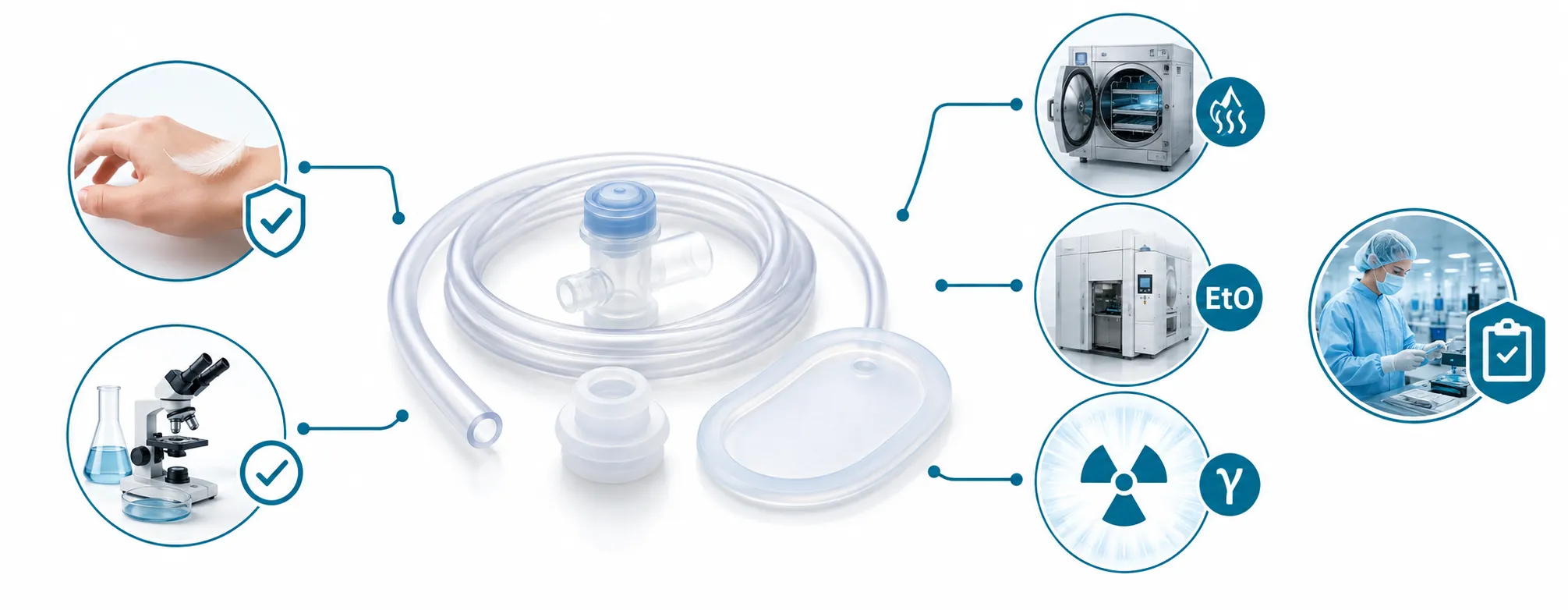
Common Biological Evaluation Areas
| Evaluation area | What it helps assess |
|---|---|
| Cytotoxicity | Potential harmful effects on cultured cells |
| Sensitization | Potential for an allergic or sensitizing response |
| Irritation | Potential for local irritation after contact |
| Systemic toxicity | Potential adverse effects beyond the local contact area |
| Genotoxicity | Potential effects involving genetic material where relevant |
| Implantation response | Local tissue response to an implanted material or device where applicable |
| Hemocompatibility | Interactions with blood for blood-contacting applications where applicable |
| Chemical characterization | Identification and assessment of chemical constituents and potential leachables |
The correct evaluation endpoints depend on the medical device and its intended contact conditions. It is not necessary or appropriate to apply every possible biological test to every device.
What Is USP Class VI Silicone?
USP Class VI is another term frequently encountered when sourcing silicone for medical and pharmaceutical applications.
A silicone supplier may provide material data showing that a particular cured elastomer has been tested according to applicable USP biological testing procedures.
However, USP Class VI should not be treated as a substitute for complete medical-device biological evaluation.
A material having USP Class VI test data does not automatically mean that every finished product made from that material is suitable for every type of patient contact.
ISO 10993 information and USP test information can support material selection, but final device suitability should be determined from the intended use and complete biological risk assessment.
Types of Medical Grade Silicone
Medical silicone is available in several processing forms. The best material depends on part geometry, production volume, mechanical properties and device requirements.
Liquid Silicone Rubber
Medical grade liquid silicone rubber, commonly called LSR, is a pumpable two-component material used in liquid injection molding.
LSR can fill detailed mold cavities and is well suited to automated manufacturing of precision components.
Potential medical applications include seals, valves, membranes, respiratory components, wearable-device parts and other molded healthcare products.
High-Consistency Silicone Rubber
HCR or HTV medical silicone has a firm, gum-like consistency before curing.
It can be extruded or molded into tubing, profiles, seals and other components.
HCR is particularly useful when continuous extrusion or high-consistency molding is required.
Silicone Gel
Silicone gels are softer and less highly crosslinked than conventional silicone rubber.
They can be used where a very soft interface, cushioning or protection of sensitive components is required.
Medical Silicone Adhesive
Specialized silicone adhesives can be used where flexible bonding is required. The exact formulation must be selected according to substrate, body contact and sterilization requirements.
Medical Silicone Tubing Compound
Extrusion-grade silicone compounds can be used to manufacture flexible tubing for fluid-management, respiratory and laboratory applications.
LSR vs HCR Medical Grade Silicone
| Feature | Medical LSR | Medical HCR / HTV |
|---|---|---|
| Uncured form | Pumpable liquid | Firm, gum-like compound |
| Material supply | Normally two components | High-consistency compound |
| Main processing | Liquid injection molding | Extrusion, compression or HCR molding |
| Complex small parts | Very suitable | Depends on tooling and process |
| Continuous tubing | Not normally the first choice | Very suitable |
| Automation | High | Depends on manufacturing system |
| Final form | Solid elastic silicone | Solid elastic silicone |
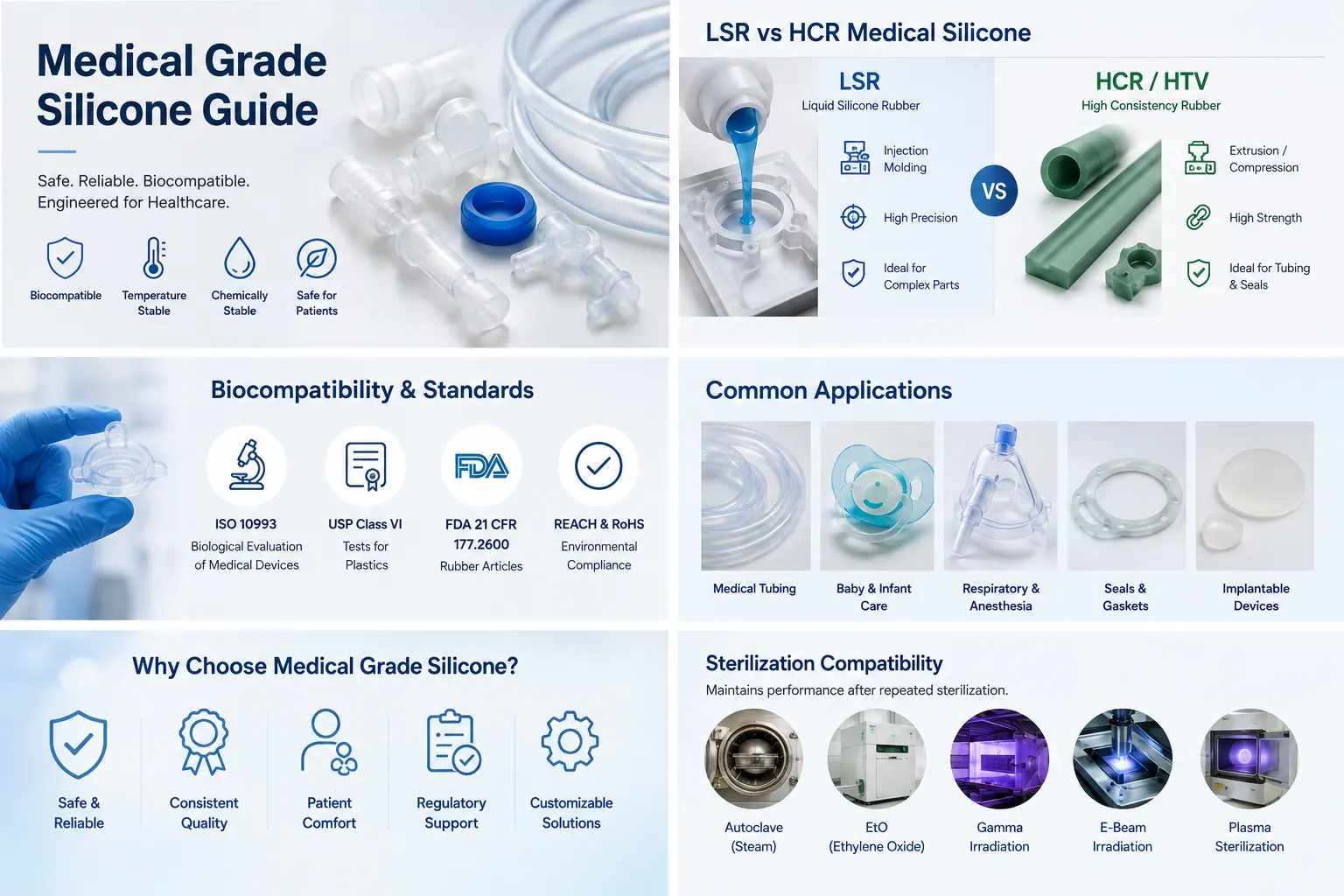
Medical Grade Silicone Properties
The actual properties vary from one compound to another. A medical silicone should therefore be specified using grade-specific technical data rather than generic silicone properties.
Hardness
Medical silicone can be formulated across a broad hardness range. Softer compounds may be suitable for flexible interfaces and seals, while firmer materials may provide improved shape retention.
Tensile Strength
Tensile strength is important for components exposed to stretching, assembly forces or pressure.
Elongation
High elongation can help flexible medical components stretch without rupture, but elongation should be considered together with tear resistance.
Tear Resistance
Tear strength is particularly important for thin membranes, tubing, valves and molded parts that contain small edges or openings.
Compression Set
Compression set matters for seals that must maintain contact pressure for long periods.
Transparency
Clear silicone formulations can be useful where visual inspection of fluids or internal components is required.
Temperature Stability
Silicone offers a relatively broad operating-temperature range, although actual limits vary by compound.
Medical Grade Silicone and Sterilization
Medical devices may be exposed to sterilization before use, and sterilization can affect polymer properties.
The silicone compound and finished component should therefore be evaluated with the actual sterilization process intended for production.
Steam Sterilization
Selected silicone materials can tolerate moist heat, making silicone useful for some reusable medical components.
Repeated sterilization cycles may still affect hardness, color, mechanical properties or bonded interfaces, so reusable products should be validated for the intended number of cycles.
Ethylene Oxide Sterilization
Ethylene oxide is used for medical devices that require a lower-temperature sterilization method.
Where EtO is used, the complete sterilization process and residual requirements must be appropriately controlled.
Radiation Sterilization
Gamma radiation or electron-beam sterilization may be used for some silicone-containing devices.
Radiation can change polymer crosslinking and mechanical properties, so dose and material compatibility should be validated on the finished product.
A silicone material may tolerate a sterilization technology, but the complete device still requires validation using the actual process, dose or cycle conditions.
Medical Silicone Tubing
Medical tubing is one of the most recognizable applications for silicone rubber.
Silicone tubing can provide flexibility, transparency and a smooth surface while being available in a wide variety of dimensions.
Applications can include respiratory systems, laboratory equipment, drainage systems and fluid-transfer equipment depending on the exact material and device qualification.
Extrusion quality is important because wall-thickness variation, contamination, air bubbles or surface defects can affect performance.
Tubing specifications may include:
- Inside diameter
- Outside diameter
- Wall thickness
- Hardness
- Tensile strength
- Elongation
- Transparency
- Pressure capability
- Biological evaluation requirements
- Sterilization requirements
Medical Silicone Seals and Gaskets
Silicone rubber is frequently used for seals, gaskets, diaphragms and valve components in healthcare equipment.
For these applications, compression set can be as important as tensile strength. A seal must continue applying pressure to a mating surface throughout its expected service life.
Seal design should account for hardness, compression level, dimensional tolerance, surface finish and sterilization exposure.
A highly biocompatible material cannot compensate for poor gasket geometry or inadequate compression.
Respiratory and Fluid-Handling Applications
Medical silicone can be used in respiratory masks, breathing-system components, flexible connectors, valves and selected fluid-handling components.
Softness and flexibility can help components conform to complicated geometries and reduce mechanical stress on mating parts.
Material formulation should still be selected according to actual gas or fluid contact, temperature, cleaning agents and sterilization requirements.
Wearable Medical Devices
Wearable healthcare systems may use silicone around sensors, electronics, straps, seals and skin-contact interfaces.
Soft silicone can provide comfort while protecting electronics from moisture and movement.
Skin-contact applications still require consideration of material composition, contact duration, adhesives, colorants and any other materials present in the final device.
The fact that the silicone base has biological test data does not automatically qualify every coating, adhesive, pigment or assembled wearable product.
Medical Silicone for Electronics
Modern medical equipment increasingly contains sensors, batteries and electronic circuits.
Silicone can provide flexible electrical insulation, environmental sealing, potting and mechanical protection.
Silicone gels and encapsulants can also protect sensitive components while accommodating differences in thermal expansion between electronic materials.
For patient-contacting equipment, the silicone used around electronics should be evaluated according to the final device architecture and potential exposure route.
Color and Pigments in Medical Grade Silicone
Medical silicone components can be clear or colored, but pigmentation should be treated as part of the complete formulation.
A pigment or color masterbatch can affect curing, extractables, mechanical performance and biological evaluation.
For critical applications, manufacturers should use color systems specifically approved by the silicone-material supplier for the selected medical grade.
Extractables and Leachables
Medical-device evaluation may require consideration of substances that can migrate out of a polymer material.
Extractables are substances that can be removed from a material under defined laboratory extraction conditions.
Leachables are substances that may migrate from the device under actual or simulated use conditions.
Potential sources can include low-molecular-weight silicone species, processing residues, catalysts, pigments, additives or substances introduced during manufacturing.
For this reason, cleanliness and formulation control can be particularly important in medical silicone applications.
Platinum-Cured Medical Grade Silicone
Many medical LSR and HCR systems use platinum-catalyzed addition curing.
Addition curing can provide controlled processing and avoids some of the decomposition products associated with certain peroxide systems.
However, platinum-cured silicone can be sensitive to cure inhibition.
Substances containing sulfur, certain amines, tin compounds and other incompatible chemicals can interfere with curing.
Manufacturing tools, gloves, mold-release products and processing surfaces should therefore be managed carefully when producing platinum-cured medical silicone components.
Peroxide-Cured Medical Silicone
Peroxide curing is also used for selected high-consistency silicone applications.
The curing system should be chosen according to the material specification, manufacturing process and final medical application.
Some peroxide-cured silicone products use post-curing to reduce volatile residues and stabilize finished properties.
Where post-curing is required, time, temperature, airflow and part configuration should be controlled as part of the validated production process.
Medical Grade Silicone Manufacturing Controls
Material selection is only one part of producing a medical silicone component. Manufacturing can introduce new risks even when the starting silicone has extensive supporting data.
Dust, oils, cleaning chemicals, mold-release agents, incorrect pigments and foreign polymers can contaminate a medical silicone component.
Manufacturing controls may therefore include material traceability, controlled mixing, equipment-cleaning procedures, contamination prevention, curing records and batch inspection.
| Production area | Important control | Possible risk if uncontrolled |
|---|---|---|
| Raw material | Grade and batch identification | Wrong or untraceable compound |
| Storage | Temperature, shelf life and packaging | Changed material behavior |
| Mixing | Correct ratio and contamination control | Incomplete or inconsistent curing |
| Pigmentation | Approved medical color system | Uncontrolled formulation change |
| Molding | Temperature, pressure and cure time | Defects or property variation |
| Post-curing | Validated time and temperature | Inconsistent residual or physical properties |
| Cleaning | Validated cleaning process | Surface contamination |
| Final inspection | Dimensions, defects and traceability | Nonconforming products reaching assembly |
Common Medical Grade Silicone Applications
| Application | Typical silicone function | Important considerations |
|---|---|---|
| Medical tubing | Flexible fluid or gas pathway | Dimensions, cleanliness, flexibility and biological evaluation |
| Respiratory components | Seal, valve, tubing or flexible interface | Gas pathway, cleaning and sterilization |
| Medical seals | Fluid or environmental sealing | Compression set and dimensional stability |
| Wearable devices | Skin interface, seal or electronics protection | Skin contact, comfort and durability |
| Diagnostic equipment | Seal, membrane or molded component | Accuracy, cleanliness and chemical compatibility |
| Electronic medical devices | Electrical insulation and encapsulation | Electrical properties and thermal behavior |
| Implantable components | Specialized long-term material function | Requires specifically qualified material and device evaluation |
How to Choose Medical Grade Silicone
- Define the exact medical device application.
Determine what the silicone component will do in the finished device. - Identify body contact.
Determine whether the component contacts skin, tissue, blood, fluid pathways or has no direct patient contact. - Define contact duration.
Temporary and long-term contact can require different evaluation strategies. - Choose the processing method.
Determine whether LSR injection molding, HCR extrusion, compression molding or another process is appropriate. - Specify mechanical properties.
Review hardness, tensile strength, elongation, tear strength and compression set. - Review biological data.
Confirm which tests have been completed on the exact material grade and under what conditions. - Review chemical characterization.
Determine whether extractables, leachables or material-composition information is required. - Define sterilization.
Confirm steam, EtO, radiation or another sterilization process before final material approval. - Evaluate colorants and additives.
Treat pigments and other formulation additions as part of the complete material. - Review supplier change control.
Understand how raw-material or formulation changes will be communicated. - Run manufacturing trials.
Confirm molding, extrusion, curing and dimensional performance. - Evaluate the finished device.
Do not rely only on the raw-material data sheet for final biological and functional qualification.
Questions to Ask a Medical Silicone Supplier
- What is the exact silicone grade?
- Is the material LSR, HCR, HTV, RTV or silicone gel?
- What healthcare applications is the grade intended for?
- What biological evaluation data are available?
- Which ISO 10993 tests or evaluations have been performed?
- Is USP biological test information available?
- Is the material intended for implantation?
- Are there restrictions on implant duration?
- Which sterilization methods have been evaluated?
- What post-curing conditions are recommended?
- Which pigments or additives are approved?
- What material traceability is provided?
- What shelf life and storage conditions apply?
- How are formulation changes controlled?
- Can the supplier provide lot-specific certificates?
Common Medical Silicone Selection Mistakes
Assuming “Medical Grade” Is Enough
The words medical grade do not establish suitability for every medical device or contact type.
Using USP Class VI as the Only Requirement
USP test data can be useful, but it should not automatically replace device-specific biological evaluation.
Using a Non-Implant Grade for an Implant
Implantable applications require materials and evaluation appropriate to the actual implantation conditions.
Ignoring Sterilization
Sterilization can change mechanical, chemical or surface properties and should be considered during material selection.
Changing Pigment Without Requalification
Colorants are part of the formulation and can change chemical or biological characteristics.
Assuming Clear Silicone Is Cleaner
Transparency is a visual characteristic and does not prove medical suitability or biological safety.
Ignoring Manufacturing Contamination
A qualified material can still produce an unsuitable finished component if processing introduces contamination or uncontrolled residues.
Testing Only the Raw Material
The finished device may contain processing residues, adhesives, coatings, inks, pigments and other materials that are not represented by the raw silicone test specimen.
Medical Grade Silicone Standards and References
Several standards may be relevant when developing silicone-containing medical devices. Which standards apply depends on the device, market and manufacturing process.
| Reference | Main relevance |
|---|---|
| ISO 10993-1 | Framework for biological evaluation of medical devices within risk management |
| ISO 10993-5 | In-vitro cytotoxicity testing |
| ISO 10993-18 | Chemical characterization of medical-device materials |
| ISO 10993-23 | Irritation testing |
| ASTM F2038 | Guidance for silicone elastomers, gels and foams used in medical applications — formulations and uncured materials |
| ASTM F2042 | Guidance for medical silicone elastomers, gels and foams — crosslinking and fabrication |
| ISO 11135 | Ethylene oxide sterilization process requirements |
| ISO 11137 | Radiation sterilization process requirements |
| ISO 17665 | Moist-heat sterilization process requirements |
Frequently Asked Questions
What is Medical Grade Silicone?
Medical Grade Silicone generally refers to silicone materials manufactured and documented for healthcare applications. Suitability must still be assessed for the exact medical device and body-contact conditions.
Is Medical Grade Silicone biocompatible?
Specific medical silicone grades may have supporting biological evaluation data, but biocompatibility should be assessed in relation to the intended use and finished medical device.
Is Medical Grade Silicone FDA approved?
The phrase “FDA approved silicone” can be misleading when applied generically to a raw material. Medical-device regulatory status applies within a specific device and intended-use context, so supplier documentation and finished-device requirements should be reviewed carefully.
Is Medical Grade Silicone the same as food grade silicone?
No. Food-contact suitability and medical-device biological suitability address different applications and requirements.
Is USP Class VI silicone Medical Grade Silicone?
USP Class VI test information may support material evaluation, but it does not automatically qualify a silicone for every medical device or replace device-specific biological evaluation.
Can Medical Grade Silicone be implanted?
Only silicone specifically intended and evaluated for the relevant implantation application should be considered. A general medical silicone grade should not automatically be used for implantation.
Can Medical Grade Silicone be sterilized?
Many medical silicone materials can be compatible with sterilization processes, but the exact grade and finished device should be validated using the intended sterilization method and conditions.
What is medical grade LSR?
Medical grade LSR is a liquid silicone rubber formulation intended for healthcare applications and normally processed by automated liquid injection molding.
What is medical grade HCR silicone?
Medical HCR is a high-consistency silicone rubber that can be extruded or molded into tubing, seals and other healthcare components.
Why is platinum-cured silicone used in medical products?
Platinum addition-cure systems are widely used because they provide controlled crosslinking and are suitable for many high-quality medical silicone formulations, although the exact grade and device still require appropriate evaluation.
How do I choose Medical Grade Silicone?
Start with device function, body contact and contact duration, then evaluate biological data, mechanical properties, processing method, sterilization compatibility, supplier controls and finished-device requirements.