
Rubber Insulation for Electrical Applications: Material Selection Guide
Rubber insulation is widely used in electrical systems because elastomeric materials can combine electrical resistance with flexibility, sealing performance, mechanical durability and resistance to environmental stress. However, not every rubber compound is suitable for the same electrical application. Silicone rubber, EPDM, neoprene and other elastomers differ significantly in heat resistance, weathering, dielectric behavior, processing and long-term reliability.
This guide explains how to select rubber insulation for electrical applications, with particular attention to high-voltage systems, wire and cable, composite insulators, electrical molded parts and EV components.
What Is Rubber Insulation?
Rubber insulation is an elastomeric material used to reduce unwanted electrical current flow between conductive components or between a conductor and its surroundings. Depending on the application, the rubber may also provide mechanical protection, sealing, flexibility, environmental resistance and thermal durability.
In electrical equipment, rubber insulation may appear as cable insulation, connector seals, boots, sleeves, molded housings, gaskets, insulator housings or other components surrounding conductive parts.
The term can create some confusion because rubber insulation is also used in the construction and HVAC industries to describe thermal insulation foam around pipes. Electrical rubber insulation is different. Its primary purpose is electrical isolation, although thermal, environmental and mechanical performance may also be important.
Why Rubber Is Used for Electrical Insulation
Many rubber materials are naturally poor electrical conductors, which makes them useful as insulating materials when properly formulated. The polymer structure and filler system can create very high resistance to electrical current.
Rubber also offers an advantage that rigid insulation materials cannot always provide: flexibility. Electrical systems often need components that bend, seal, absorb movement or withstand vibration without cracking.
Electrical Resistance
Properly formulated insulating rubber can provide high volume resistivity and strong resistance to electrical breakdown.
Flexibilidade
Rubber can bend and deform without losing its ability to provide mechanical protection and insulation.
Environmental Protection
Suitable compounds can withstand heat, moisture, UV exposure, ozone and outdoor weathering.
These characteristics explain why rubber electrical insulation remains important in cable systems, power equipment, high-voltage accessories, transportation and industrial electrical products.
Which Rubber Materials Are Used for Electrical Insulation?
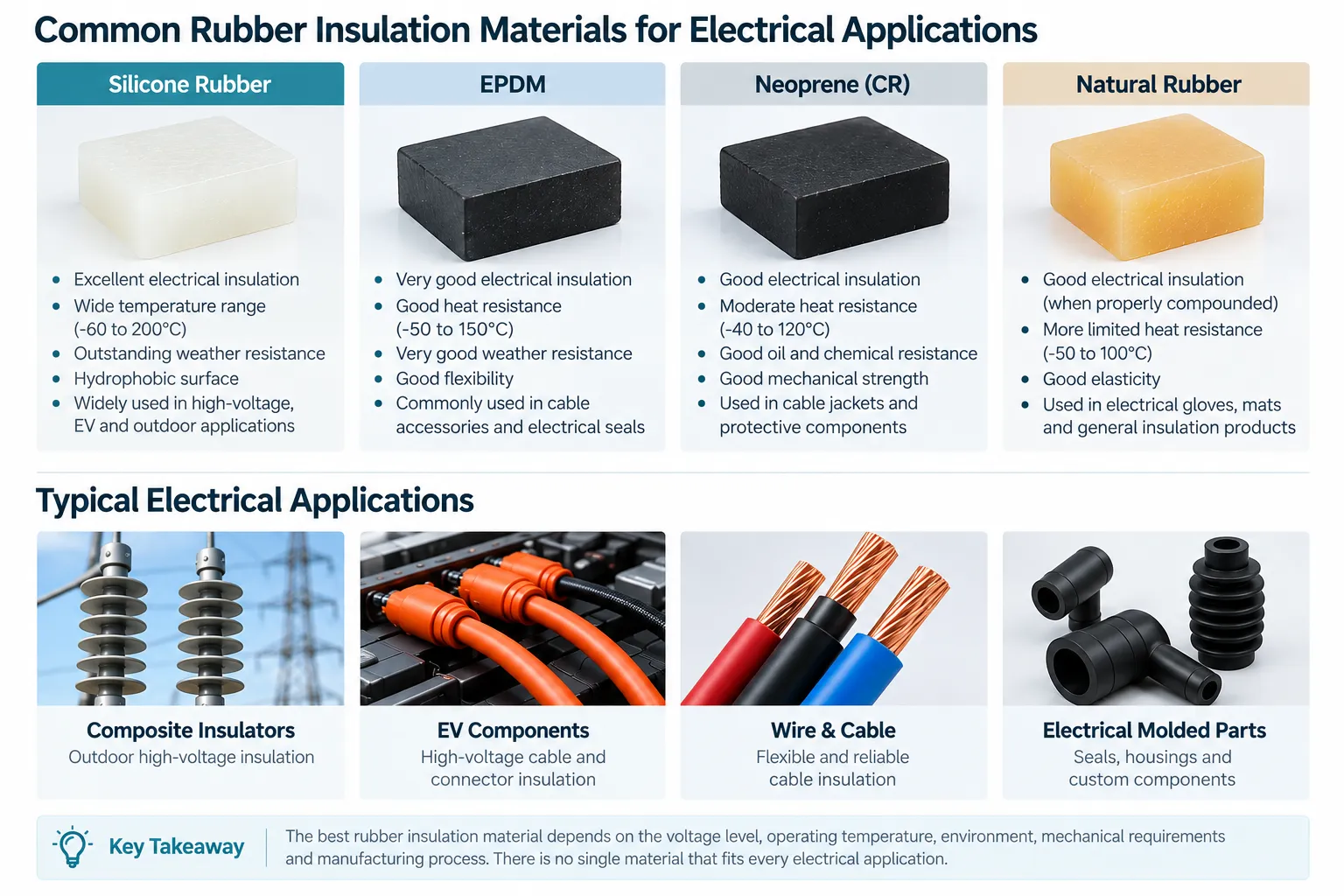
Several elastomer families can be used as electrical insulation materials. The correct choice depends on voltage level, operating temperature, outdoor exposure, mechanical requirements, chemical environment and manufacturing process.
| Material | Isolamento elétrico | Heat Resistance | Outdoor Performance | Typical Electrical Uses |
|---|---|---|---|---|
| Borracha de silicone | Excelente | Excelente | Excelente | Composite insulators, high-voltage cable, cable accessories, EV components |
| EPDM | Very good | Good | Very good | Cable accessories, connectors, electrical seals |
| Neoprene / CR | Good | Moderado | Good | Cable jackets, protective electrical components |
| Borracha natural | Good when properly compounded | More limited | More limited | Electrical gloves, mats and traditional insulating products |
For high-temperature, outdoor and high-voltage applications, silicone rubber insulation is especially important because it combines electrical insulation with thermal stability, hydrophobicity and weather resistance.
Silicone Rubber Insulation
Silicone rubber has become one of the most important elastomers for demanding electrical insulation. Its siloxane polymer backbone gives it a different combination of thermal and environmental properties from conventional organic rubbers.
Electrical-grade silicone rubber can maintain useful flexibility over a wide temperature range while providing high resistivity and stable dielectric behavior. It also performs well in outdoor environments where UV radiation, moisture and temperature cycling are present.
These characteristics make silicone rubber suitable for applications such as composite insulators, surge arresters, cable accessories, high-voltage cables, electrical connectors and EV components.
Why Silicone Rubber Is Widely Used in Electrical Systems
Silicone Rubber vs EPDM for Electrical Insulation
Silicone rubber and EPDM are both widely used in electrical applications, but they are not interchangeable in every situation.
EPDM offers strong weathering resistance and good electrical properties and is widely used in cable accessories and electrical sealing. Silicone rubber is often selected when high-temperature performance, hydrophobic surface behavior and long-term outdoor electrical insulation are especially important.
| Propriedade | Borracha de silicone | EPDM |
|---|---|---|
| Isolamento elétrico | Excelente | Very good |
| High-Temperature Performance | Excelente | Good |
| Outdoor Weathering | Excelente | Very good |
| Hydrophobic Surface Behavior | Strong advantage in many outdoor applications | Good but different surface behavior |
| Flexibility at Temperature Extremes | Excelente | Good |
| Typical High-Voltage Use | Composite insulators, cable systems, arresters | Cable accessories, seals and insulation components |
The best choice depends on voltage level, temperature, outdoor exposure, mechanical stress and cost requirements rather than on one property alone.
Rubber Insulation for High-Voltage Applications
High-voltage insulation is much more demanding than ordinary electrical isolation. The material may be exposed to electric fields, surface contamination, moisture, corona activity, thermal cycling and long-term environmental stress.
For this reason, a high-voltage rubber insulation material must be evaluated not only by dielectric strength but also by long-term surface and mechanical performance.
| Propriedade | Why It Matters in High Voltage |
|---|---|
| Rigidez dielétrica | Indicates resistance to electrical breakdown under defined test conditions. |
| Resistividade volumétrica | Measures resistance to current passing through the bulk material. |
| Acompanhamento da resistência | Important when contamination and moisture create leakage current across the surface. |
| Resistência à erosão | Helps the surface withstand repeated discharge and thermal stress. |
| Hidrofobicidade | Reduces formation of continuous conductive water films on outdoor surfaces. |
| Heat Aging | Shows whether mechanical and electrical properties remain stable over time. |
This is why silicone rubber is widely associated with modern outdoor high-voltage insulation. The complete compound formulation determines whether the material can maintain hydrophobicity, mechanical strength and resistance to tracking and erosion over long service periods.
Rubber Insulation for Composite Insulators
Composite insulators are one of the most demanding applications for silicone rubber. The outer housing surrounds a load-bearing core and protects the structure from environmental and electrical stress.
The silicone rubber housing must tolerate rain, pollution, UV radiation, temperature changes and electrical leakage currents while maintaining useful surface properties.
For composite insulator manufacturers, the material selection normally involves a balance between electrical and mechanical properties rather than maximizing one value.
Electrical Requirements
Tracking resistance, erosion resistance, dielectric properties and hydrophobic surface behavior are important for outdoor insulation.
Mechanical Requirements
Tear strength, tensile strength and elongation help the housing survive molding, assembly and long-term service.
Environmental Requirements
UV, moisture, ozone, pollution and temperature cycling must be considered for outdoor installations.
Processing Requirements
The compound needs stable molding behavior so the housing can be produced consistently around the insulator core.
For a deeper discussion of this application, see silicone rubber in high-voltage applications.
Rubber Insulation for Wire and Cable
Wire and cable applications place different demands on rubber insulation. The material must provide electrical isolation while also surviving continuous flexing, heat exposure, extrusion and installation stress.
Silicone rubber is commonly used where higher temperature capability and flexibility are required. It can be processed into insulation layers, sleeves, tubing and other cable-related components.
For cable manufacturers, material performance during extrusion can be just as important as cured electrical properties.
| Cable Requirement | What Buyers Should Evaluate |
|---|---|
| Isolamento elétrico | Dielectric strength and volume resistivity |
| Extrusion Stability | Consistent feeding, dimensional control and surface quality |
| Flexibilidade | Ability to bend without cracking or losing integrity |
| Heat Aging | Retention of tensile strength and elongation after thermal exposure |
| Surface Quality | Absence of contamination, agglomerates and extrusion defects |
A cable-grade rubber insulation compound therefore needs to be evaluated as both an electrical material and a processing material.
Rubber Insulation in EV and Automotive Electrical Systems
The growth of higher-voltage electrical systems in vehicles has increased the importance of insulation materials that can handle heat, vibration, sealing and electrical stress at the same time.
Silicone rubber may be used in cable systems, connector seals, high-voltage boots, gaskets and other components within EV power systems.
These applications may require a combination of electrical resistance, compression performance, thermal aging, tear strength and flexibility. The compound must also remain compatible with high-volume manufacturing methods.
For EV projects, material selection should be based on the actual voltage environment, temperature cycle, mechanical loading and production process rather than simply specifying “high-voltage silicone.”
How Temperature Affects Rubber Electrical Insulation
Electrical insulation does not operate independently from temperature. Heat can gradually change rubber hardness, elongation, tensile strength and compression behavior. These changes may eventually affect the electrical component even if the material initially passes dielectric testing.
When comparing rubber insulation materials, distinguish between continuous service temperature and short-duration thermal peaks.
Silicone rubber is especially useful where long-term temperature exposure would cause faster aging in many conventional rubber materials.
Important Electrical Properties to Check
When purchasing electrical rubber insulation, buyers should look beyond generic claims such as “excellent insulation.” The useful specification depends on measurable properties and clearly defined test conditions.
| Electrical Property | What It Indicates | Buyer Consideration |
|---|---|---|
| Rigidez dielétrica | Ability to resist electrical breakdown | Check specimen thickness and test method |
| Resistividade volumétrica | Resistance to current through the material | Confirm test conditions and minimum value |
| Surface Resistivity | Resistance to current flowing along the surface | Important in surface-sensitive applications |
| Constante dielétrica | Material response to an electrical field | May influence electrical design and field distribution |
| Acompanhamento da resistência | Resistance to conductive path formation on the surface | Important for contaminated or wet high-voltage environments |
These values should always be interpreted together with the relevant test method rather than compared as isolated numbers.
Mechanical Properties Also Matter
Electrical insulation can fail because of mechanical damage long before the polymer loses its fundamental insulating properties. Tear, cracking, compression and abrasion can expose conductive parts or create weak points in the insulation system.
For this reason, electrical rubber insulation specifications frequently include mechanical requirements alongside electrical values.
Resistência ao rasgo
Important for thin housings, molded edges, cable components and parts removed from complex molds.
Resistência à tração
Shows how much tensile stress the cured rubber can withstand before failure.
Elongation
Indicates the ability of the material to stretch and accommodate movement before breaking.
Why Hydrophobicity Matters for Outdoor Insulation
Outdoor insulation surfaces are exposed to rain, fog, dust and industrial pollution. If a continuous conductive water layer develops across the surface, leakage current may increase.
Silicone rubber has an important advantage in this environment because its surface is naturally hydrophobic. Water tends to form droplets rather than a continuous film.
In some silicone systems, low-molecular-weight silicone species can also migrate toward the surface and help restore hydrophobic behavior after contamination or surface stress.
This characteristic is especially valuable in composite insulators and other outdoor high-voltage components where surface electrical performance is critical.
What Causes Rubber Insulation to Fail?
Rubber electrical insulation can fail for many reasons, and the root cause is not always insufficient dielectric strength.
| Failure Mechanism | Possible Result |
|---|---|
| Long-Term Heat Aging | Hardening, cracking or loss of elongation |
| Electrical Tracking | Formation of conductive surface paths |
| Surface Erosion | Gradual loss of insulation material |
| UV and Weathering | Surface degradation and property changes |
| Mechanical Damage | Tears, cuts or exposed conductive areas |
| Poor Processing | Voids, contamination, weak areas or dimensional variation |
| Incorrect Material Selection | Premature failure under temperature, voltage or environmental stress |
This is why material selection, formulation and manufacturing quality must be considered together.
HTV and HCR Silicone Rubber for Electrical Insulation
HTV and HCR silicone rubber are widely used when manufacturers need a high-consistency silicone compound for molding or extrusion.
HTV refers to high-temperature vulcanizing silicone, while HCR refers to high consistency rubber. In many industrial contexts, the two terms describe the same general family of solid, gum-like silicone compounds cured at elevated temperature.
Electrical-grade HTV/HCR silicone rubber can be formulated for applications including composite insulators, cable systems, surge arresters and molded electrical components.
The formulation may be adjusted around hardness, tensile strength, elongation, tear strength, dielectric properties, tracking resistance, erosion resistance and processing behavior.
You can learn more about how these compounds are produced in our guide to the HTV silicone rubber manufacturing process.
How to Choose Rubber Insulation for an Electrical Project
The correct rubber insulation material should be selected from the complete operating environment rather than from one performance number.
What Should Buyers Include in an RFQ?
A detailed RFQ makes it easier for a rubber insulation supplier to recommend an appropriate material rather than simply quoting a generic grade.
How to Evaluate a Rubber Insulation Supplier
For electrical applications, supplier selection should consider more than price per kilogram. Material consistency and technical support can have a direct effect on production efficiency and long-term insulation performance.
| Supplier Capability | What Buyers Should Check |
|---|---|
| Seleção de materiais | Can the supplier recommend grades based on the actual electrical application? |
| Electrical Testing | Are relevant electrical properties measured and documented? |
| Consistência do lote | Are hardness, mechanical and electrical properties controlled consistently? |
| Processing Support | Can the supplier discuss molding or extrusion problems during qualification? |
| Personalização | Can hardness, color or functional properties be adjusted if required? |
| Documentation | Are TDS, SDS, CoA and project-specific test reports available where applicable? |
Electrical Silicone Rubber from Yakows
Yakows supplies HTV/HCR silicone rubber compounds for electrical and industrial applications, including composite insulators, wire and cable, high-voltage components, EV systems and molded electrical parts.
Electrical applications often require a balance between dielectric performance, mechanical properties, heat resistance and processing behavior. For that reason, material selection should begin with the final component and production process rather than hardness alone.
Buyers can provide the intended application, molding or extrusion method, target Shore A hardness, electrical requirements, mechanical properties and estimated production volume so that a suitable silicone rubber compound can be evaluated.
Perguntas frequentes
A borracha é um bom isolante elétrico?
Many properly formulated rubber materials are excellent electrical insulators because they have high electrical resistance. The exact performance depends on polymer type, fillers, formulation and operating conditions.
Which rubber is best for electrical insulation?
There is no single best rubber for every electrical application. Silicone rubber is especially useful for high-temperature, outdoor and high-voltage applications, while EPDM is also widely used in electrical and cable systems.
Is silicone rubber electrically insulating?
Standard silicone rubber is generally highly electrically insulating. Specialized conductive silicone compounds can also be produced using conductive fillers.
Why is silicone rubber used in high-voltage insulation?
Silicone rubber can combine high electrical resistivity with hydrophobicity, weather resistance, heat resistance and flexibility, making it suitable for demanding outdoor high-voltage environments.
What is the difference between rubber insulation and rubber foam insulation?
Electrical rubber insulation is designed primarily to resist electrical current. Rubber foam insulation used around pipes is generally intended for thermal insulation and condensation control. The two products serve different functions.
Is silicone rubber better than EPDM for electrical insulation?
It depends on the application. Silicone rubber typically provides advantages in high-temperature performance and hydrophobic outdoor insulation, while EPDM also offers very good electrical and weathering properties.
What properties should I check when buying electrical rubber insulation?
Important properties can include dielectric strength, volume resistivity, hardness, tensile strength, elongation, tear strength, heat aging, tracking resistance and erosion resistance depending on the application.