
Silicone Material Comparison
Difference Between HTV & RTV Silicone
HTV silicone and RTV silicone belong to the same broad silicone elastomer family, but they are designed for very different manufacturing methods and applications. HTV silicone normally requires heat for vulcanization and is widely used for extrusion and molding, while RTV silicone can cure at or near room temperature and is commonly used for sealing, bonding, coating, potting and moldmaking.
What Is the Difference Between HTV and RTV Silicone?
The main difference between HTV silicone and RTV silicone is how they are processed and cured.
HTV means high-temperature vulcanizing. HTV silicone is normally a high-consistency, gum-like rubber compound that is shaped first and then cured with heat. It is commonly used in extrusion, compression molding, transfer molding, calendering and specialized injection-molding processes.
RTV means room-temperature vulcanizing. RTV silicone is usually supplied as a liquid, paste or pourable material that can be applied directly to a component, joint, mold or electronic assembly. It then cures at room temperature or with relatively mild heating.
HTV silicone is mainly a heat-cured manufacturing rubber, while RTV silicone is mainly an in-place curing silicone used for sealing, bonding, casting, coating and encapsulation.
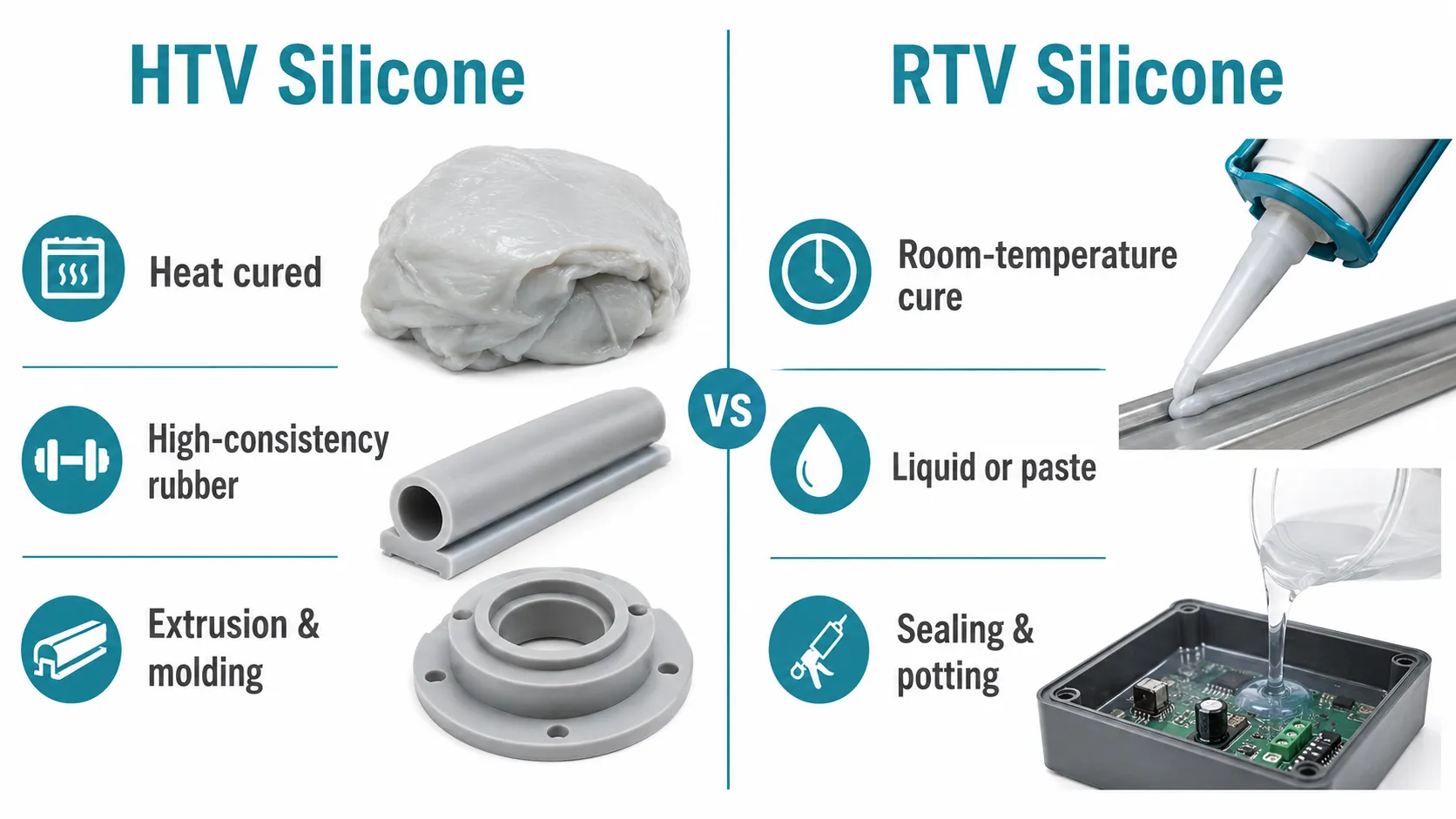
HTV Silicone vs RTV Silicone at a Glance
| Recurso | HTV Silicone | Silicone RTV |
|---|---|---|
| Full name | High-Temperature Vulcanizing Silicone | Room-Temperature Vulcanizing Silicone |
| Typical uncured form | Firm, gum-like high-consistency compound | Liquid, paste or pourable compound |
| Método principal de cura | Cura por calor | Cura à temperatura ambiente |
| Typical processing | Extrusion, compression molding, transfer molding and calendering | Dispensing, casting, sealing, coating and potting |
| Typical production style | Factory manufacturing | In-place or assembly-stage curing |
| Tooling | Usually requires dies, molds or processing equipment | Often requires little or no high-pressure tooling |
| Production volume | Well suited to industrial production | Common in assembly, repair and lower-volume processing |
| Produtos típicos | Tubing, profiles, seals, gaskets and electrical insulation | Sealants, adhesives, molds, encapsulants and coatings |
| Final state | Elastic solid rubber | Elastic solid or soft elastomer after cure |
What Is HTV Silicone?
HTV silicone is a heat-cured silicone rubber normally supplied as a high-consistency compound. It is also commonly referred to as HCR, or high-consistency rubber.
Before curing, HTV silicone has a firm, gum-like consistency. It does not normally flow under its own weight like a liquid silicone. The material can be cut into preforms, rolled into sheets, extruded through a die or mechanically fed into molding equipment.
Heat activates the curing system and creates permanent crosslinks between silicone polymer chains. After curing, the compound becomes a flexible thermoset elastomer.
Common HTV Silicone Processing Methods
- Extrusão
- Moldagem por compressão
- Moldagem por transferência
- High-consistency rubber injection molding
- Calandragem
- Fabric coating and laminating
Common HTV Silicone Products
HTV silicone is widely used to manufacture tubing, profiles, gaskets, O-rings, cable insulation, electrical parts, automotive seals, industrial components and high-voltage silicone rubber housings.
What Is RTV Silicone?
RTV silicone is a silicone material designed to cure at room temperature without the high processing temperatures normally associated with HTV rubber manufacturing.
RTV silicone can be supplied as a one-component or two-component system. Before curing, it may be a thick paste, flowable liquid or pourable compound depending on the formulation.
After application, the RTV material chemically crosslinks and becomes an elastic silicone rubber.
Common RTV Silicone Applications
- Construction and industrial sealing
- Bonding and assembly
- Electronic potting
- Electrical encapsulation
- Conformal coating
- Prototype moldmaking
- Gasket forming
- Repair and maintenance
One-Part and Two-Part RTV Silicone
RTV silicone is commonly divided into one-component and two-component systems.
One-Part RTV Silicone
One-part RTV silicone is supplied ready to use. The material is normally dispensed directly from a tube, cartridge or automated system.
Many one-component RTV materials react with atmospheric moisture. The curing reaction begins at the exposed surface and progresses inward.
This makes one-part RTV convenient for beads, joints and relatively thin sections, but thick enclosed sections may cure slowly because moisture must reach the material.
Two-Part RTV Silicone
Two-part RTV silicone contains separate A and B components. When the components are mixed in the specified ratio, a chemical reaction begins throughout the material.
This allows thicker sections and cast components to cure more uniformly than moisture-dependent one-part systems.
Two-part RTV is widely used for moldmaking, potting, encapsulation and industrial casting.
Curing Systems: HTV vs RTV Silicone
The curing chemistry has a major influence on manufacturing, final properties and compatibility with nearby materials.
| Curing system | Common material | Main characteristics |
|---|---|---|
| Peroxide cure | HTV silicone | Widely used for industrial extrusion and molding |
| Platinum addition cure | HTV and selected RTV systems | Controlled crosslinking with limited decomposition by-products |
| Moisture condensation cure | One-part RTV silicone | Cures from atmospheric moisture |
| Two-part condensation cure | RTV silicone | Mixing two components starts the curing reaction |
| Two-part addition cure | RTV silicone | Can provide controlled curing with low shrinkage |
Physical Form Before Curing
One of the easiest ways to understand the difference between HTV and RTV silicone is to compare how the materials feel before curing.
HTV silicone is normally similar to soft gum or putty with very high viscosity. It can be mechanically shaped but does not pour easily.
RTV silicone is generally much more flowable. Some grades are thick pastes suitable for sealing vertical joints, while others are low-viscosity liquids suitable for casting or potting.
Temperature Performance
Both HTV silicone and RTV silicone can provide good temperature resistance, but the actual service range depends on the individual formulation.
Many general silicone elastomers are used over a broad temperature range compared with conventional organic rubbers. Specialized grades may be formulated for even more demanding thermal environments.
HTV silicone is often selected for components that require stable mechanical performance during long-term industrial service, such as cable insulation, molded seals and high-temperature profiles.
RTV silicone may also provide excellent temperature resistance, but the maximum service temperature can vary significantly between sealants, adhesives, encapsulants and specialty RTV compounds.
Always use the continuous and short-term temperature limits specified for the exact HTV or RTV silicone product.
Propriedades mecânicas
HTV silicone is generally selected when the finished product requires controlled mechanical properties and repeatable industrial manufacturing.
Its formulation can be optimized for tensile strength, elongation, tear strength, hardness and compression-set performance.
RTV silicone can also provide good elasticity, but its formulation is often optimized for other characteristics such as adhesion, flow, pot life, cure speed or encapsulation behavior.
| Propriedade | HTV Silicone | Silicone RTV |
|---|---|---|
| Mechanical consistency | Highly controllable for molded and extruded products | Varies widely by sealant, casting and potting formulation |
| Tear resistance | Can be formulated for demanding molded parts | Depends strongly on RTV type |
| Compression set | Important for molded seals and gaskets | Important for formed-in-place gaskets and sealants |
| Adhesion | Not necessarily designed to bond directly to substrates | Many grades are specifically formulated for adhesion |
Adhesion: A Major RTV Advantage
RTV silicone is frequently chosen because it can be applied directly to a substrate and cured in place.
Special RTV adhesives and sealants are designed to bond to materials such as glass, aluminum, steel, ceramics and selected plastics.
Some substrates still require cleaning, plasma treatment, corona treatment or primer to achieve reliable long-term adhesion.
HTV silicone, by comparison, is more often molded or extruded as an independent rubber component. Bonding HTV silicone to metal, plastic or FRP usually requires a carefully designed primer or overmolding system.
HTV and RTV Silicone for Electrical Insulation
Both HTV silicone and RTV silicone can be formulated for electrical insulation, but they are used in different ways.
HTV silicone is commonly used where the insulation itself is a manufactured rubber component. Examples include wire insulation, cable profiles, boots, connector components and high-voltage housings.
RTV silicone is commonly used where the silicone must be applied directly to an electrical assembly. Examples include potting, encapsulation, conformal coating, sealing and bonding.
| Electrical application | HTV Silicone | Silicone RTV |
|---|---|---|
| Wire insulation | Very suitable | Not normally used for continuous wire extrusion |
| Cable profiles | Very suitable | Limited |
| Molded electrical seals | Suitable | Possible for formed-in-place sealing |
| Electronic potting | Not usually the primary choice | Very suitable |
| Conformal coating | Não é típico | Suitable |
| Electrical bonding | Requires specialized process | Amplamente utilizado |
HTV Silicone in Composite Insulators
High-voltage composite insulators are an important application of specialized HTV silicone.
A composite insulator normally contains a fiberglass-reinforced polymer core covered by a silicone rubber housing and weather sheds.
The silicone housing provides external electrical insulation and protects the FRP core from moisture, ultraviolet radiation and environmental exposure.
High-voltage HTV silicone compounds can be formulated for hydrophobicity, tracking and erosion resistance, weather resistance and strong mechanical properties.
During production, the silicone housing is molded around the prepared FRP core. Reliable bonding between the silicone, primer and FRP surface is essential.
Why HTV Is Suitable for Composite Insulators
- Good outdoor weather resistance
- Hydrophobic surface
- Isolamento elétrico
- Tracking and erosion resistance in suitable grades
- UV and ozone resistance
- Low-temperature flexibility
- Suitable mechanical properties for weather sheds
- Industrial molding capability
RTV Silicone in High-Voltage Applications
RTV silicone is also important in the electrical power industry, but it normally serves a different role from molded HTV composite-insulator housings.
RTV silicone coatings can be applied to existing ceramic or glass electrical insulation to modify surface behavior and improve hydrophobicity.
RTV materials may also be used for sealing, bonding and protective applications around electrical equipment.
The formulation must be specifically designed for the electrical environment. General construction RTV should not automatically be treated as a high-voltage insulation material.
HTV silicone is commonly molded into the actual composite-insulator housing, while specialized RTV silicone may be applied as a coating, sealant or protective material.
HTV and RTV Silicone in Automotive Applications
Both materials are used in automotive and new energy vehicle applications.
HTV Silicone Automotive Applications
- Isolamento de fios e cabos
- Molded seals and gaskets
- Connector components
- Hoses and tubing
- High-temperature profiles
- Battery and electrical components
RTV Silicone Automotive Applications
- Formed-in-place gaskets
- Electronic sealing
- Sensor protection
- Power-electronics potting
- Adhesive bonding
- Housing sealing
Manufacturing Differences
HTV Manufacturing
HTV silicone manufacturing normally requires dedicated processing equipment. Extruders, heated molds, calenders and other machinery are used to shape the uncured rubber.
Temperature, pressure, compound preparation and curing time must be controlled carefully.
This approach is well suited to repeatable industrial production.
RTV Manufacturing
RTV processing is generally simpler from a tooling perspective. The material can be manually or automatically dispensed directly into or onto the final assembly.
Important process variables include mixing ratio, dispensing accuracy, pot life, cure depth, humidity, temperature and surface cleanliness.
RTV is particularly useful when the silicone must conform to the geometry of an existing component rather than being manufactured as a separate molded part.
Velocidade de produção
HTV silicone can support high production rates once the molding or extrusion process is established. Continuous extrusion is particularly efficient for tubing, wire insulation and profiles.
RTV curing is often slower because the material is designed to crosslink at or near room temperature.
One-part moisture-cure RTV can require considerable time for deep sections because curing progresses inward from the exposed surface.
Two-part RTV systems can cure more uniformly and may offer adjustable pot life and demolding time.
Tooling and Equipment Requirements
| Requirement | HTV Silicone | Silicone RTV |
|---|---|---|
| Heated mold | Comum | Usually not required |
| Extruder | Common for profiles and tubing | Não é típico |
| Metering system | Depends on process | Common for two-part RTV |
| Dispensing equipment | Not normally the main process | Very common |
| High molding pressure | Often required | Usually not required |
| Room-temperature cure area | Not normally needed | Comum |
Advantages of HTV Silicone
- Suitable for extrusion and mass production
- Good mechanical property control
- Available in many hardness levels
- Suitable for molded seals and structural rubber components
- Excellent weather and temperature performance in appropriate grades
- Widely used for electrical insulation
- Can be formulated for high-voltage applications
- Well suited to continuous profiles and tubing
Advantages of RTV Silicone
- Cures without high-temperature molding equipment
- Can be applied directly to an assembly
- Excellent for sealing and bonding
- Useful for complex cavities
- Suitable for electronic potting
- Available as one-part and two-part systems
- Useful for repair and maintenance
- Can form custom gaskets in place
Limitations of HTV Silicone
HTV processing normally requires more equipment and tooling than RTV silicone. Heated molds, extrusion lines or specialized molding systems may be necessary.
Changing component geometry may also require new tooling.
HTV silicone is therefore not always economical for one-off sealing or repair applications.
Direct adhesion to substrates may also require primers or specialized overmolding processes.
Limitations of RTV Silicone
RTV silicone can have slower cure times than heat-cured silicone manufacturing systems.
Moisture-cure materials may have limitations in deep or enclosed sections.
RTV sealants may also have lower mechanical strength than silicone compounds specifically developed for industrial molded rubber parts.
Certain curing systems release chemical by-products during cure, which may be important around sensitive electronics or metals.
For this reason, the exact RTV curing chemistry should be checked rather than treating all RTV products as interchangeable.
HTV vs RTV vs LSR Silicone
Liquid silicone rubber, or LSR, is another important silicone category and is sometimes confused with RTV because both may begin in a liquid state.
| Recurso | HTV / HCR | LSR | RTV |
|---|---|---|---|
| Forma não curada | High-consistency gum | Pumpable liquid | Líquido ou pasta |
| Typical cure | Heat | Heat | Temperatura ambiente |
| Main processing | Extrusion and molding | Moldagem por injeção de líquido | Dispensing and casting |
| Automation | Medium to high | Very high | Low to high depending on dispensing system |
| Typical use | Profiles, tubing and molded components | Precision molded parts | Sealing, bonding, potting and coating |
How to Choose Between HTV and RTV Silicone
- Define the product form. Determine whether you need a molded rubber part, continuous profile, sealant, coating or potting material.
- Consider production volume. HTV is often better for repeated manufacturing, while RTV can be practical for assembly-stage processing.
- Review tooling. Determine whether heated molds or extrusion equipment are available.
- Define curing requirements. Decide whether room-temperature curing or heat curing is more practical.
- Check mechanical properties. Compare hardness, tensile strength, elongation, tear strength and compression set.
- Evaluate adhesion. RTV may be preferred where direct bonding to a substrate is required.
- Review temperature conditions. Use the actual continuous and peak temperature limits of the selected product.
- Check electrical requirements. Select an electrical-grade formulation where insulation is required.
- Evaluate chemicals and moisture. Confirm compatibility with the actual operating environment.
- Consider cure by-products. This can be important for electronics and corrosion-sensitive components.
- Run application testing. Evaluate the cured silicone in the finished component rather than relying only on material data.
When Should You Choose HTV Silicone?
HTV silicone is generally the better choice when the product must be manufactured as a defined rubber component.
Typical examples include:
- Extruded tubing
- Isolamento de fios e cabos
- Continuous sealing profiles
- Compression-molded gaskets
- Electrical insulation components
- Composite-insulator housings
- Automotive molded seals
- Industrial high-temperature components
When Should You Choose RTV Silicone?
RTV silicone is usually more suitable when the silicone must cure directly on or around the final component.
Typical examples include:
- Formed-in-place gaskets
- Building and industrial sealants
- Electronic potting
- PCB protection
- Adhesive bonding
- Moldmaking
- Repair work
- Electrical equipment sealing
Common Selection Mistakes
Choosing Only by Temperature Rating
Both HTV and RTV silicone can provide broad temperature resistance. The processing method and application function are usually more important in deciding between them.
Assuming RTV Means Soft Silicone
RTV describes the curing method, not the final hardness. RTV formulations can range from very soft gels to relatively firm elastomers.
Assuming HTV Always Has Better Electrical Properties
Electrical performance depends on formulation. Both HTV and RTV can be developed as electrical insulating materials.
Using General RTV on Sensitive Electronics
The curing chemistry and by-products must be compatible with electronic components and metals.
Using Ordinary HTV for High-Voltage Insulators
Composite-insulator applications require specialized formulations with suitable hydrophobicity, weather resistance and tracking and erosion resistance.
Ignoring Adhesion
RTV and HTV silicone interact differently with substrates. Surface preparation and primers may be critical to long-term reliability.
Perguntas frequentes
What does HTV silicone mean?
HTV means high-temperature vulcanizing silicone. It normally refers to high-consistency silicone rubber that is shaped and then cured using heat.
What does RTV silicone mean?
RTV means room-temperature vulcanizing silicone. It is designed to cure at or near room temperature after application or mixing.
What is the main difference between HTV and RTV silicone?
HTV is mainly used for heat-cured extrusion and molding, while RTV is mainly used for room-temperature sealing, bonding, casting, coating and potting.
Is HTV silicone stronger than RTV silicone?
Some HTV compounds are formulated for high mechanical strength, but the actual comparison depends on the specific HTV and RTV products.
Can RTV silicone be used for electrical insulation?
Yes. Electrical-grade RTV silicone is widely used for potting, encapsulation, coating and sealing. The exact formulation must be selected for the electrical application.
Can HTV silicone be used for electrical insulation?
Yes. HTV silicone is widely used for cable insulation, molded electrical components and high-voltage silicone rubber housings.
Which is better, HTV or RTV silicone?
Neither is universally better. HTV is usually better for manufactured rubber parts and continuous profiles, while RTV is usually better for in-place sealing, bonding and potting.
Does RTV silicone need heat?
RTV silicone is designed to cure at room temperature, although mild heating may sometimes be used to accelerate the process when permitted by the product specification.
Is HTV silicone used for composite insulators?
Yes. Dedicated high-voltage HTV silicone compounds are widely used for molded composite-insulator housings and weather sheds.
Is RTV silicone used in the power industry?
Yes. Specialized RTV silicone can be used for insulation coatings, sealing, bonding and protective applications in electrical equipment.