
Silicone Material Guide
What Is Silicone Rubber Compound?
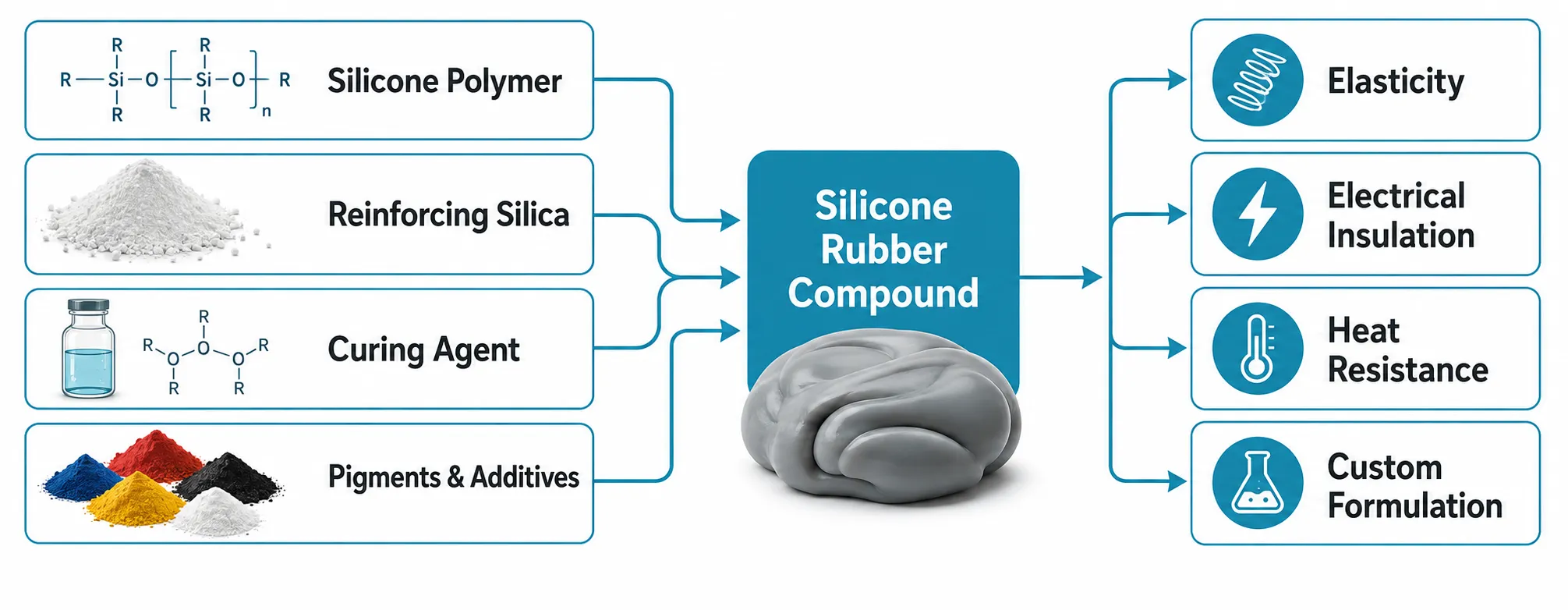
A silicone rubber compound is a formulated material made by combining a silicone polymer base with reinforcing fillers, curing ingredients, pigments and other additives. The formulation determines how the material processes and how the cured silicone performs in sealing, electrical insulation, automotive, medical, industrial and high-voltage applications.
What Is Silicone Rubber Compound?
A silicone rubber compound is a prepared silicone elastomer formulation designed for a specific manufacturing process and final application. It normally contains a silicone polymer as the main elastomer together with reinforcing fillers, curing agents, processing aids, pigments and optional functional additives.
The word compound is important because commercial silicone rubber is rarely just pure silicone polymer. The raw polymer alone normally does not provide the complete mechanical strength, processing behavior, curing characteristics or special performance required by an industrial product.
By changing the type and amount of ingredients in the formulation, manufacturers can produce silicone rubber compounds with different hardness, tensile strength, elongation, tear resistance, compression set, electrical properties, thermal conductivity, flame behavior and resistance to environmental exposure.
This is why two materials described as silicone rubber can behave very differently. One compound may be designed for a soft connector seal, another for an electrical insulator housing, and another for a thermally conductive pad used around power electronics.
A silicone rubber compound is a complete silicone formulation prepared for processing and curing into a finished elastomer component.
Silicone Rubber Base vs Silicone Rubber Compound
A silicone rubber base and a silicone rubber compound are related, but they are not always the same thing.
The silicone rubber base provides the main polymer structure. Depending on the material family, the base may already contain reinforcing fillers or processing ingredients, but additional components may still be required before production.
A silicone rubber compound is formulated for a defined processing method or performance target. Depending on the supplier and product system, it may be supplied ready to process or may require the addition of a curing agent, pigment or other approved additive before manufacturing.
| Material | Main purpose | Typical condition |
|---|---|---|
| Silicone polymer | Provides the primary polymer structure | Raw polymer material |
| Silicone rubber base | Provides the base elastomer system for further formulation | May contain polymer and reinforcing ingredients |
| Silicone rubber compound | Provides a formulated material for production | Contains ingredients selected for processing and final performance |
| Cured silicone rubber | Provides the final elastic component | Crosslinked solid elastomer after curing |
What Is Inside a Silicone Rubber Compound?
The exact composition is proprietary and varies by supplier, but most silicone rubber formulations use several main groups of ingredients.
Polímero de silicone
The silicone polymer forms the continuous elastomer network of the cured rubber. Its molecular structure contributes to flexibility, thermal stability, electrical behavior and resistance to ozone and weathering.
Sílica de reforço
Silica is commonly used to reinforce silicone rubber. Without suitable reinforcement, silicone polymer may not provide the mechanical properties required for many industrial products.
The type of silica, surface treatment, loading level and dispersion can influence tensile strength, tear strength, hardness, viscosity and processing behavior.
Agentes de cura
Curing ingredients create chemical crosslinks between silicone polymer chains. After curing, the material changes from a processable compound into an elastic solid that maintains its shape.
Heat-cured silicone rubber compounds may use peroxide curing or platinum-catalyzed addition curing depending on the product and application.
Processing Aids
Processing additives can help control mixing, extrusion, mold filling, release behavior, storage stability and surface quality.
The correct processing system is particularly important for high-consistency compounds because excessive structuring or poor dispersion can make the material difficult to extrude or mold consistently.
Pigmentos
Pigments are used for identification, appearance and product branding. Grey, black, red, blue, white and many other colors can be produced.
Color should not be changed casually in critical applications because pigment chemistry can affect curing, electrical properties, UV behavior and processing.
Functional Fillers
Special fillers can provide properties that ordinary silicone rubber does not have. A formulation may be modified for thermal conductivity, electrical conductivity, flame resistance, tracking resistance, heat aging or other functional requirements.
Property Modifiers
Additional ingredients may be used to adjust hardness, resilience, compression set, oil resistance, surface friction or other characteristics of the finished rubber.
Why Does Silicone Rubber Need Compounding?
Compounding allows one basic silicone polymer technology to serve many completely different applications.
A connector seal must remain soft enough to compress around a mating surface. A cable-insulation compound may need excellent extrusion stability. A composite-insulator housing requires hydrophobicity and resistance to electrical tracking and erosion. A thermal pad requires significantly higher thermal conductivity than ordinary silicone rubber.
These requirements cannot normally be achieved by changing the polymer alone. The complete formulation must be engineered around the final component.
| Performance target | What formulation may adjust | Example application |
|---|---|---|
| Higher tear strength | Reinforcement system and polymer formulation | Thin seals and flexible molded parts |
| Low compression set | Curing system and compound formulation | Long-life gaskets and connector seals |
| Isolamento elétrico | Insulating fillers and contamination control | Cables, connectors and electrical components |
| Tracking resistance | High-voltage insulation formulation | Composite insulators and surge arresters |
| Thermal conductivity | Thermally conductive fillers | EV batteries and power electronics |
| Electrical conductivity | Conductive filler system | EMI gaskets and grounding components |
| Flame performance | Flame-retardant formulation | Electrical and automotive components |
| Fluid resistance | Polymer chemistry and formulation | Automotive seals and industrial equipment |
HTV and HCR Silicone Rubber Compounds
HTV silicone rubber compound is one of the most common forms of industrial silicone rubber. HTV means high-temperature vulcanizing. The same general material category is also widely called HCR, or high-consistency rubber.
Before curing, an HCR or HTV compound normally has a firm, gum-like consistency. It cannot be pumped like a conventional liquid but can be cut, rolled, extruded or mechanically fed into molding equipment.
HTV silicone rubber compounds are commonly processed by extrusion, compression molding, transfer molding, calendering and specialized high-consistency injection molding.
Typical products include tubing, hoses, profiles, gaskets, electrical insulation, cable products, molded seals and composite-insulator housings.
Peroxide-Cured HTV Compound
Peroxide curing is widely used for general industrial HCR processing. Heat causes the curing chemistry to create crosslinks within the silicone.
Depending on the compound and application, post-curing may be used after the first curing stage to remove volatile residues or stabilize finished properties.
Platinum-Cured HTV Compound
Some high-consistency silicone compounds use platinum-catalyzed addition curing. This curing system can provide different processing characteristics and may be selected where peroxide decomposition products are undesirable.
Platinum-cure systems require good contamination control because certain substances can interfere with the curing reaction.
What Is Liquid Silicone Rubber Compound?
Liquid silicone rubber, commonly called LSR, is another major silicone rubber compound family.
Unlike HCR, LSR is pumpable. It is normally supplied as two components that are accurately metered and mixed before entering a heated injection mold.
After mixing and heating, chemical crosslinking converts the liquid formulation into a solid elastic silicone component.
LSR is widely used for precision molded products because it can flow into complicated mold cavities and can be integrated into highly automated production systems.
Applications include connector seals, membranes, medical components, consumer products, electrical parts and automotive components.
| Recurso | HTV / HCR compound | LSR compound |
|---|---|---|
| Forma não curada | Firm, high-consistency gum | Pumpable liquid |
| Typical supply form | Blocks, strips, sheets or prepared compound | Two liquid components |
| Processamento | Extrusão, moldagem e calandragem | Moldagem por injeção de líquido |
| Material feeding | Mechanical feeding or preforms | Metering pumps |
| Flow before cure | Baixo | High |
| Automation potential | Depends on process | Very high |
| After curing | Solid elastomer | Solid elastomer |
How a Silicone Rubber Compound Becomes Rubber
Before curing, the polymer chains within the silicone compound are able to move relative to one another. The material can therefore be shaped by an extruder, mold or other processing equipment.
During curing, chemical bonds form between the polymer chains. These crosslinks create a continuous three-dimensional network.
Once sufficiently crosslinked, the material no longer behaves as an uncured compound. It becomes an elastic thermoset rubber that can stretch and recover while retaining its basic shape.
- Compound preparation: The required silicone formulation is selected or mixed.
- Material forming: The uncured material is extruded, molded, calendered or injected.
- Curing: Heat or another curing mechanism activates crosslinking.
- Property development: Hardness, tensile strength and elastic recovery develop as curing proceeds.
- Post-curing when required: An additional heating stage may be used for selected formulations.
- Finished rubber: The cured component is inspected and tested.
Key Properties of Silicone Rubber Compounds
The correct silicone rubber compound should be selected by evaluating a group of properties rather than one number such as hardness.
Dureza
Hardness affects flexibility, sealing pressure, assembly force, deformation and shape retention. Different products may require very different Shore A hardness levels.
Resistência à tração
Tensile strength indicates how much tensile stress the cured silicone can withstand before breaking under the specified test conditions.
Alongamento na ruptura
Elongation describes how far the rubber can stretch before rupture. High elongation can be useful in flexible components but does not automatically guarantee high tear resistance.
Resistência ao rasgo
Tear resistance is particularly important for thin sections, molded edges, connector seals, membranes and composite-insulator weather sheds.
Deformação residual por compressão
Compression set measures permanent deformation after a rubber specimen has been compressed under defined temperature and time conditions.
This property is especially important for seals that must maintain contact pressure for long periods.
Resistência à temperatura
Silicone rubber is widely used where broad temperature capability is required. The actual service range varies according to compound formulation and application.
Propriedades elétricas
Insulating compounds may be evaluated for volume resistivity, dielectric strength, dielectric constant and dissipation factor.
Environmental Resistance
Silicone can provide useful resistance to ozone, ultraviolet radiation and outdoor weathering. Additional formulation changes may be required for aggressive chemicals, oils or fuels.
Insulating and Conductive Silicone Rubber Compounds
Silicone rubber is commonly associated with electrical insulation, but compounding makes it possible to produce materials with very different electrical behavior.
Electrical Insulating Silicone
Electrical-grade compounds are formulated to maintain high electrical resistance and appropriate dielectric performance. They can be used for cable insulation, connector components, electronic protection and high-voltage applications.
Borracha de silicone condutora
Conductive fillers can be added to reduce electrical resistance. These compounds may be used for conductive gaskets, grounding, electromagnetic shielding and specialized electrical interfaces.
Semiconductive Silicone
Controlled-resistance formulations can be used where the material must provide electrical stress control rather than behave as either a highly insulating or highly conductive material.
Never determine the electrical behavior of a silicone rubber compound from its color alone. Black silicone may be insulating or conductive depending on the formulation.
Thermally Conductive Silicone Rubber Compound
Standard silicone rubber is not automatically a high-performance thermal conductor.
A thermally conductive silicone rubber compound contains a significant amount of thermally conductive filler designed to transfer heat more effectively through the material.
These compounds are used in thermal pads, thermal interface components, battery systems, inverters, power electronics and other applications where heat must move from a component toward a heat sink or cooling structure.
Increasing thermal filler loading can also affect hardness, elongation, density, viscosity and processing behavior. Thermal conductivity therefore has to be balanced against mechanical and manufacturing requirements.
Flame-Retardant Silicone Rubber Compound
Some electrical, transportation and industrial components require specified flame-performance characteristics.
Although silicone has useful thermal stability, not every silicone rubber compound has the same flammability classification.
Flame-retardant silicone rubber compounds use specialized formulation technology to meet targeted flame-performance requirements while maintaining the mechanical and electrical properties needed by the component.
The exact test method and classification should always be confirmed instead of relying only on a description such as “flame resistant.”
Silicone Rubber Compound for Composite Insulators
High-voltage composite insulators are a good example of why silicone rubber compounding matters.
The silicone housing of a composite insulator must do much more than provide ordinary mechanical protection. It forms the external insulation surface and protects the FRP core against moisture and environmental exposure.
A suitable high-voltage silicone rubber compound should provide hydrophobic behavior, electrical insulation, resistance to ultraviolet radiation and ozone, sufficient tear strength and resistance to electrical tracking and erosion.
Hidrofobicidade
The hydrophobic silicone surface encourages water to remain as separate droplets rather than spreading easily into a continuous film. This characteristic can help reduce surface leakage current under wet and polluted conditions.
Tracking and Erosion Resistance
Pollution and moisture can cause leakage current and dry-band electrical discharge on an outdoor insulator. High-voltage silicone rubber compounds are therefore specially formulated to resist tracking and erosion.
Housing-to-Core Bonding
The compound must also work with the selected primer and fiberglass-reinforced polymer core. Poor interface adhesion can create internal moisture paths even when the silicone itself has good material properties.
Processing Stability
Composite-insulator housings contain long flow paths, multiple weather sheds and critical interfaces around the FRP core. The silicone formulation and molding process must provide consistent filling, curing and adhesion.
Ordinary general-purpose silicone rubber should not automatically be substituted for a dedicated high-voltage silicone rubber compound.
Silicone Rubber Compound in NEV Applications
New energy vehicles also demonstrate how the same silicone chemistry can be modified for very different functions.
Battery systems, high-voltage connectors, charging interfaces, power electronics and thermal-management systems require different combinations of sealing, electrical insulation, temperature resistance and thermal performance.
| NEV application | Possible silicone compound | Main requirement |
|---|---|---|
| Battery enclosure seal | Low-compression-set silicone rubber | Long-term environmental sealing |
| Conector de alta tensão | Electrical insulating silicone | Sealing, dielectric performance and flexibility |
| Thermal pad | Thermally conductive silicone | Heat transfer and electrical isolation |
| Power electronics | Silicone gel or encapsulant | Electrical and environmental protection |
| EMI gasket | Conductive silicone compound | Electrical conductivity and environmental sealing |
| Charging-port seal | Weather-resistant silicone rubber | UV, temperature and water resistance |
This is why the phrase silicone rubber alone is often not sufficient when specifying an automotive material. The required compound should be defined according to the actual component function.
How Silicone Rubber Compound Is Manufactured
The exact production process depends on whether the material is HCR, LSR or another silicone system.
For high-consistency silicone rubber, the polymer and reinforcing system are mixed using equipment capable of handling highly viscous materials. Functional ingredients, pigments and curing components are then incorporated according to the formulation and manufacturing sequence.
Uniform dispersion is important because local differences in filler or catalyst concentration can affect curing, surface appearance and mechanical performance.
For LSR, the material is normally supplied as two controlled components. Production equipment meters the components in the required ratio, mixes them and injects the reactive material into a heated mold.
In both systems, material preparation and processing conditions are part of the final product quality.
Ready-to-Use vs Custom Silicone Rubber Compounds
Manufacturers can select a standard commercial formulation or work with a silicone supplier to develop a customized compound.
Standard Silicone Rubber Compound
A standard product can reduce qualification time when its existing properties already match the component requirements.
Standard materials may also have established processing recommendations and more extensive production history.
Custom Silicone Rubber Compound
A custom formulation may be useful when the application requires a particular combination of hardness, color, thermal conductivity, electrical behavior, chemical resistance or processing characteristics that is not available in a standard product.
Customization should be controlled carefully because changes to one property can affect other characteristics. For example, increasing filler concentration may improve one functional property while reducing elongation or increasing viscosity.
How to Choose a Silicone Rubber Compound
- Define the application. Identify whether the material will function as a seal, insulator, thermal interface, cable, molded part or high-voltage housing.
- Select the processing method. Determine whether extrusion, compression molding, HCR injection molding or LSR injection molding will be used.
- Specify hardness. Consider flexibility, sealing force, wall thickness and assembly requirements.
- Review mechanical properties. Compare tensile strength, elongation, tear strength and compression set.
- Define the temperature range. Include continuous operating temperature, temperature peaks and cold-service conditions.
- Check electrical requirements. Determine whether the material must be insulating, semiconductive or conductive.
- Evaluate chemicals and fluids. Identify oils, fuels, coolants, solvents, cleaning chemicals or other substances.
- Review flame requirements. Confirm the required test method and classification.
- Consider environmental exposure. Include UV, ozone, water, humidity and outdoor weathering.
- Check curing requirements. Determine catalyst, cure temperature, cure time and possible post-curing requirements.
- Confirm color and pigment system. Use only pigments compatible with the approved compound.
- Run production trials. Validate processing and finished-component performance before mass production.
Common Silicone Rubber Compounding Mistakes
Selecting by Hardness Only
Hardness is only one property. Two compounds with the same Shore A hardness can have very different tear strength, compression set, electrical behavior and temperature resistance.
Adding Unapproved Pigment
A pigment can influence curing and material performance. Color changes in critical applications should be qualified rather than made directly on the production floor.
Changing the Curing Agent
Curing chemistry affects processing and finished properties. A peroxide or catalyst should not be substituted without supplier approval and validation.
Assuming Silicone Is Always Electrically Insulating
Conductive and semiconductive silicone compounds exist. Electrical properties must be confirmed from the exact formulation.
Assuming Silicone Is Always Thermally Conductive
High thermal conductivity requires a specially filled compound. Standard silicone rubber normally should not be treated as a thermal interface material.
Ignoring Processing Conditions
A technically suitable silicone formulation can still produce defective parts when mixing, mold temperature, extrusion conditions or curing time are poorly controlled.
Changing Raw Materials Without Requalification
Changing the silicone base, filler, pigment, curing agent or functional additive may affect the final compound and can require renewed testing.
What Should Be on a Silicone Rubber Compound Data Sheet?
A useful technical data sheet should provide enough information to determine whether a compound is suitable for initial evaluation.
| Data category | Typical information to review |
|---|---|
| Material identification | Product grade, silicone type and curing system |
| Uncured properties | Appearance, consistency, density and processing information |
| Dureza | Shore hardness and applicable test method |
| Mechanical properties | Tensile strength, elongation and tear strength |
| Compression behavior | Compression set under specified conditions |
| Electrical data | Resistivity, dielectric strength or other applicable properties |
| Thermal performance | Recommended service range and heat-aging information |
| Curing conditions | Cure temperature, cure time and post-cure recommendations |
| Storage | Shelf life and recommended storage conditions |
| Conformidade | Relevant regulatory or application-specific documentation |
A technical data sheet is useful for material screening, but the finished component should still be tested because geometry and manufacturing conditions can change performance.
Perguntas frequentes
What does silicone rubber compound mean?
A silicone rubber compound is a formulated silicone material containing a silicone polymer system together with fillers, curing ingredients and other additives selected for processing and final performance.
Is silicone rubber compound pure silicone?
No. Industrial silicone rubber compounds normally contain reinforcing fillers, curing components and other formulation ingredients in addition to the silicone polymer.
What is the difference between silicone rubber and silicone rubber compound?
Silicone rubber describes the elastomer material family or cured rubber, while silicone rubber compound normally refers to a formulated material prepared for processing and curing.
What is HTV silicone rubber compound?
HTV silicone rubber compound is a high-consistency silicone formulation that is shaped during manufacturing and cured with heat. It is also commonly called HCR.
What is liquid silicone rubber compound?
Liquid silicone rubber is a pumpable two-component silicone system that is mixed and normally injection molded before heat curing into a solid elastomer.
Can silicone rubber compound conduct electricity?
Standard insulating grades resist electrical current, but conductive and semiconductive silicone rubber compounds can be produced using specialized filler systems.
Can silicone rubber compound conduct heat?
Special thermally conductive silicone compounds can transfer heat effectively because they contain thermally conductive fillers. Standard silicone should not automatically be considered a thermal interface material.
Is silicone rubber compound flame retardant?
Some formulations are designed for specified flame performance, but not every silicone rubber compound has the same flammability classification.
Which silicone rubber compound is used for composite insulators?
Composite insulators use dedicated high-voltage silicone rubber formulations designed for hydrophobicity, electrical insulation, weather resistance and tracking and erosion resistance. Both HCR and LSR technologies can be used.
How do I select the right silicone rubber compound?
Start with the application and processing method, then compare hardness, tensile strength, elongation, tear resistance, compression set, temperature range, electrical properties and environmental requirements.