
Where Is High Temperature Silicone Rubber Used?
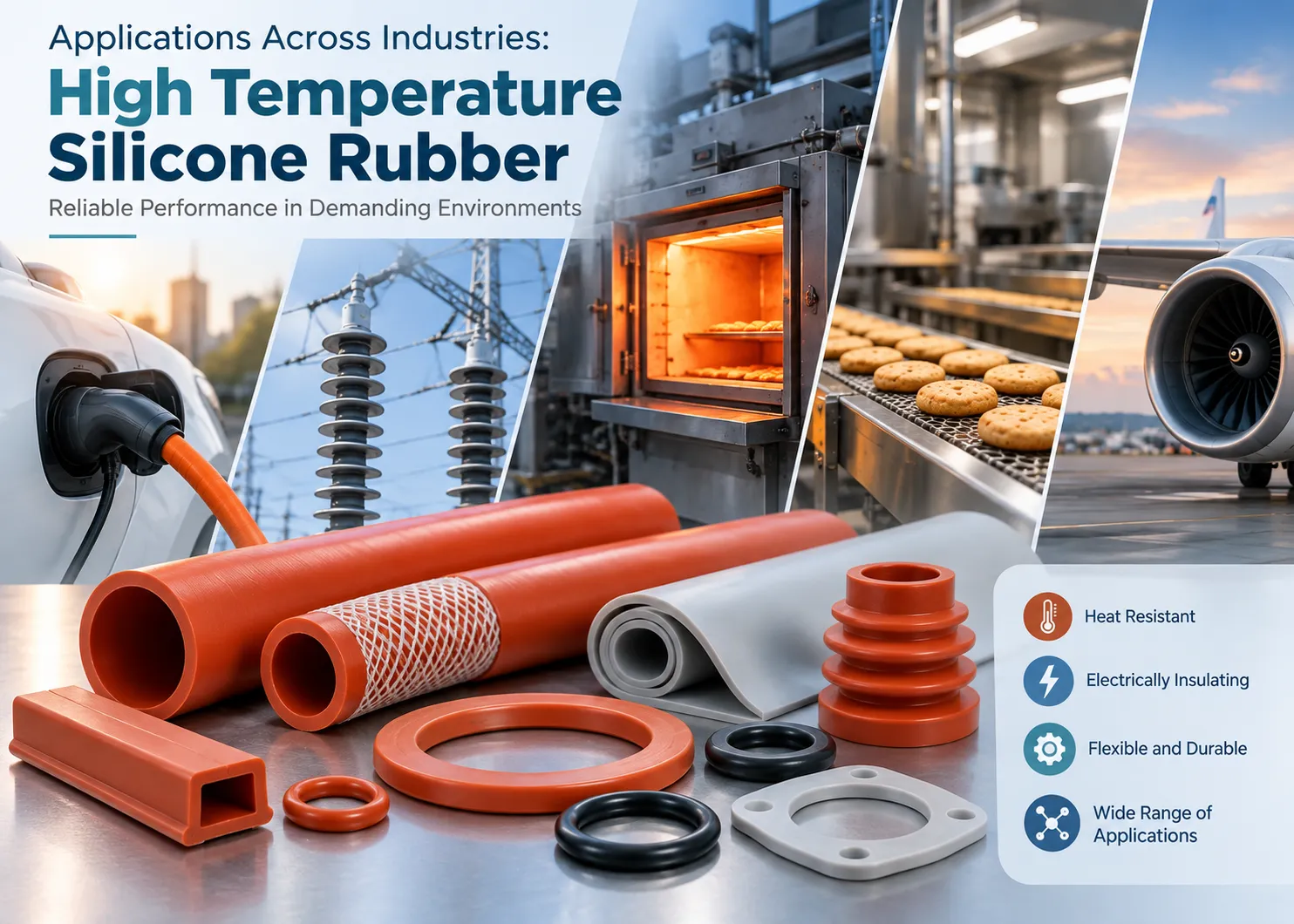
High temperature silicone rubber is used in industrial applications where ordinary elastomers may harden, crack, lose flexibility or degrade after prolonged heat exposure. It is especially valuable in electrical insulation, wire and cable, EV systems, industrial seals, food-processing equipment and other components exposed to elevated operating temperatures.
Silicone rubber is not selected only because it can tolerate heat. In many applications, manufacturers also need electrical insulation, flexibility, weather resistance, sealing performance or mechanical stability at the same time. This combination is what makes high temperature silicone rubber useful across power, automotive, industrial processing and transportation sectors.
This article explains where high temperature silicone rubber is used, why it performs well in hot environments and what buyers should consider when selecting an HTV/HCR silicone compound for demanding applications.
What Is High Temperature Silicone Rubber?
High temperature silicone rubber is a silicone elastomer formulated to retain useful properties during prolonged exposure to elevated temperatures. Depending on the grade and application, it may be supplied as HTV/HCR silicone for molding and extrusion, or as another silicone system designed for specialized processing.
The term “high temperature” should not be treated as one universal number. Continuous operating temperature, short-term peak temperature and heat-aging conditions are different. A silicone compound that survives a short temperature spike may not provide the same long-term property retention under continuous heat.
Why Silicone Rubber Performs Well at High Temperature
The heat resistance of silicone rubber is strongly related to its siloxane polymer backbone. The alternating silicon-oxygen structure gives silicone different thermal behavior from many conventional carbon-based elastomers.
This helps properly formulated silicone rubber remain flexible at temperatures where some general-purpose rubbers begin to harden or lose mechanical performance more quickly.
However, the final heat resistance of a commercial compound depends on more than the base polymer. Reinforcing silica, heat stabilizers, fillers, pigments, curing chemistry and processing conditions all influence long-term thermal performance.
High Temperature Silicone Rubber in Wire and Cable
Wire and cable is one of the most important applications for high temperature silicone rubber. Silicone insulation is used where cables must remain flexible while operating close to heat-generating equipment, motors, heaters, industrial machinery or electrical systems.
HTV/HCR silicone can be extruded continuously around conductors and then vulcanized to form a flexible insulation layer. The compound needs both electrical and processing stability.
| Cable Requirement | Почему это важно |
|---|---|
| Термостойкость | Helps insulation retain flexibility and mechanical performance during prolonged thermal exposure. |
| Электроизоляция | Provides dielectric separation around the conductor. |
| Extrusion Stability | Helps maintain uniform wall thickness and surface quality. |
| Гибкость | Allows cable routing without excessive cracking or stiffness. |
| Heat Aging | Shows how tensile strength and elongation change after elevated-temperature exposure. |
Electrical Insulation and High-Voltage Equipment
High temperature silicone rubber is widely used in electrical insulation because it can combine dielectric properties with thermal stability and weather resistance.
Electrical components can experience heat from current flow, environmental exposure, electrical discharge or nearby equipment. Silicone rubber can help maintain insulation performance while remaining flexible under these conditions.
Applications include insulating boots, molded electrical parts, cable accessories, protective covers and components used around switchgear and power-distribution equipment.
Composite Insulators and Outdoor Power Equipment
Composite insulators used on transmission and distribution networks rely heavily on silicone rubber housings. These components face not only heat but also UV radiation, rain, pollution, ozone and electrical stress.
The silicone housing needs to maintain hydrophobic surface behavior and withstand long-term weathering. In hot climates or areas with high solar exposure, thermal stability becomes an additional requirement.
For this type of application, the silicone compound may also need strong tracking and erosion resistance together with tensile strength and tear resistance.
Read more in Silicone Rubber in High-Voltage Applications.
High Temperature Silicone Rubber in EV Systems
Electric vehicles create demanding thermal environments around batteries, power electronics, motors, connectors and high-voltage cables.
Silicone rubber may be used in EV cable insulation, connector seals, grommets, boots and molded electrical components because it can combine heat resistance with electrical insulation and flexibility.
Temperature cycling is especially important in EV applications. A component may repeatedly heat during operation or charging and cool when the vehicle is parked.
High-Voltage Cable
Requires electrical insulation, flexibility and thermal aging resistance.
Connector Seals
Need compression recovery and temperature stability.
Insulating Boots
Need flexibility, tear strength and electrical protection.
Battery Components
May require sealing or insulation around thermally active assemblies.
For more detail, see Silicone Rubber in EV High-Voltage Systems.
Industrial Seals and Gaskets
Seals and gaskets are among the most common applications for high temperature silicone rubber. These parts may be installed around ovens, industrial enclosures, machinery, heating systems and process equipment.
Heat resistance alone is not enough for a sealing material. The rubber must also maintain compression recovery and flexibility over time.
If a gasket becomes too hard or develops excessive compression set, sealing pressure can be lost even if the rubber has not visibly failed.
| Seal Property | Почему это важно |
|---|---|
| Остаточная деформация при сжатии | Helps determine whether the seal can recover after long-term compression. |
| Твёрдость | Influences sealing force and deformation. |
| Elongation | Helps the material tolerate assembly and movement. |
| Heat Aging | Shows whether sealing performance may change over time. |
Ovens, Furnaces and Heating Equipment
Silicone rubber is widely used around industrial ovens, heating cabinets and equipment that operates at elevated temperatures.
Typical components may include door seals, flexible strips, gaskets, tubing and protective profiles. The material is especially useful where a seal must remain elastic while repeatedly heating and cooling.
In these environments, buyers should distinguish between direct flame exposure and high ambient temperature. A heat-resistant silicone compound is not automatically flame-retardant or fireproof.
If direct flame performance matters, the required fire or flammability test should be specified separately.
Food Processing and Baking Equipment
Food-contact silicone rubber is commonly used in baking molds, oven seals, food-processing gaskets, tubing and other components exposed to elevated temperature.
These applications may require both high temperature performance and food-contact documentation.
Depending on the market, buyers may need support related to requirements such as FDA 21 CFR, LFGB or BfR Recommendation XV. These requirements should be evaluated for the exact material and intended contact conditions rather than treated as one universal certification.
Automotive Engine and Under-Hood Components
Conventional and electric vehicles both contain locations where rubber components are exposed to elevated temperatures.
Silicone rubber can be used in seals, boots, grommets, hoses and electrical components where thermal stability and flexibility are important.
Under-hood applications may also expose the material to oils, fluids, vibration and repeated temperature cycling. Chemical compatibility therefore needs to be considered together with heat resistance.
Aerospace and Transportation Applications
Aerospace, rail and other transportation systems may use high temperature silicone rubber in sealing, insulation and vibration-control components.
These industries often require materials that remain stable across changing temperatures while maintaining low-temperature flexibility and high-temperature durability.
Depending on the project, flame performance, smoke behavior, environmental resistance and mechanical properties may also be required.
The exact silicone compound should therefore be selected according to the applicable component specification rather than the general term “high temperature silicone.”
Industrial Rollers, Sheets and Profiles
High temperature silicone rubber is also manufactured into rollers, sheets, strips and extruded profiles.
These forms are used in packaging equipment, printing machinery, textile processing, laminating systems, thermal processing lines and other industrial machines.
High Temperature Silicone Rubber in Industrial Molding
HTV/HCR silicone rubber is well suited to industrial compression molding and transfer molding. It can be formulated for seals, grommets, electrical parts, boots and custom components that must tolerate elevated temperature.
For molding operations, buyers need to consider more than service temperature. Cure behavior, mold flow, demolding, tear strength and batch consistency all affect production efficiency.
A material that performs well in the finished part but creates unstable molding conditions may not be the best production compound.
What Happens When Silicone Rubber Gets Too Hot?
High temperature silicone rubber still has limits. Under excessive or prolonged heat, the material can gradually undergo chemical and mechanical changes.
Depending on the formulation and exposure conditions, hardness may increase while elongation decreases. In more severe thermal conditions, the surface can become brittle, cracked or degraded.
This is why heat-aging data is often more useful than simply asking for the maximum temperature of a silicone compound.
Continuous Temperature vs Short-Term Peak Temperature
A common mistake is to compare high temperature silicone rubber grades using only one temperature number.
Continuous service and peak exposure are very different.
A material may tolerate a high peak briefly while experiencing much greater property change if exposed continuously to the same temperature.
High Temperature Silicone Rubber vs Other Rubber Materials
Silicone rubber is often selected when temperature stability is more important than the strengths offered by other elastomer families.
| Материал | General Strength | Typical Limitation Compared with Silicone |
|---|---|---|
| Силиконовый каучук | Wide temperature range, electrical insulation, flexibility and weather resistance | Not always ideal where strong resistance to certain oils or abrasion is the main requirement |
| EPDM | Weather, ozone and water resistance | High-temperature capability may be lower depending on grade |
| NBR | Good resistance to many oils and fuels | Generally more limited in high-temperature and outdoor UV service |
| Natural Rubber | Strong elasticity and mechanical properties | Less suitable for prolonged high-temperature, ozone and outdoor exposure |
The best material depends on the total operating environment rather than temperature alone.
How to Choose High Temperature Silicone Rubber
The correct material should be selected from the actual application rather than from a generic temperature claim.
What Should Buyers Include in an RFQ?
A clear RFQ helps a silicone rubber supplier recommend the correct grade faster.
High Temperature Silicone Rubber from Yakows
Yakows supplies HTV/HCR silicone rubber compounds for electrical insulation, wire and cable, composite insulators, EV systems, industrial molding, food-contact applications and high-temperature components.
Different high-temperature applications require different formulation priorities. Cable grades may focus on extrusion stability, dielectric properties and heat aging. Industrial seals may require compression recovery and flexibility. Electrical compounds may need to balance heat resistance with tracking, erosion and dielectric performance.
Customers can provide the application, processing method, target Shore A hardness, continuous and peak temperature, electrical requirements, mechanical properties and expected order volume so that a suitable high temperature silicone rubber grade can be evaluated.
Часто задаваемые вопросы
Where is high temperature silicone rubber used?
High temperature silicone rubber is used in wire and cable, electrical insulation, composite insulators, EV components, industrial seals, ovens, food-processing equipment, automotive parts and high-temperature machinery.
Why is silicone rubber used at high temperatures?
Silicone rubber has a thermally stable siloxane polymer backbone that helps it retain flexibility and useful mechanical properties under elevated-temperature conditions.
Is high temperature silicone rubber fireproof?
No. Heat resistance and fire resistance are different properties. A high-temperature silicone compound should not automatically be considered flame retardant or fireproof.
Can high temperature silicone rubber be used for cable?
Yes. HTV/HCR silicone rubber is widely used for cable insulation where electrical insulation, flexibility and heat resistance are required.
Is high temperature silicone rubber electrically insulating?
Standard silicone rubber is generally electrically insulating, and specialized grades can be formulated for high-voltage and cable applications.
Can high temperature silicone rubber be used for food contact?
Suitable grades can be used in food-contact applications, but food-contact documentation must be evaluated separately from thermal performance.
What happens when silicone rubber gets too hot?
Prolonged excessive heat can increase hardness, reduce elongation and gradually degrade mechanical performance. Severe exposure can eventually cause cracking or decomposition.
Is HTV silicone the same as high temperature silicone rubber?
HTV means high-temperature vulcanizing and is commonly associated with high-consistency silicone rubber. However, the term describes the curing method and should not be confused automatically with a specific maximum service temperature.
How should high temperature silicone rubber be selected?
Buyers should consider continuous temperature, peak temperature, processing method, hardness, mechanical properties, electrical requirements and the actual operating environment.