
Silicone Rubber in EV High-Voltage Systems
Silicone rubber is widely used in electric-vehicle high-voltage systems because it can combine electrical insulation, heat resistance, flexibility, sealing performance and long-term environmental stability. These properties are valuable in components exposed to elevated voltage, temperature cycling, vibration, moisture and repeated mechanical movement.
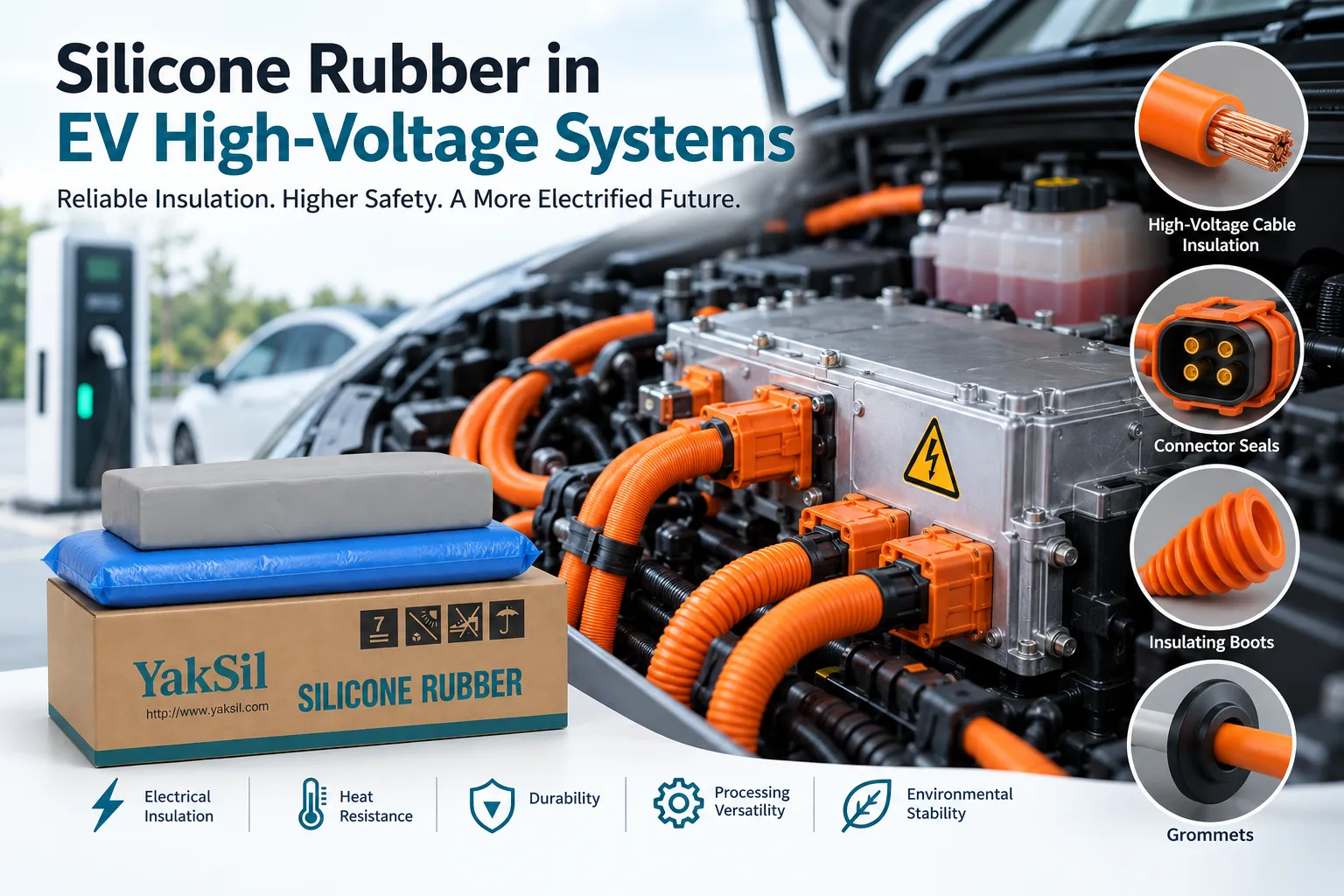
In EV applications, silicone rubber may be used in high-voltage cables, connector seals, insulating boots, grommets, molded electrical parts and other components around batteries, inverters, motors and charging systems. The correct grade, however, depends on much more than dielectric strength. Processing method, heat aging, tear resistance, compression behavior, flame performance and long-term material consistency can all influence the reliability of the finished system.
Why EV High-Voltage Systems Are Demanding
Electric vehicles operate with electrical systems that carry far more voltage and power than traditional low-voltage automotive circuits. High-voltage architectures improve power delivery and charging performance, but they also place greater demands on insulation materials.
An insulation component in an EV may experience electrical stress at the same time as heat, vibration, compression, humidity and rapid temperature changes. These stresses can interact. A material that performs well during a short laboratory dielectric test may still be unsuitable if it becomes hard, cracked or mechanically damaged after prolonged thermal cycling.
Electrical Stress
Insulating materials must resist unwanted current flow and electrical breakdown under the specified system conditions.
Thermal Stress
Heat from batteries, motors, inverters, cables and charging can gradually change elastomer properties.
Mechanical Stress
Vibration, assembly, bending, compression and vehicle movement can damage weak or poorly selected insulation materials.
This combination is why EV material selection should focus on long-term system reliability rather than one maximum voltage or temperature number.
Where Is Silicone Rubber Used in EV High-Voltage Systems?
Silicone rubber can be used in several areas of an EV electrical system. The exact material form depends on whether the component is molded, extruded, overmolded or used mainly as a sealing element.
High-Voltage Cable
Silicone compounds can be extruded as flexible electrical insulation or protective layers where heat resistance and cable flexibility are important.
Connector Seals
Silicone seals help protect electrical interfaces against moisture, dust and environmental contamination.
Insulating Boots
Molded silicone boots can isolate conductive connections while providing flexibility around complex geometries.
Grommets
Silicone grommets can protect cables where they pass through panels or housings and can reduce mechanical damage around openings.
Battery & Power Electronics
Depending on the design, silicone parts may provide sealing, insulation or protection around battery, inverter and power-distribution assemblies.
Компоненты системы зарядки
Flexible silicone parts can be used in seals, boots and cable-related components exposed to repeated connection cycles and outdoor environments.
Silicone is not the only polymer used in EV high-voltage systems. Thermoplastics, EPDM and other elastomers are also common. Silicone rubber is most valuable where its particular combination of electrical, thermal and flexible elastomeric behavior matches the component requirements.
Electrical Insulation Is Only Part of the Job
Silicone rubber is generally electrically insulating unless conductive fillers are intentionally added. Electrical-grade compounds can provide high volume resistivity and strong resistance to dielectric breakdown.
However, an EV component usually needs more than electrical resistance. A connector seal, for example, must remain compressed without excessive permanent deformation. A cable compound must remain flexible and resist damage during installation and vehicle operation. An insulating boot needs sufficient tear strength to survive assembly and maintenance.
| Недвижимость | Why It Matters in EV High-Voltage Systems |
|---|---|
| Диэлектрическая прочность | Helps evaluate resistance to electrical breakdown under defined test conditions. |
| Объёмное удельное сопротивление | Indicates resistance to current flowing through the bulk material. |
| Прочность на разрыв | Important for boots, seals and thin molded sections that may be stretched during assembly. |
| Elongation | Helps the material tolerate movement and deformation without breaking. |
| Остаточная деформация при сжатии | Important for sealing components that remain compressed for long periods. |
| Heat Aging | Shows how mechanical properties change after prolonged elevated-temperature exposure. |
Why Silicone Rubber Handles Heat Well
Heat resistance is one of the main reasons silicone rubber is considered for EV electrical components. The siloxane backbone of silicone differs from the carbon-based backbone of many conventional organic elastomers, giving properly formulated silicone materials strong thermal stability.
This does not mean every silicone grade has the same temperature capability. Long-term operating temperature, short-duration peaks and heat-aging requirements should be evaluated separately.
A silicone component may still appear physically intact after high-temperature exposure while its hardness or elongation has changed. For this reason, heat-aging data can be more useful than a single headline temperature claim.
Temperature Cycling Can Be as Important as Maximum Temperature
EV components do not normally stay at one constant temperature. A vehicle may experience cold ambient conditions, rapid heating during operation and cooling after shutdown. Charging and power-electronics operation can add additional thermal cycles.
Repeated expansion and contraction create stress at interfaces between rubber, metal, plastic and cable materials. Silicone rubber is useful because it can remain flexible across a broad temperature range, reducing the risk of embrittlement associated with some materials at low temperature.
For seals and boots, maintaining elasticity during repeated thermal cycles helps preserve contact pressure and environmental protection. For cable insulation, flexibility can help reduce cracking during bending and vibration.
Silicone Rubber for EV High-Voltage Cable
High-voltage cable is one of the most visible applications of elastomeric insulation in an EV. The cable must safely carry electrical power while remaining flexible enough for routing through a compact vehicle architecture.
When silicone rubber is used as cable insulation, the compound must perform both electrically and during extrusion. Stable extrusion behavior is essential for consistent wall thickness, smooth surface quality and reliable continuous production.
| Cable Requirement | What the Silicone Compound Must Provide |
|---|---|
| Электроизоляция | Suitable dielectric strength and resistivity for the cable design. |
| Extrusion Stability | Consistent feeding, die behavior and dimensional control. |
| Гибкость | Ability to bend through vehicle routing without cracking. |
| Heat Aging | Retention of mechanical properties over long-term thermal exposure. |
| Surface Quality | Low contamination and uniform extrusion to reduce weak areas and visual defects. |
| Mechanical Strength | Resistance to stretching, tearing and handling damage. |
For cable manufacturers, the best silicone rubber is therefore not necessarily the grade with the highest tensile strength. Process stability and long-term property retention can be equally important.
Silicone Rubber in High-Voltage Connectors
High-voltage connectors must maintain electrical separation while protecting contact areas from moisture, dust and mechanical movement. Silicone rubber is frequently used for connector seals and flexible protective parts because it can combine insulation with elastic sealing.
The rubber must remain compressed over long service periods without losing too much recovery. Compression set can therefore be a critical property for sealing applications.
Tear resistance also matters. Connector seals may contain thin lips or complex geometries that can be damaged during assembly if the compound is too weak. A suitable formulation needs to balance softness, recovery and mechanical strength.
Insulating Boots and Flexible Protective Parts
Molded silicone boots can cover terminals, joints or conductive connections in high-voltage systems. Their flexibility allows them to fit around geometries that would be difficult to protect using a rigid material alone.
These parts can experience repeated bending, installation stress and temperature cycling. If the material becomes too hard after aging or has insufficient tear strength, cracks may develop around edges or narrow sections.
For this reason, buyers should evaluate hardness together with tensile strength, elongation, tear resistance and thermal aging instead of specifying only a Shore A value.
Silicone Rubber for Sealing Around High-Voltage Components
Electrical insulation can be compromised when moisture or contamination reaches critical conductive areas. Sealing therefore becomes an important part of the insulation strategy.
Silicone rubber can be molded into seals, gaskets and grommets around battery enclosures, connectors, cable entry points and power-electronics assemblies. The exact design determines whether compression set, tear strength, low-temperature flexibility or environmental resistance becomes the dominant material requirement.
A good electrical insulator is not automatically a good long-term seal. The compound must provide both electrical and mechanical performance appropriate to the joint design.
What About Tracking and Surface Electrical Stress?
In high-voltage systems, the surface of an insulating material may experience electric-field stress, contamination or moisture. Under severe conditions, surface discharge can gradually create conductive paths or damage the material.
Tracking and erosion resistance are especially important in outdoor high-voltage insulation such as composite insulators, but they can also become relevant in other high-voltage designs where the insulation surface is exposed to electrical stress and contamination.
Specialized silicone compounds can be formulated with filler systems designed to improve resistance to these forms of electrical degradation. The need for such performance should be determined from the actual component geometry and operating environment rather than assumed for every EV silicone part.
Creepage and Clearance Cannot Be Replaced by Better Rubber
Material properties are only one part of electrical insulation design. The physical distance between conductive elements also matters.
Clearance refers to the shortest distance through air between conductive parts. Creepage refers to the shortest path along the surface of an insulating material.
A high-performance silicone compound cannot compensate for an electrical design that does not provide adequate spacing for the system voltage and operating conditions. Engineers therefore need to evaluate material selection together with geometry, pollution level, moisture exposure and applicable product standards.
Flame Performance Depends on the Compound
Silicone rubber is often associated with good behavior at elevated temperatures, but heat resistance and flame retardancy are not the same property.
Where flame performance is part of the EV component specification, a dedicated flame-retardant silicone compound may be required. Functional fillers and additives can change burning behavior, but they can also influence hardness, elongation, tear strength, density and processing.
Buyers should therefore specify the actual flame or finished-product requirement rather than assuming that every silicone rubber grade provides the same fire performance.
Why Orange Silicone Does Not Automatically Mean EV Grade
Orange is widely used as a visual identifier for high-voltage electrical components in vehicles. As a result, orange silicone cables, boots and seals are common in EV systems.
Color, however, does not define material performance. Two orange silicone compounds can have very different electrical, mechanical and thermal properties.
The pigment system must also be compatible with the base formulation. A manufacturer should therefore evaluate the complete material specification rather than treating orange color as evidence that a compound is suitable for high-voltage service.
HCR Silicone and LSR in EV Components
Both high-consistency silicone rubber and liquid silicone rubber can be used in automotive electrical systems, but they suit different manufacturing processes.
| Characteristic | HCR / HTV Silicone | LSR |
|---|---|---|
| Uncured Form | Solid, gum-like compound | Two-component liquid |
| Экструзия | Widely used | Not the normal processing route |
| Формование под давлением | Common | Not the primary process |
| Liquid Injection Molding | Not typical | Primary manufacturing method |
| Typical EV Uses | Cables, boots, seals, profiles and molded components | Precision seals, connectors and complex molded components |
For high-voltage cable and many extruded components, HTV/HCR silicone is especially relevant because it can be processed as a high-consistency compound through continuous extrusion equipment.
For more detail on the material itself, see What Is HCR Silicone?
Mechanical Damage Can Cause Electrical Failure
An electrical insulation material does not have to lose its intrinsic dielectric properties to fail. Mechanical damage can create an exposed conductive area or a weak point that compromises the entire component.
Разрыв
Thin seals and boots can tear during assembly if the compound lacks sufficient tear resistance.
Cracking
Thermal aging or unsuitable material selection can gradually reduce flexibility and increase cracking risk.
Compression Loss
Seals with excessive permanent deformation may lose environmental protection over time.
Повреждения поверхности
Abrasion, contamination or discharge activity may create weak regions in the insulation.
Common Causes of Silicone Rubber Failure in EV Systems
Silicone rubber can provide long service life when the correct compound is matched to the component. Failure often begins when material selection, processing or design does not match the actual operating environment.
| Failure Cause | Possible Effect |
|---|---|
| Excessive Heat | Hardness increase, reduced elongation or gradual mechanical degradation |
| Poor Cure | Weak mechanical properties, unstable dimensions or incomplete performance |
| Contamination | Surface defects or possible weak areas in critical insulation components |
| Incorrect Hardness | Poor sealing, difficult assembly or insufficient mechanical support |
| Insufficient Tear Strength | Damage during demolding, installation or service |
| Poor Compression Recovery | Loss of sealing pressure over long periods |
| Wrong Compound for Process | Extrusion instability, molding defects or inconsistent cure |
How to Select Silicone Rubber for an EV High-Voltage Project
Material selection should begin with the component rather than with a generic request for “EV silicone rubber.” The supplier needs to understand where the silicone will be used and how it will be processed.
Test the Material After Processing
Raw-material data is important, but the finished EV component is what ultimately needs to perform. Molding temperature, cure time, extrusion conditions, post-curing and component geometry can influence the final properties.
For this reason, qualification should ideally include samples produced using realistic manufacturing conditions. Electrical tests can then be combined with heat aging, mechanical testing, sealing tests and other application-specific validation.
Batch Consistency Matters in Automotive Production
Once an EV component has been qualified, changes in material behavior can create expensive production problems. A variation in viscosity can affect extrusion or mold filling. Changes in cure behavior can affect cycle time. Variation in hardness or tear strength can influence assembly and sealing.
For this reason, buyers should evaluate how a silicone supplier controls raw materials, mixing, formulation, batch testing and traceability.
| Supplier Control | Почему это важно |
|---|---|
| Batch Testing | Helps confirm routine production remains within the agreed specification. |
| Lot Traceability | Makes it possible to investigate production issues using the material batch number. |
| Change Control | Helps customers manage significant formulation or raw-material changes. |
| Production Support | Technical communication is useful when extrusion, molding or curing behavior changes. |
What Should Be Included in an EV Silicone Rubber RFQ?
A detailed RFQ helps the supplier understand whether an existing compound is suitable or whether additional material development is needed.
Silicone Rubber for EV High-Voltage Applications from Yakows
Yakows supplies HTV/HCR silicone rubber compounds for electrical insulation, high-voltage cable, EV components and other industrial applications requiring a combination of thermal, electrical and mechanical performance.
EV projects can require different formulation priorities depending on the component. A cable compound may focus on extrusion stability, dielectric performance and heat aging. A molded insulating boot may require higher tear strength and flexibility. A sealing component may place greater emphasis on compression behavior and temperature cycling.
Customers can provide the application, processing method, target Shore A hardness, electrical requirements, mechanical properties, temperature conditions, color and estimated production volume to evaluate a suitable silicone rubber compound.
Часто задаваемые вопросы
Why is silicone rubber used in EV high-voltage systems?
Silicone rubber can combine electrical insulation, heat resistance, flexibility, sealing performance and environmental stability, making it useful in cables, connector seals, boots, grommets and other high-voltage components.
Is silicone rubber electrically insulating?
Standard silicone rubber is generally highly electrically insulating. Conductive or semiconductive silicone can also be produced using specialized fillers, so the exact compound specification should always be confirmed.
Can silicone rubber be used for EV high-voltage cable?
Yes. High-consistency silicone compounds can be extruded as flexible electrical insulation for cable applications where suitable heat resistance, dielectric performance and mechanical properties are required.
Why is high-voltage EV cable often orange?
Orange is commonly used to identify high-voltage automotive electrical systems visually. The color itself does not determine the electrical or thermal performance of the insulation material.
Is HCR silicone suitable for EV components?
Yes. HCR/HTV silicone is especially relevant for extruded cables, molded boots, seals, grommets and other high-consistency silicone components.
What properties should be checked for EV silicone rubber?
Depending on the component, buyers may need to evaluate dielectric strength, volume resistivity, hardness, tensile strength, elongation, tear strength, compression set, heat aging and processing behavior.
Does all silicone rubber have the same heat resistance?
No. Temperature capability depends on polymer formulation, fillers, additives, curing system, exposure duration and the property-retention requirements of the finished component.
Is flame-resistant silicone the same as ordinary silicone rubber?
No. Flame performance depends on the specific formulation and applicable test requirements. A dedicated flame-retardant compound may be needed where fire performance is part of the component specification.