
Conductive Insulator and Silicone Rubber: Electrical Properties Explained
The terms conductive insulator and silicone rubber can seem contradictory when they appear together. An insulator is normally expected to resist electrical current, while a conductive material is designed to allow electrical charge to move. In practice, however, modern electrical systems often use insulating, semiconductive and conductive elastomers together, each performing a different electrical function.
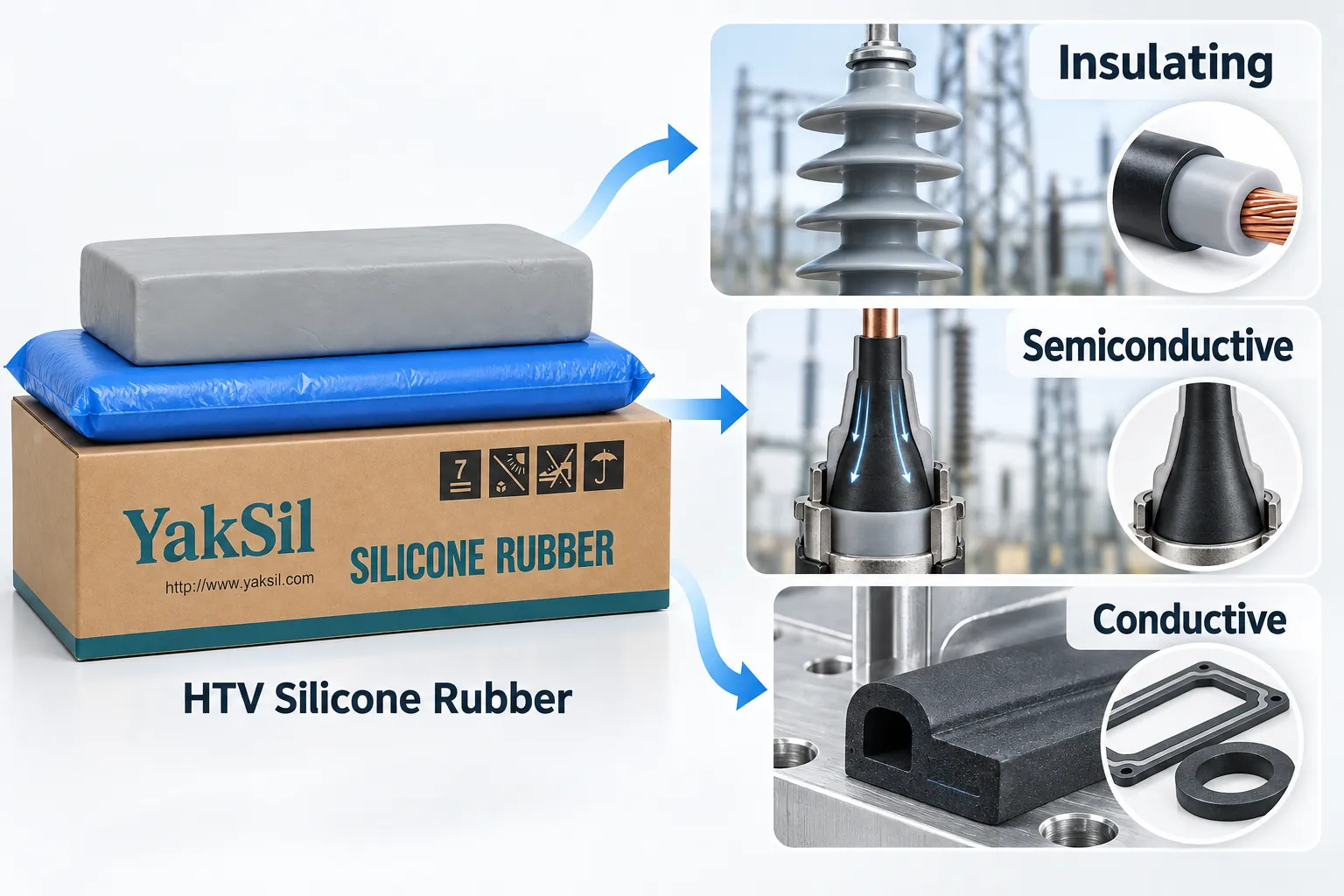
Silicone rubber is a good example. Standard silicone rubber is naturally a strong electrical insulator and is widely used in composite insulators, high-voltage equipment, wire and cable, connectors and EV electrical systems. By changing the formulation and adding conductive fillers, the same silicone elastomer platform can also be made semiconductive or electrically conductive.
This article explains what people usually mean when searching for a conductive insulator, how silicone rubber changes from insulating to conductive, which electrical properties matter, and how these different materials are used in power, cable and industrial electrical systems.
What Does Conductive Insulator Mean?
Conductive insulator is not usually a precise material classification. The two words describe opposite electrical behaviors, so the phrase often reflects a search for a material or system that combines electrical insulation with controlled conductivity.
In practical engineering, several situations can create this idea. A component may contain an insulating body together with a conductive surface. A cable accessory may combine semiconductive silicone with insulating silicone. A conductive elastomer may also be used around an insulation system for grounding, electric-field control or charge dissipation.
Is Silicone Rubber an Electrical Insulator?
Yes. Standard silicone rubber is generally an excellent electrical insulating material because it has high electrical resistivity and does not readily allow current to pass through its polymer structure.
This is one reason silicone rubber is widely used in high-voltage and outdoor electrical applications. In addition to electrical insulation, it can provide heat resistance, UV resistance, weatherability, hydrophobicity and flexibility.
These properties make silicone rubber especially useful where the insulating material also needs to survive mechanical movement and harsh environmental conditions.
High Electrical Resistivity
Helps limit current flowing through the bulk silicone material.
Диэлектрическая прочность
Helps the material withstand electrical stress before breakdown under defined test conditions.
Environmental Stability
Provides useful performance under heat, moisture, UV exposure and outdoor weathering.
How Can Silicone Rubber Become Conductive?
The electrical behavior of silicone rubber can be changed dramatically through compounding. Conductive particles can be dispersed into the silicone matrix until they form continuous pathways through the cured rubber.
Once enough conductive filler is present, electrical resistance decreases and the material begins to behave as a semiconductive or conductive elastomer.
This transition depends on filler type, filler loading, particle shape, dispersion quality and the structure of the cured silicone.
| Filler Type | Typical Electrical Role | General Consideration |
|---|---|---|
| Carbon Black | Conductive or semiconductive compounds | Widely used because it can provide useful conductivity at practical cost. |
| Graphite / Carbon Fillers | Controlled conductivity and static dissipation | Electrical performance depends strongly on loading and dispersion. |
| Metal Particles | Higher conductivity and EMI-related applications | Can significantly increase density and compound cost. |
| Metal-Coated Fillers | Conductive gaskets and shielding materials | Used where conductivity must be combined with silicone elasticity. |
Insulating, Semiconductive and Conductive Silicone Rubber
Silicone rubber should not be treated as only conductive or only insulating. Depending on formulation, it can cover a wide range of electrical resistance.
Insulating Silicone Rubber
Designed to maximize electrical resistance and dielectric insulation. Common in composite insulators, cable insulation, electrical boots and high-voltage molded components.
Semiconductive Silicone Rubber
Designed for controlled electrical resistance. Often used for field grading, stress control and specialized cable accessory interfaces.
Проводящая силиконовая резина
Designed to allow electrical current or charge movement. Used in grounding, conductive gaskets, contacts, EMI shielding and static-control applications.
Electrical Properties That Define Silicone Rubber Behavior
Terms such as conductive, semiconductive and insulating should ideally be supported by measurable electrical properties rather than marketing descriptions alone.
| Недвижимость | Что измеряется | Почему это важно |
|---|---|---|
| Объёмное удельное сопротивление | Resistance to electrical current passing through the bulk material | One of the clearest indicators of whether silicone behaves as an insulator or conductive compound. |
| Surface Resistivity | Resistance to current flowing along the surface | Important for contamination, charge dissipation and surface leakage behavior. |
| Диэлектрическая прочность | Resistance to electrical breakdown | Critical for insulating silicone used in cable and high-voltage components. |
| Диэлектрическая проницаемость | Electrical response of the material to an applied electric field | Influences electrical design and field distribution. |
| Contact Resistance | Resistance at an interface between conductive materials | Important for conductive gaskets and electrical contacts. |
Why Volume Resistivity Is Especially Important
Volume resistivity is one of the most useful properties for distinguishing insulating silicone rubber from conductive silicone rubber.
A high volume resistivity means the material strongly resists current through its bulk. This is desirable for insulation. A much lower resistivity means current can travel more easily through the silicone compound, which is desirable for conductive and semiconductive functions.
The exact numerical range required depends on the application, so buyers should specify the electrical function rather than simply requesting “conductive silicone” or “insulating silicone.”
Why Conductive Fillers Change Mechanical Properties
Adding conductive filler changes more than electrical resistance. It can also change hardness, tensile strength, elongation, tear resistance, density and processing viscosity.
As conductive filler loading increases, the compound may become harder and less flexible. This can make molding or extrusion more difficult and may reduce the elongation available in the finished part.
This is why conductive silicone rubber is a formulation problem rather than simply a matter of adding more conductive material.
Conductive Insulator Systems in High-Voltage Cable Accessories
High-voltage cable accessories demonstrate clearly how the idea of a conductive insulator can exist at the system level.
A cable termination or joint may contain insulating silicone rubber that provides the primary dielectric barrier, together with semiconductive silicone rubber that helps control electric-field distribution.
At the point where the cable screen ends, the electric field can become highly concentrated. A properly designed semiconductive stress-control layer helps smooth the field distribution and reduce localized electrical stress.
Silicone Rubber in Composite Insulators
Composite insulators use electrical insulating silicone rubber rather than conductive silicone for the external housing.
The silicone sheds and housing must restrict electrical current while also surviving rain, pollution, sunlight, ozone and temperature cycling.
Hydrophobicity is particularly important. Water tends to form droplets on a silicone rubber surface rather than immediately creating a continuous water film. This can reduce surface leakage current under wet outdoor conditions.
Special electrical formulations may also be optimized for tracking and erosion resistance, which becomes important when electrical stress, contamination and moisture occur together.
Silicone Rubber in Wire and Cable Insulation
In wire and cable applications, silicone rubber is commonly used as an insulating material around electrical conductors.
HTV/HCR silicone can be extruded continuously around copper or other conductors and then vulcanized. The cured insulation can combine dielectric performance with heat resistance and flexibility.
For demanding cable systems, manufacturers may also use multiple layers with different electrical properties. One layer may be insulating while another is semiconductive or conductive.
| Cable Layer | Typical Electrical Function |
|---|---|
| Conductor | Carries electrical current |
| Semiconductive Screen | Helps create controlled electric-field distribution |
| Insulation | Provides the main dielectric barrier |
| Outer Protection | Provides environmental or mechanical protection |
Conductive Silicone Rubber for EMI Shielding
Conductive silicone rubber is also widely associated with EMI shielding applications.
Electronic housings often need both environmental sealing and electrical continuity. A standard silicone gasket can provide sealing but may electrically isolate two metal surfaces. A conductive silicone gasket can provide elastic sealing while helping maintain an electrically conductive path across the enclosure joint.
Depending on the required shielding performance, conductive fillers may include carbon systems, nickel-based systems or more highly conductive metallic fillers.
Conductive Silicone Rubber for Static Dissipation
Static electricity can be undesirable in electronics, manufacturing equipment and sensitive industrial environments.
Silicone compounds with controlled resistance can be formulated to allow electrical charge to dissipate gradually instead of accumulating on the surface.
These antistatic or static-dissipative materials are different from both highly insulating silicone and highly conductive silicone. The target resistance is selected according to the electrical function of the application.
Silicone Rubber in EV High-Voltage Systems
Electric vehicles use silicone rubber in high-voltage cables, connector seals, grommets, insulating boots and molded electrical parts.
Most of these components rely on silicone rubber as an electrical insulator. At the same time, conductive or semiconductive elastomers can appear in shielding, grounding or field-control functions within the broader electrical system.
This is another example where conductive and insulating materials can work together rather than compete.
See Silicone Rubber in EV High-Voltage Systems for a deeper discussion of EV electrical applications.
Temperature Can Change Electrical Behavior
The electrical performance of silicone rubber is not completely independent of temperature.
In insulating silicone, temperature can influence resistivity, dielectric properties and long-term aging. In conductive silicone, thermal expansion can change how closely conductive particles contact one another.
This means resistance may change with temperature, compression or mechanical deformation.
For components that operate under large temperature cycles, electrical performance should therefore be validated under realistic service conditions.
Compression Can Affect Conductive Silicone Rubber
Compression is particularly important in conductive silicone gaskets.
When the rubber is compressed, conductive particles and contact surfaces may move closer together, which can reduce electrical resistance. Insufficient compression may produce unstable electrical contact, while excessive compression may damage the gasket or reduce long-term sealing performance.
Designers therefore need to consider both electrical contact resistance and mechanical compression when specifying a conductive silicone gasket.
Can Black Silicone Rubber Be Electrically Insulating?
Yes. Color alone does not determine whether silicone rubber is conductive or insulating.
Carbon black is commonly used in conductive rubber formulations, which is why conductive silicone is often black. However, black pigments can also be used in insulating compounds depending on the formulation.
Likewise, gray, red or other colors do not guarantee that a material is electrically insulating.
Conductive Silicone Rubber vs Electrical Insulating Silicone Rubber
| Characteristic | Проводящая силиконовая резина | Electrical Insulating Silicone Rubber |
|---|---|---|
| Electrical Resistance | Low or controlled | Очень высокий |
| Main Purpose | Conductivity, grounding, shielding or static dissipation | Electrical isolation and dielectric protection |
| Conductive Fillers | Required | Normally avoided |
| High-Voltage Insulation | Not normally used as the primary dielectric barrier | Major application |
| EMI Shielding | Common application | Not the primary role |
| Composite Insulators | Not used as the main external housing | Common application |
| Electrical Stress Control | Conductive or semiconductive grades may be used | Works together with stress-control materials |
How to Select the Right Silicone Rubber Electrical Grade
Material selection should begin with the electrical function of the finished component.
What Should Buyers Include in an RFQ?
Requests such as “conductive silicone” or “electrical silicone” are usually not detailed enough for accurate material selection.
Electrical Silicone Rubber from Yakows
Yakows supplies HTV/HCR silicone rubber compounds for electrical insulation, composite insulators, wire and cable, high-voltage components, EV systems and other industrial applications.
Electrical-grade silicone rubber can be selected around dielectric strength, volume resistivity, hydrophobicity, tracking resistance, erosion resistance, heat aging and mechanical performance.
For high-voltage and cable projects, customers can provide the application, processing method, hardness, electrical requirements, operating temperature and production volume so that an appropriate silicone rubber compound can be evaluated.
Where a project also involves conductive or semiconductive functions, the required resistivity and role of the material should be defined clearly because insulating and conductive silicone formulations are designed around very different electrical targets.
Часто задаваемые вопросы
What is a conductive insulator?
Conductive insulator is not usually a precise material category. It often refers to an insulation system that combines insulating and conductive or semiconductive materials for different electrical functions.
Is silicone rubber electrically insulating?
Standard silicone rubber is generally highly electrically insulating and is widely used in composite insulators, cable, connectors and high-voltage equipment.
Can silicone rubber be conductive?
Yes. Conductive fillers such as carbon-based or metallic particles can be added to silicone rubber to create conductive electrical pathways.
What is semiconductive silicone rubber?
Semiconductive silicone has controlled electrical resistance between insulating and highly conductive behavior. It can be used for electric-field control and stress-management applications.
Can conductive and insulating silicone rubber be used together?
Yes. High-voltage cable accessories can combine semiconductive silicone for electric-field control with insulating silicone that provides the primary dielectric barrier.
Why is silicone rubber used for high-voltage insulation?
Silicone rubber can combine high electrical resistance with hydrophobicity, weather resistance, heat resistance and flexibility.
Is black silicone always conductive?
No. Color does not determine electrical performance. Black silicone can be conductive or insulating depending on the formulation.
How is silicone rubber conductivity measured?
Volume resistivity, surface resistivity and contact resistance may be measured depending on the application and electrical function of the compound.
Can conductive silicone be used for EMI shielding?
Yes. Conductive silicone gaskets can provide electrical continuity and EMI shielding while retaining the flexibility and sealing properties of silicone rubber.