
New Energy Vehicle Material Guide
Why Use Silicone Rubber in NEV Design?
Silicone rubber is widely used in new energy vehicles because it can combine electrical insulation, sealing, temperature resistance, flexibility and environmental durability in a single material system. From EV batteries and high-voltage connectors to charging ports, power electronics and thermal-management components, the right silicone rubber can improve reliability in demanding automotive environments.
Why Use Silicone Rubber in NEV Design?
Silicone rubber is well suited to many new energy vehicle applications because electric and hybrid vehicles expose materials to a difficult combination of voltage, heat, vibration, moisture, chemicals and repeated temperature cycling.
Unlike a conventional vehicle component that may only need mechanical sealing, many NEV parts must provide several functions at the same time. A gasket around a battery enclosure may need to prevent water entry, remain flexible in cold weather, tolerate heat, resist compression deformation and maintain electrical isolation around nearby high-voltage components.
Silicone rubber is particularly useful because its formulation can be adjusted for different functions. Standard insulating grades can be used for sealing and electrical protection, while specialized materials can be made flame-retardant, thermally conductive, electrically conductive or suitable for precision molding.
Silicone rubber is used in NEV design because it can remain flexible over a broad temperature range while providing sealing, electrical insulation, weather resistance and long-term durability around batteries, high-voltage systems and power electronics.
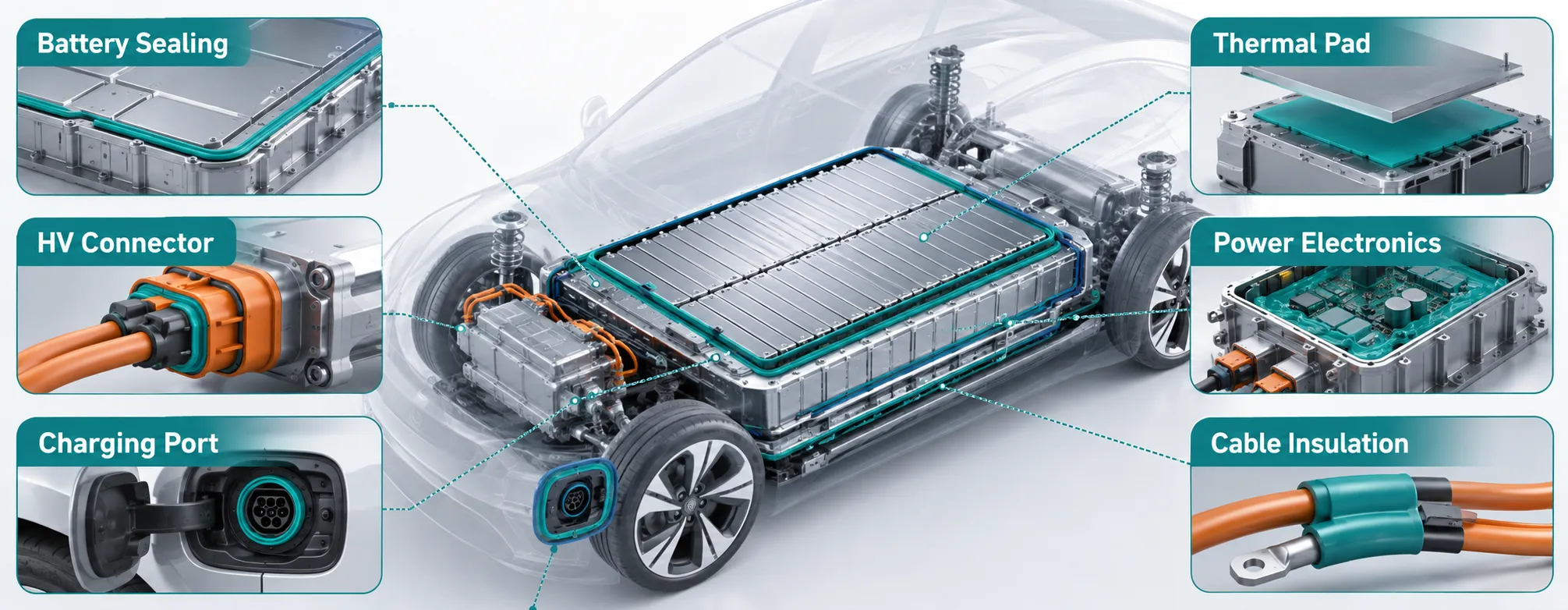
Where Is Silicone Rubber Used in New Energy Vehicles?
The use of silicone rubber in NEVs extends far beyond ordinary O-rings and seals. Depending on the formulation and manufacturing method, it can be found throughout the high-voltage electrical architecture and thermal-management system.
| NEV system | Typical silicone application | Main material requirement |
|---|---|---|
| Battery pack | Enclosure seals, vent seals, connector seals, insulating parts and protective components | Sealing, electrical insulation, temperature resistance and compression recovery |
| High-voltage connectors | Connector seals, cable seals, terminal protection and molded insulation | Dielectric performance, flexibility and environmental sealing |
| Charging port | Weather seals, dust seals, cable components and connector interfaces | Water resistance, UV resistance, low-temperature flexibility and durability |
| Power electronics | Potting, encapsulation, gaskets, thermal pads and insulating components | Electrical isolation, thermal stability and vibration resistance |
| Thermal management | Thermally conductive pads, gap fillers, seals and flexible interfaces | Heat transfer, conformability and electrical insulation |
| Electric motor and e-drive | Connector seals, cable seals, gaskets and protective insulation | Heat resistance, oil compatibility and vibration durability |
| On-board charger | Potting, sealing and thermal interface components | Electrical insulation, heat dissipation and environmental protection |
| DC-DC converter | Encapsulation, thermal pads and housing seals | Dielectric strength, heat resistance and thermal management |
Silicone Rubber in EV Battery Systems
The battery system is one of the most demanding areas of an electric vehicle. Battery packs contain high-voltage electrical connections, cells, busbars, cooling components, sensors and electronic control systems that must operate reliably while the vehicle experiences vibration, road splash, temperature changes and mechanical movement.
Silicone rubber can be used around the battery pack where flexible sealing and insulation are required. Typical applications include enclosure gaskets, connector seals, pressure-relief or vent-related seals, electrical insulation components and flexible protective parts.
Battery Pack Sealing
A battery enclosure must help protect internal components from water, dust and road contaminants. Silicone rubber gaskets can maintain contact pressure while accommodating dimensional variation between metal or polymer housing components.
The material should have suitable compression-set performance because a seal that permanently loses thickness may gradually lose sealing pressure during vehicle service.
Temperature cycling is also important. The battery enclosure and silicone gasket may expand and contract at different rates. A flexible elastomer can accommodate some of this movement without cracking.
Electrical Isolation Around Battery Components
Many silicone formulations provide high electrical resistance. This makes silicone useful for insulation around high-voltage connections, sensors, terminals and other parts where accidental current paths must be controlled.
However, not every silicone is electrically insulating. Conductive and static-control silicone compounds also exist, so the electrical properties of the exact formulation must always be confirmed.
High-Voltage Connectors and Cable Systems
NEVs use high-voltage cable systems to connect the battery, inverter, motor, charger and other power components. Connector reliability is critical because moisture, contamination or mechanical damage can affect insulation performance.
Silicone rubber is commonly suited to connector seals because it can deform around cables and connector housings while maintaining elastic recovery.
Connector Interface Sealing
Silicone seals can help prevent water and dust from entering connector cavities. The rubber must maintain sealing force even after repeated mating, vibration and temperature cycling.
Cable Entry Seals
Where a cable enters a connector or enclosure, a silicone seal can accommodate cable movement while maintaining environmental protection.
High-Voltage Electrical Insulation
Electrical-grade silicone can provide useful dielectric strength and high volume resistivity. These properties make silicone suitable for insulation components around high-voltage terminals and cable interfaces.
Silicone Rubber in EV Charging Systems
The vehicle charging interface is repeatedly exposed to users and the external environment. Charging-port components may experience rain, dust, temperature changes, sunlight and repeated mechanical operation.
Silicone rubber can be used for charging-port seals, flexible protective covers, connector seals and cable-related components.
Outdoor Weather Resistance
Silicone provides strong resistance to ultraviolet radiation and ozone, making it useful for components that may be exposed when the charging door is open.
Low-Temperature Flexibility
Charging systems must also function in cold climates. A sealing component that becomes excessively hard in winter may not conform correctly to mating surfaces.
Suitable silicone rubber maintains useful flexibility at low temperature, although the exact minimum operating temperature depends on the compound.
Repeated Connection Cycles
Charging connectors are used repeatedly during the vehicle lifetime. Silicone seals should therefore be evaluated for tearing, compression deformation, friction and long-term elastic recovery.
Electrical Insulation Is a Major Advantage
Electric vehicles contain much more high-voltage equipment than conventional internal-combustion vehicles. Batteries, inverters, chargers, busbars, converters and electric motors all create requirements for reliable electrical isolation.
Properly formulated insulating silicone rubber can provide high resistivity and dielectric performance while remaining flexible.
| Electrical property | Why it matters in NEV design |
|---|---|
| Volume resistivity | Helps limit electrical current through the bulk material |
| Surface resistivity | Relevant to leakage current across exposed surfaces |
| Dielectric strength | Helps determine resistance to electrical breakdown |
| Dielectric constant | Influences electric-field and capacitance behavior |
| Dissipation factor | Indicates dielectric energy loss under alternating electrical stress |
The correct electrical properties depend on the component. A connector seal, battery insulation part and power-electronics encapsulant may require different silicone formulations even when all three applications need electrical insulation.
Temperature Resistance in NEV Applications
Temperature resistance is another major reason silicone rubber is used in electric vehicles.
Vehicle components can experience cold starts in winter, high underbody temperatures, heat generated by power electronics and repeated thermal cycling during charging and driving.
Many general silicone rubber materials can operate across a broad temperature range, while specialized automotive silicone grades can extend beyond ordinary formulations.
Temperature suitability should always be based on the exact material data sheet rather than a generic statement that all silicone rubber withstands the same temperature.
Low-Temperature Performance
At low temperatures, conventional elastomers may become harder and less flexible. Silicone rubber generally maintains useful elasticity at lower temperatures, which is valuable for seals and flexible electrical components.
High-Temperature Performance
Silicone rubber can maintain useful properties under elevated temperatures, but long-term heat exposure still causes aging. Hardness, tensile strength, elongation and compression set should be evaluated after heat aging.
Thermal Cycling
In an NEV, components may repeatedly move between cold ambient conditions and elevated operating temperatures. Different materials expand and contract by different amounts, creating stress at seals, bonded joints and interfaces.
Silicone's flexibility can help accommodate this movement.
Silicone Rubber for Thermal Management
Thermal management is essential in EV batteries and power electronics because excessive temperature can reduce component efficiency, affect battery life and accelerate material aging.
Standard silicone rubber is not automatically a high-performance heat conductor. However, silicone can be heavily modified with thermally conductive fillers to create thermal interface materials.
Thermal Pads
Soft silicone thermal pads can fill small gaps between electronic components and cooling surfaces. Their conformability helps reduce air gaps that would otherwise increase thermal resistance.
Gap Fillers
Silicone-based gap fillers can conform around irregular components while transferring heat toward a cooling plate or housing.
Thermally Conductive Encapsulation
Filled silicone encapsulants can provide electrical insulation and thermal transfer in power-electronics assemblies.
“Silicone rubber” does not automatically mean “thermally conductive silicone.” High thermal conductivity requires a specially filled formulation, and increasing filler loading can change viscosity, hardness, density and mechanical behavior.
Power Electronics and Silicone Encapsulation
Power electronics are central to NEV operation. Inverters, on-board chargers and DC-DC converters contain sensitive electronic components operating under high voltage and significant thermal stress.
Silicone gels, potting materials and encapsulants can protect assemblies from moisture, dust, vibration and electrical stress.
Silicone Gel
Silicone gel is very soft and can surround delicate components without generating the mechanical stress associated with harder encapsulation materials.
Silicone Potting Compound
Potting compounds can completely surround electronic components and provide environmental and electrical protection.
Flexible Encapsulation
Silicone's low modulus compared with many rigid resins can help accommodate thermal-expansion differences between metals, ceramics, circuit boards and semiconductor packages.
Flame Resistance in NEV Design
Fire and thermal-safety requirements are important in high-voltage automotive systems, particularly around batteries and power electronics.
Silicone has useful thermal stability, but not every silicone rubber grade has the same flame-retardant performance.
Automotive designers should select a formulation with verified flammability performance where flame resistance is required.
Flame-retardant silicone compounds can be developed using specially selected fillers and formulation technologies. The resulting material should still be evaluated for electrical, mechanical and processing requirements.
| Requirement | Why it matters | What to verify |
|---|---|---|
| Flammability | Helps control material behavior when exposed to ignition | Specified test method and classification |
| Smoke behavior | May be relevant to enclosed vehicle spaces | Application-specific requirements |
| Heat aging | Shows how the material changes after long-term thermal exposure | Hardness, tensile strength and elongation retention |
| Electrical insulation | Required around high-voltage components | Electrical properties after thermal aging |
Sealing Against Water, Dust and Road Contaminants
Many NEV components are installed in locations exposed to rain, road splash, dust, mud and cleaning fluids.
Silicone rubber can provide flexible environmental sealing around battery housings, electrical connectors, charging interfaces, electronic enclosures and thermal-management connections.
Seal reliability depends on more than the rubber material itself. Groove geometry, compression ratio, surface finish, assembly tolerance and long-term compression set all influence performance.
Compression Set
Compression set measures how much permanent deformation remains after a rubber component has been compressed for a specified time and temperature.
Low compression set can be important for long-life vehicle seals because the material must continue applying sealing pressure after years of compression.
Seal Geometry
Even excellent silicone rubber can leak when the gasket groove is incorrectly designed or compression is uneven.
Material and mechanical design should therefore be developed together.
Resistance to Vibration and Mechanical Movement
Automotive components experience vibration from roads, motors, pumps and drivetrain systems. Battery packs and power-electronics assemblies may also experience continuous small movements during driving.
A flexible silicone component can absorb movement without transferring excessive stress to nearby components.
This characteristic is useful in connector seals, cable interfaces, electronic encapsulation and thermal interface materials.
However, softness alone does not guarantee durability. Tear resistance, fatigue behavior and abrasion resistance should also be evaluated.
Chemical Resistance Must Be Checked Carefully
Silicone rubber provides useful resistance to many environmental conditions, but it is not universally resistant to every automotive fluid.
NEV components may come into contact with coolant, lubricants, cleaning chemicals, road salt and other substances. Chemical exposure can cause swelling, hardness changes or loss of mechanical strength in unsuitable compounds.
The exact silicone formulation should therefore be tested against the actual fluids, concentration, temperature and exposure duration expected in the vehicle.
HTV Silicone Rubber in NEV Manufacturing
HTV silicone rubber, also known as HCR or high-consistency silicone rubber, is widely used for extruded and molded components.
Before curing, HTV silicone has a firm, gum-like consistency. It can be processed through extrusion, compression molding, transfer molding and specialized injection-molding systems.
Potential NEV applications include cable insulation, molded seals, profiles, gaskets, connector components and thermal or electrical protective parts.
HTV can be formulated for different hardness levels, electrical properties, flame behavior and temperature requirements.
Liquid Silicone Rubber in NEV Design
Liquid silicone rubber, or LSR, is a two-component pumpable silicone used primarily for automated injection molding.
LSR is particularly useful for producing high-volume precision parts with detailed geometry and consistent dimensions.
Typical automotive applications can include connector seals, membranes, grommets, electrical components, sensor seals and other precision molded parts.
Because LSR can flow into fine mold details, it can be particularly suitable for complex sealing geometries.
HTV vs Liquid Silicone Rubber for NEV Parts
| Feature | HTV / HCR silicone | Liquid silicone rubber |
|---|---|---|
| Uncured form | Firm, high-consistency compound | Pumpable liquid |
| Typical processing | Extrusion, compression and HCR injection molding | Liquid injection molding |
| Continuous profiles | Well suited | Normally not the primary choice |
| Complex precision parts | Possible depending on molding system | Very well suited |
| Automation | Depends on production system | Highly suited to automated molding |
| Typical NEV use | Cable products, seals, profiles and molded components | Connector seals, grommets, membranes and precision parts |
Silicone Rubber Can Be Electrically Conductive Too
Although silicone rubber is commonly associated with electrical insulation, specialized compounds can be made electrically conductive by adding conductive fillers.
Conductive silicone can be used for electromagnetic interference shielding, grounding, conductive gaskets and other specialized functions.
Static-dissipative and semiconductive formulations are also possible.
This illustrates why material identification is important in NEV design. A black silicone component should not automatically be assumed to be conductive, and a light-colored component should not automatically be assumed to be insulating.
Electrical resistance must be verified from the formulation and technical data.
Key Silicone Rubber Properties for NEV Design
| Property | Why it matters in an NEV |
|---|---|
| Hardness | Affects sealing pressure, deformation and assembly |
| Tensile strength | Supports mechanical durability |
| Elongation | Allows flexible parts to stretch without rupture |
| Tear strength | Important for thin seals, edges and repeated assembly |
| Compression set | Critical for long-term gasket and connector sealing |
| Temperature range | Supports operation from cold climates to hot electronics environments |
| Volume resistivity | Important for high-voltage electrical isolation |
| Dielectric strength | Helps evaluate insulation capability |
| Flame performance | May be important around batteries and power electronics |
| Thermal conductivity | Important for silicone used as a thermal interface material |
| Chemical resistance | Determines compatibility with coolant, oils and road contaminants |
How to Choose Silicone Rubber for an NEV Application
- Define the component function. Determine whether the silicone provides sealing, electrical insulation, thermal transfer, vibration protection or multiple functions.
- Define the voltage environment. Identify operating voltage, electrical clearance and required insulation performance.
- Define the temperature range. Include continuous temperature, cold starts, peak temperature and repeated thermal cycling.
- Check mechanical requirements. Review hardness, tensile strength, elongation, tear resistance and compression set.
- Evaluate environmental sealing. Consider water, dust, humidity, road splash and washing conditions.
- Review chemical exposure. Test compatibility with coolant, oil, cleaners and other relevant fluids.
- Define flame requirements. Select a verified flame-retardant formulation where required.
- Determine thermal conductivity. For thermal interface applications, specify the required thermal performance rather than using standard silicone.
- Select the manufacturing process. Compare HTV, LSR, RTV and silicone gel according to part geometry and production volume.
- Check bonding requirements. Determine whether the silicone must adhere to aluminum, steel, plastic, glass or another elastomer.
- Evaluate aging. Test heat aging, thermal cycling, vibration and environmental exposure.
- Test the finished component. Material data alone cannot validate the complete NEV assembly.
Common Mistakes When Selecting Silicone for NEVs
Choosing by Hardness Alone
Two silicone compounds with the same Shore A hardness can have very different tear strength, compression set, electrical properties and temperature performance.
Assuming Every Silicone Is Flame Retardant
Silicone has good heat stability, but required flame performance must be verified for the exact formulation.
Assuming Every Silicone Is Electrically Insulating
Conductive and semiconductive silicone formulations also exist.
Using Standard Silicone as a Thermal Interface Material
Thermal conductivity normally requires specialized filled silicone formulations.
Ignoring Compression Set
A material can appear soft and flexible while gradually losing sealing force after prolonged compression.
Ignoring Chemical Compatibility
Automotive fluids can cause swelling or property changes in an unsuitable elastomer.
Testing Only at Room Temperature
NEV components should be tested across realistic temperature, vibration and environmental conditions.
Frequently Asked Questions
Why is silicone rubber used in electric vehicles?
Silicone rubber is used because it can combine temperature resistance, electrical insulation, sealing, flexibility, weather resistance and vibration durability.
Where is silicone rubber used in an EV battery?
Applications can include enclosure seals, connector seals, insulating components, vent-related seals and other flexible protective parts.
Is silicone rubber electrically insulating?
Many standard silicone rubber compounds are good electrical insulators, but conductive and static-control silicone formulations are also available.
Can silicone rubber handle EV battery temperatures?
Many silicone grades provide broad temperature capability, but suitability should be determined from the exact material specification and actual battery operating conditions.
Is silicone rubber flame resistant?
Silicone has useful thermal stability, but flame-retardant performance varies by formulation. A qualified flame-retardant grade should be used when a specific classification is required.
Is silicone rubber used for EV thermal management?
Yes. Special thermally conductive silicone materials can be used in pads, gap fillers and encapsulation systems for batteries and power electronics.
What is the difference between HTV and LSR in automotive applications?
HTV is a high-consistency compound suited to extrusion and several molding processes, while LSR is a pumpable two-component material suited to automated precision injection molding.
Can silicone rubber seal high-voltage connectors?
Yes. Suitable silicone grades can provide flexible environmental sealing and electrical insulation around high-voltage connector systems.
Is silicone rubber resistant to EV coolant?
Compatibility depends on the silicone formulation, coolant chemistry, temperature and exposure time. The actual material and fluid should be tested together.
What is the most important silicone property for NEV design?
There is no single most important property. Temperature resistance, electrical performance, compression set, tear strength, flame requirements and chemical compatibility should be evaluated according to the component function.