
Is Food Grade Silicone Safe?
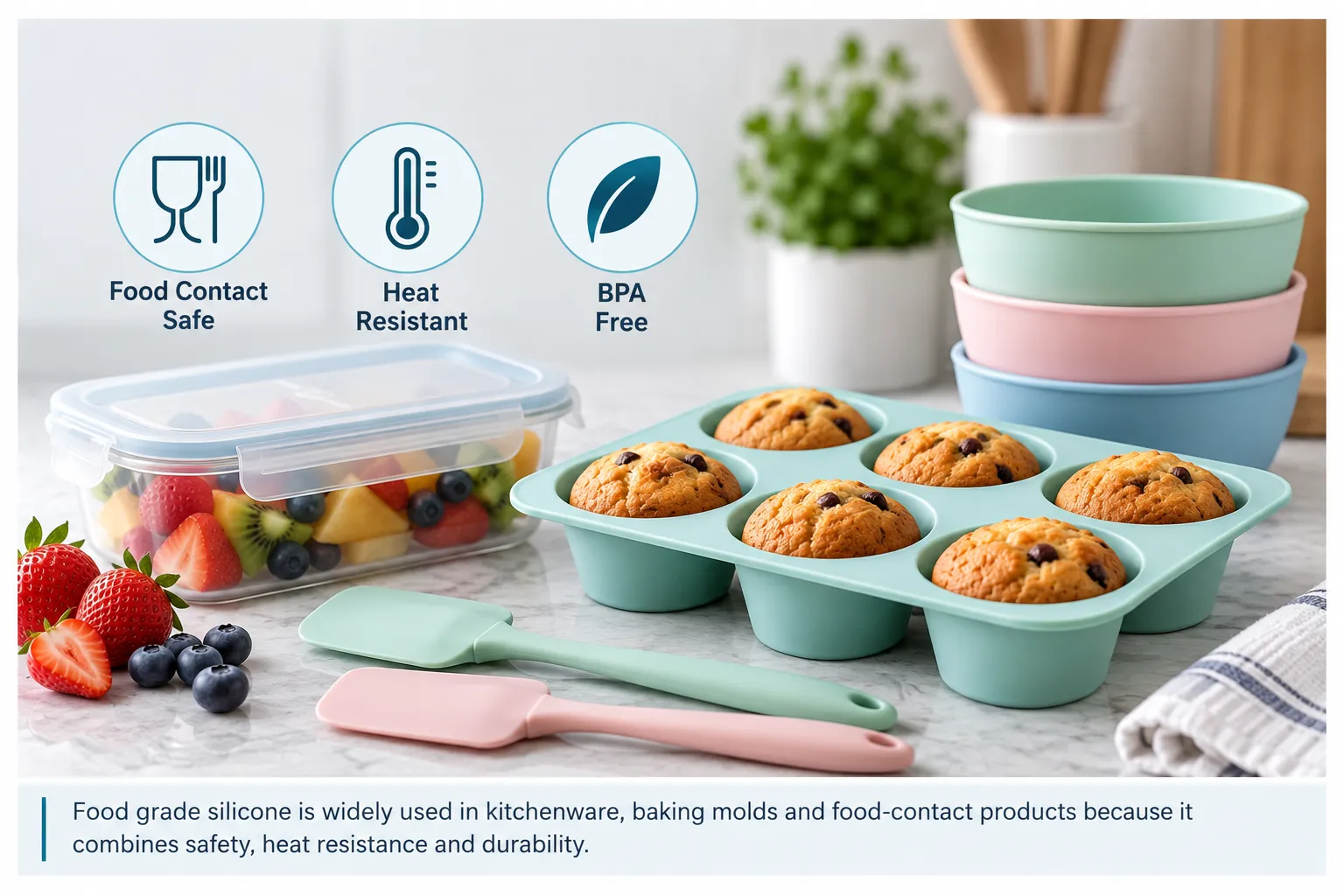
Food grade silicone is generally considered suitable for food-contact applications when it is correctly formulated, properly cured and used within the conditions for which the material has been evaluated. It is widely used for kitchenware, baking molds, seals, tubing, food-processing components and other products that may repeatedly contact food.
However, the words “food grade” alone are not enough to prove that every silicone product is appropriate for every food-contact use. The safety of a finished silicone article depends on the complete formulation, curing process, pigments and additives, manufacturing cleanliness, temperature exposure and the regulatory requirements of the market where the product will be sold.
This guide explains what food grade silicone means, why it is used, which safety questions buyers should ask and how requirements such as FDA 21 CFR, LFGB and BfR Recommendation XV relate to silicone rubber.

What Is Food Grade Silicone?
Food grade silicone is silicone rubber formulated and manufactured for applications where the finished material may come into contact with food. It is not a completely different polymer from industrial silicone rubber. The difference is primarily in raw-material selection, formulation control, processing, testing and documentation for the intended food-contact application.
Most silicone elastomers are based on a siloxane polymer backbone containing alternating silicon and oxygen atoms. Reinforcing silica, processing ingredients, pigments and a curing system are then incorporated to produce the required hardness, mechanical properties and processing behavior.
For a food-contact compound, these ingredients need to be selected with the intended market and regulatory requirements in mind.
So, Is Food Grade Silicone Safe for Food Contact?
When an appropriate silicone compound is correctly manufactured, cured and tested for its intended food-contact conditions, it can be a suitable material for repeated food-contact use.
The important phrase is “for its intended conditions of use.” Food-contact safety cannot be separated from temperature, contact time, food type and the way the finished article is manufactured.
A silicone baking mold may face prolonged exposure to elevated temperatures. A beverage seal may remain in repeated contact with liquid. A food-processing gasket may experience heat, cleaning chemicals and compression. These products can all use food grade silicone, but they do not necessarily require identical formulations or test conditions.
Why Is Silicone Rubber Used for Food-Contact Products?
Silicone rubber offers a combination of properties that makes it useful for kitchenware and food-processing components. Properly formulated silicone can remain flexible over a wide temperature range, resist moisture and maintain elastic sealing performance during repeated use.
Heat Resistance
Silicone is widely used in baking and cooking products because suitable grades can tolerate elevated temperatures better than many conventional elastomers.
Flexibility
The material can be molded into soft, flexible shapes such as baking molds, seals and kitchen utensils.
Water Resistance
Silicone has low water absorption and performs well in wet food-processing environments.
Elastic Sealing
Silicone can maintain compression and flexibility in seals, gaskets and closures.
Temperature Range
Suitable compounds can remain functional across both cold and hot service conditions.
Molding Versatility
HTV/HCR and LSR materials can be processed into a wide range of food-contact shapes and components.
What Does “Food Grade” Actually Mean?
“Food grade” is a useful commercial description, but buyers should not treat it as one universal international certification.
Different markets use different regulatory systems and test approaches. A material appropriate for one market may need different documentation or additional testing for another.
| Requirement | What It Relates To | What Buyers Should Understand |
|---|---|---|
| FDA 21 CFR | United States food-contact requirements | Certain repeated-use rubber articles may be evaluated against applicable provisions such as 21 CFR 177.2600. |
| LFGB | German food and consumer-product legal framework | “LFGB silicone” is commonly used commercially, but buyers should ask which test or declaration supports the specific article or material. |
| BfR Recommendation XV | German recommendation concerning silicones | Frequently referenced for food-contact silicone materials in Germany and related European projects. |
| REACH | EU chemical regulation | REACH is important for chemical compliance but should not be described as a food-contact certification. |
For purchasing purposes, it is more useful to ask for the exact declaration, test report or applicable regulatory reference than simply to ask whether a product is “certified food grade.”
FDA Silicone Does Not Mean Every Silicone Product Is FDA Approved
The phrase “FDA silicone” is widely used in the market, but it can be misleading if it is interpreted as a universal FDA approval for every finished product.
For repeated-use rubber articles, buyers may encounter references to 21 CFR 177.2600. The relevant evaluation can include requirements associated with the composition and extractives of the material under defined test conditions.
The supplier should be able to explain which regulation or test method applies to the specific compound rather than using “FDA” only as a marketing label.
Better Question for Suppliers
Instead of asking “Is this FDA certified?”, ask: “Which FDA food-contact requirement does this grade support, and what documentation is available for the exact material?”
What Is LFGB Silicone?
LFGB is frequently mentioned when silicone kitchenware and food-contact materials are sold in Germany or European markets. In commercial language, “LFGB silicone” often refers to silicone materials or finished articles that have undergone testing associated with German food-contact requirements.
However, LFGB should not simply be treated as the European equivalent of an FDA certificate. The regulatory frameworks and testing approaches are different.
Buyers should therefore request the actual test report or declaration and verify that it applies to the exact silicone grade, color and intended article being purchased.
What Is BfR Recommendation XV?
BfR Recommendation XV is commonly referenced for silicones intended for food-contact use in Germany. It addresses silicone materials and provides guidance relevant to the composition and use of silicone products that may contact food.
For suppliers of silicone rubber compounds, BfR XV may form part of the documentation package requested by customers manufacturing kitchenware, seals, tubing and food-processing components.
As with other regulatory references, the important issue is whether the documentation applies to the specific compound being supplied and whether the finished article is manufactured under appropriate conditions.
Why Migration and Extractables Matter
A major purpose of food-contact testing is to evaluate whether substances can transfer from the material into food or food simulants under defined conditions.
Silicone rubber is a crosslinked elastomer, but the finished material can still contain low-molecular-weight substances, residual processing ingredients or other extractable components depending on formulation and curing.
This is one reason proper curing and, where required by the formulation or application, post-curing can be important for certain silicone products.
Does the Curing System Affect Food Grade Silicone?
Yes. Silicone rubber can use different curing chemistries, and the curing system influences both processing and the characteristics of the finished material.
High-consistency silicone rubber may use peroxide curing or platinum-catalyzed addition curing. Liquid silicone rubber commonly uses platinum addition curing.
| Aushärtungssystem | General Characteristics | Food-Contact Consideration |
|---|---|---|
| Peroxide Cure | Widely used in traditional HTV/HCR silicone processing | Correct curing and, where appropriate, post-curing conditions need to be followed for the specified application. |
| Platinum Addition Cure | Used in LSR and certain HCR compounds | Often selected for clean curing behavior and tightly controlled food-contact or precision applications. |
Platinum-cured silicone is sometimes marketed as automatically “safer” than peroxide-cured silicone, but this is too simplistic. A properly formulated and processed peroxide-cured compound can also be suitable for food-contact applications where the required testing and conditions are met.
Does Food Grade Silicone Contain BPA?
BPA is associated primarily with certain polycarbonate plastics and epoxy systems. It is not normally part of the basic silicone elastomer polymer chemistry.
However, buyers should avoid assuming that every product marketed as silicone is identical. Finished articles can contain pigments, fillers, coatings, bonded components or other materials that are not the silicone polymer itself.
If BPA-related declarations are important to a customer specification or retail market, request supporting documentation for the actual finished material rather than relying only on the generic fact that silicone chemistry is different from polycarbonate plastic.
Is Food Grade Silicone Plastic?
Silicone rubber is generally classified as an elastomer rather than a conventional thermoplastic. Its chemistry is based on a siloxane backbone rather than the carbon-chain structure typical of most plastics.
After curing, silicone rubber forms a crosslinked elastic network. It does not normally soften and remelt in the same way as common thermoplastics such as polyethylene or polypropylene.
This distinction helps explain why silicone is useful for flexible baking molds, seals and other products that must maintain their shape over repeated heating and cooling cycles.
Is Food Grade Silicone Safe at High Temperatures?
Suitable silicone rubber grades are widely used in high-temperature food-contact applications, including baking products and food-processing seals. However, no single temperature limit should be applied to every food grade silicone compound.
Temperature capability depends on the formulation, curing system, exposure duration and design of the finished product. Continuous exposure and short-term peak temperature should also be treated separately.
Consumers should follow the temperature limits provided by the finished-product manufacturer. Industrial buyers should define the actual service temperature before selecting the silicone compound.
Can Food Grade Silicone Be Used in an Oven?
Many silicone baking products are specifically designed for oven use, but oven suitability depends on the finished product and the temperature range specified by its manufacturer.
The term food grade does not itself define the maximum oven temperature. A food-contact seal used at moderate temperatures and a baking mold exposed to repeated high-temperature cycles may both be food grade silicone while requiring different formulations.
For manufacturers, heat resistance should therefore be evaluated together with food-contact compliance rather than assuming one automatically guarantees the other.
Can Food Grade Silicone Be Used in a Microwave?
Silicone products specifically designed and validated for microwave use are widely available. The suitability of a particular product still depends on its design, formulation and any other materials incorporated into the finished article.
Metal inserts, coatings, printed elements or bonded components can change the suitability of the finished product even if the silicone portion itself is appropriate for food contact.
For consumers, follow the instructions supplied with the actual kitchen product. For manufacturers, qualification should be performed on the finished design rather than on raw silicone rubber alone.
Does Food Grade Silicone Leach Into Food?
The purpose of appropriate food-contact formulation, curing and testing is to control the transfer of substances from the material under intended conditions of use.
It is more accurate to discuss migration or extractables than to claim that every silicone product either “leaches” or “does not leach.” Test results depend on temperature, time, food simulant and the exact material formulation.
A properly evaluated silicone compound should therefore be supported by documentation relevant to the intended food-contact conditions.
Why Some Silicone Products Have an Odor
A noticeable odor can result from processing residues, curing by-products, packaging or other materials associated with the finished product. Odor alone does not provide a complete determination of food-contact safety, but strong or persistent odor can indicate that the product deserves further investigation.
For industrial manufacturers, proper curing, post-curing where required, clean production and appropriate packaging can help control odor and volatile residues.
If a supplier claims a food grade material but cannot provide basic technical or food-contact documentation, appearance and smell should not be used as substitutes for verification.
Color Can Affect the Finished Silicone Compound
Food grade silicone is available in many colors, but pigments are part of the overall formulation. A compliant natural or translucent base compound does not automatically mean every possible pigment system will meet the same requirements.
When color is customized, buyers should confirm that the pigment package is also appropriate for the intended food-contact market.
Food Grade Silicone vs Regular Silicone Rubber
The difference is not simply appearance. Both materials may look and feel almost identical, but the food-contact grade is selected, manufactured and documented around requirements that may not apply to general industrial silicone.
| Characteristic | Food Grade Silicone | General Industrial Silicone |
|---|---|---|
| Base Chemistry | Silicone elastomer | Silicone elastomer |
| Raw-Material Selection | Controlled around intended food-contact requirements | Selected around industrial performance requirements |
| Food-Contact Documentation | May include applicable FDA, LFGB/BfR or other market-specific support | Not necessarily available |
| Processing Control | May require additional attention to cleanliness, curing and post-curing | Depends on industrial application |
| Typical Uses | Kitchenware, seals, tubing and food-processing parts | Electrical, automotive, industrial seals, molded parts and cable |
Food Grade Silicone vs Medical Grade Silicone
Food grade and medical grade are not interchangeable descriptions. A material suitable for food contact is not automatically suitable for a medical device or for contact with the human body under medical-use conditions.
Medical projects can involve different biological evaluation, cleanliness, traceability, sterilization and regulatory requirements.
Manufacturers should therefore specify the actual end use rather than assuming that one “high purity” silicone grade is suitable for every regulated application.
What Products Use Food Grade Silicone?
Food-contact silicone is used both in consumer products and industrial processing equipment. The formulation and processing method can vary depending on the component.
Baking Molds
Flexible silicone allows cakes, bread and other baked products to be removed from molds easily.
Kitchen Utensils
Spatulas, handles and other kitchen products can use heat-resistant silicone components.
Seals & Gaskets
Silicone provides flexible sealing in food-processing and dispensing equipment.
Tubing
Suitable silicone tubing can be used to transfer liquids in food and beverage processing.
Containers & Lids
Flexible silicone can be used in closures, sealing rings and reusable storage products.
Processing Components
Custom molded parts may be used in food-production machinery where repeated food contact occurs.
HTV/HCR Food Grade Silicone
High-consistency silicone rubber is widely used for compression molding, extrusion, calendering and other industrial processes. Food-contact HTV/HCR compounds can be formulated for products such as seals, gaskets, tubing, kitchenware and molded components.
HCR stands for high consistency rubber, while HTV refers to high-temperature vulcanizing silicone. In many industrial contexts, the terms describe closely related high-consistency, heat-cured silicone compounds.
For food-contact applications, the HCR formulation needs to provide both the required regulatory support and the processing characteristics necessary for stable manufacturing.
LSR Food Grade Silicone
Liquid silicone rubber is also widely used for food-contact products. LSR is supplied as a two-component liquid system and is normally processed using automated liquid injection molding.
It can be particularly useful for high-volume precision parts, thin geometries and products requiring automated molding. Platinum-catalyzed curing is commonly associated with LSR processing.
The decision between HCR and LSR should be based primarily on production equipment, part geometry, annual volume and required properties rather than on the assumption that one material is automatically more food safe than the other.
What Can Make a Silicone Product Unsuitable for Food Contact?
Silicone chemistry itself does not guarantee that every silicone-looking product is suitable for direct food contact. Several factors can create problems.
How Can Buyers Verify Food Grade Silicone?
Industrial buyers should verify food-contact suitability through documentation rather than appearance, flexibility or marketing language.
| What to Check | What to Ask the Supplier |
|---|---|
| Exact Grade | Which material grade is being quoted, and is the documentation linked to that grade? |
| Target Market | Is the finished product intended for the United States, Germany, EU or another market? |
| Regulatory Support | Which FDA, LFGB/BfR or other food-contact requirements are supported? |
| Test Report | Can the relevant report be supplied, and which formulation or color does it cover? |
| Curing Conditions | What curing or post-curing process should be used? |
| Traceability | Can commercial batches be traced using batch or lot identification? |
What Should Be Included in a Food Grade Silicone RFQ?
A clear RFQ helps the supplier identify whether an existing food-contact silicone compound is suitable for the project.
Why Supplier Control Matters
Food-contact applications place greater importance on formulation control and traceability. A good sample is useful, but commercial production also needs consistency from batch to batch.
Manufacturers should understand how the supplier controls raw materials, compounding, pigments, curing ingredients, batch identification and quality testing.
| Supplier Control | Why It Matters |
|---|---|
| Raw-Material Control | Helps ensure that the agreed formulation is produced consistently. |
| Batch Identification | Allows the material to be traced if a production issue occurs. |
| Change Control | Important when changes could affect previously reviewed food-contact documentation. |
| Quality Testing | Helps confirm routine material properties remain within the agreed specification. |
| Documentation Control | Helps connect declarations and reports to the correct silicone grade. |
Food Grade Silicone from Yakows
Yakows supplies HTV/HCR silicone rubber compounds for food-contact and industrial applications. Food grade silicone materials can be selected for kitchenware, seals, tubing, food-processing components and other molded or extruded products.
Depending on the project and target market, Yakows can support requirements associated with FDA 21 CFR, LFGB, BfR Recommendation XV and REACH. These requirements are treated according to their actual regulatory or documentation role rather than being described collectively as one universal certification.
Customers can provide the product application, processing method, Shore A hardness, operating temperature, target market, color and required food-contact documentation so that an appropriate silicone rubber grade can be evaluated.
Frequently Asked Questions
Is food grade silicone safe?
Food grade silicone can be suitable for food contact when the material is correctly formulated, properly cured, appropriately tested and used within the conditions for which it was evaluated.
Is food grade silicone toxic?
A properly formulated and evaluated food-contact silicone is designed for the intended contact conditions. Buyers should rely on applicable food-contact documentation and testing rather than assuming safety from the material name alone.
Is food grade silicone BPA free?
BPA is not normally part of the basic silicone elastomer chemistry. However, a finished product may contain other materials, pigments or components, so BPA-related claims should be verified for the actual product when required.
Is silicone safer than plastic for food?
Silicone and plastics are different material families and each can be suitable for food contact when appropriately formulated and used. Safety depends on the specific material, additives, conditions of use and applicable regulatory requirements rather than on a simple silicone-versus-plastic comparison.
Can food grade silicone go in the oven?
Many silicone baking products are designed for oven use, but the allowable temperature depends on the exact product and formulation. Follow the finished-product manufacturer's temperature instructions.
Can food grade silicone go in the microwave?
Silicone products specifically designed for microwave use can be suitable, but the complete finished article must be considered, including inserts, coatings and other non-silicone components.
Does food grade silicone leach chemicals?
Food-contact testing evaluates migration or extractables under defined conditions. The results depend on the formulation, curing process, temperature, contact time and test medium, so documentation for the specific material should be reviewed.
What is FDA food grade silicone?
The term is commonly used for silicone materials intended to support applicable U.S. food-contact requirements. For certain repeated-use rubber applications, buyers may encounter references to 21 CFR 177.2600. The exact regulatory basis should be confirmed with the supplier.
What is LFGB silicone?
LFGB silicone is a common commercial term for silicone products intended for German or European food-contact applications and supported by relevant testing or documentation. Buyers should review the actual test report rather than relying only on the label.
Is platinum-cured silicone safer than peroxide-cured silicone?
Platinum curing offers clean addition-cure chemistry and is widely used in food-contact products, but correctly formulated and processed peroxide-cured silicone can also be suitable. The appropriate choice depends on the application and required testing.
How can I tell if silicone is really food grade?
For industrial sourcing, request the exact grade, technical datasheet, relevant food-contact declaration or test report, target-market information and batch traceability. Appearance alone cannot confirm food-contact suitability.