
Silicone Rubber Formulation Guide
How To Adjust The Hardness Of Silicone
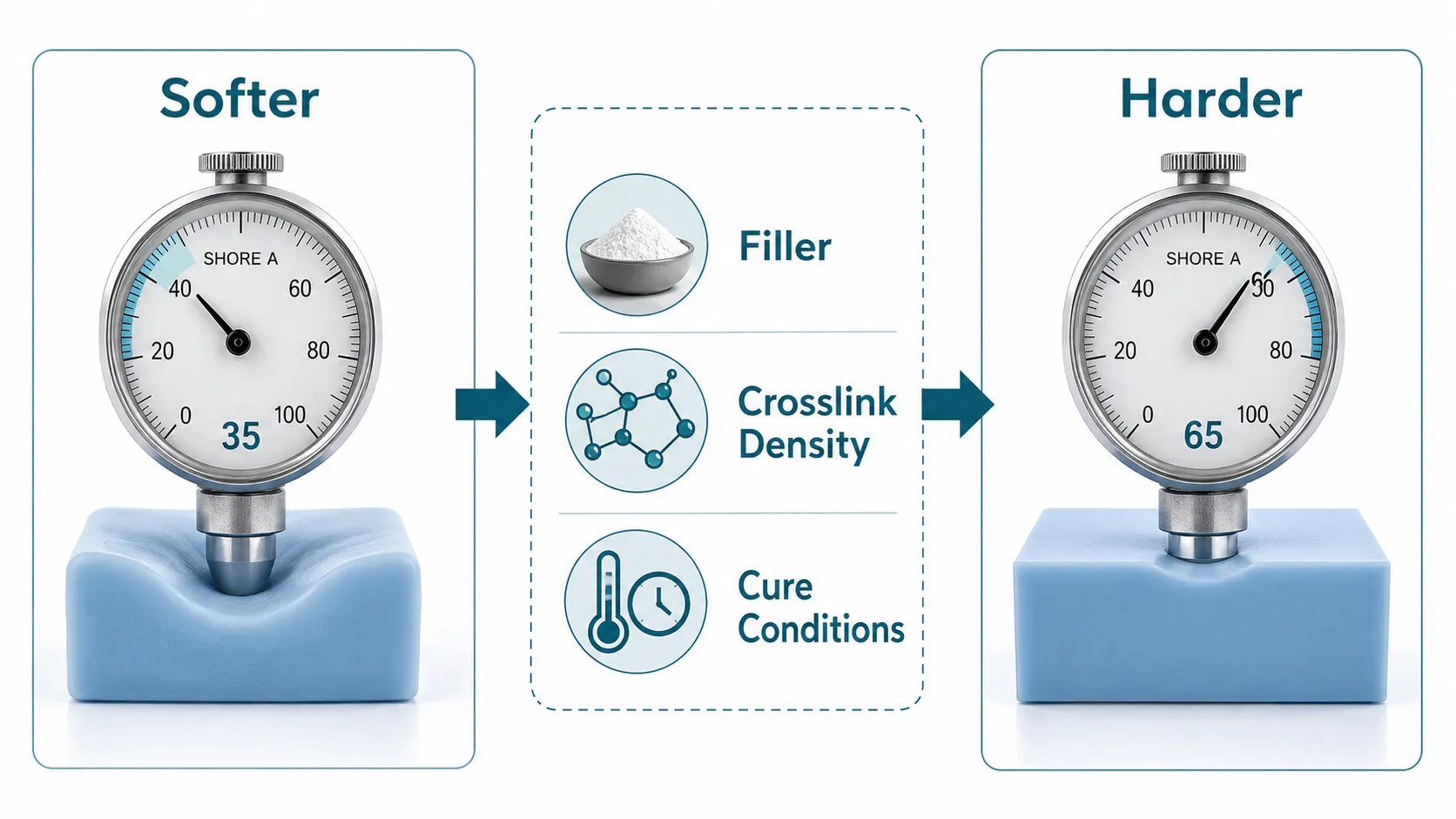
Adjusting silicone hardness is not simply a matter of adding more or less curing agent. In industrial silicone rubber, hardness is the result of the complete formulation, including the silicone polymer, reinforcing filler, crosslink density, processing additives and curing conditions. For HTV and HCR silicone rubber in particular, the correct way to obtain Shore A 30, 50, 60 or 70 is to design the compound around the required hardness while maintaining tensile strength, elongation, tear resistance, compression behavior and processing stability.
01
Understanding the Target
What Does Silicone Hardness Actually Mean?
Silicone hardness describes how strongly cured silicone rubber resists indentation. For most industrial silicone elastomers, this property is measured with a Shore A durometer. A lower Shore A value generally indicates a softer and more easily deformed silicone, while a higher value indicates a firmer material with greater resistance to indentation.
Hardness should not be confused with tensile strength or stiffness under every type of load. Two silicone compounds can both measure 60 Shore A while having very different tear strength, elongation, compression set or rebound behavior. This is why adjusting silicone hardness must be treated as a formulation problem rather than a single-property adjustment.
Soft and highly deformable
Flexible general-purpose range
Firmer industrial silicone
High support and low deformation
The correct hardness depends on the final product. A soft sealing lip may need easy deformation to conform to an irregular surface, whereas an electrical insulator housing or structural molded component may require greater dimensional support.
02
Formulation Logic
What Controls Silicone Hardness?
The hardness of silicone rubber is created by several interacting variables. The silicone polymer forms the elastic matrix, reinforcing silica gives the compound mechanical strength and body, and the curing system creates the crosslinked network that holds the elastomer together. Processing aids and other additives then modify how these ingredients interact.
Because these variables influence one another, increasing hardness usually changes more than hardness itself. A compound that becomes firmer may also show lower elongation, different tear behavior, increased mixing viscosity or greater molding pressure. A softer formulation may become easier to compress but could lose dimensional stability or mechanical strength if the adjustment is too aggressive.
| Formulation Variable | Typical Effect on Hardness | Other Properties That May Change |
|---|---|---|
| Reinforcing silica | Usually increases hardness | Tensile strength, tear strength, viscosity and processing |
| Polymer selection | Changes the base response of the compound | Elasticity, processing behavior and mechanical strength |
| Crosslink density | Higher density generally produces a firmer network | Elongation, compression behavior and elastic recovery |
| Silicone processing fluid / modifier | Can reduce hardness in suitable formulations | Strength, migration, compression properties and processing |
| Curing condition | Insufficient cure may give artificially low hardness | Mechanical properties and long-term stability |
03
HTV/HCRシリコーン
How to Increase the Hardness of Silicone Rubber
For HTV and HCR silicone rubber, one of the most common ways to increase hardness is to modify the reinforcing system. Fumed or precipitated silica is used to reinforce silicone polymer, and changing the type and loading of silica can significantly affect the hardness of the cured compound.
Adding more reinforcing filler generally makes the material firmer because the polymer chains become more strongly constrained by the filler network. The effect is not unlimited, however. Excessive filler can make an HCR compound difficult to mix, extrude or mold. It can also reduce elongation and produce poor flow around complex mold geometry.
The polymer-to-filler balance therefore needs to be adjusted as a complete system. A well-designed 70 Shore A silicone should not simply be a 50 Shore A compound with a large amount of additional filler. The polymer viscosity, silica surface treatment, structure-control additives and curing package may all need to be rebalanced.
Key formulation principleIncrease hardness by redesigning the compound around the target Shore A value rather than forcing hardness upward with one ingredient.
04
Softening the Compound
How to Reduce Silicone Hardness
Reducing silicone hardness normally requires lowering the effective reinforcement or introducing a compatible softening component while preserving the integrity of the cured network. In HCR formulations, this can involve changing filler loading, selecting a different polymer system or adjusting suitable silicone-based processing modifiers.
Low-molecular-weight silicone fluids can soften certain silicone compounds, but they should not be treated as universal plasticizers. Excessive addition may reduce tensile strength, tear resistance or compression performance. Depending on the chemistry, free silicone fluid may also influence surface behavior, bonding or long-term dimensional stability.
A softer compound therefore needs to be designed deliberately. If a product needs to move from 70 Shore A to 40 Shore A, using a dedicated lower-hardness base formulation is usually more reliable than attempting to dilute a finished 70 Shore A compound without considering its complete formulation.
| Softening Approach | Potential Benefit | Main Risk |
|---|---|---|
| Reduce reinforcing filler | Lower Shore hardness and easier deformation | Possible loss of tensile and tear strength |
| Modify polymer system | Changes the fundamental elasticity of the compound | Requires reformulation and processing validation |
| Use compatible silicone modifier | Can reduce hardness and improve processing | Excessive use may reduce mechanical performance |
| Select a softer commercial grade | Predictable properties and processing | May require qualification of a new material |
05
Crosslinking
How Crosslink Density Changes Silicone Hardness
After silicone rubber is cured, its polymer chains are connected through chemical crosslinks. The density of this network has a major influence on how freely the polymer chains can move. A relatively loose network allows greater deformation, while a denser network restricts movement and generally produces a firmer elastomer.
This does not mean that simply adding more curing agent is a good method for increasing silicone hardness. Every curing system has a designed formulation window. Excessive peroxide, crosslinker or catalyst can create processing problems, undesirable by-products or an unbalanced network rather than a properly engineered higher-hardness compound.
→
→
→
Crosslink density should therefore be adjusted through a validated formulation rather than by randomly changing cure-agent concentration during production.
06
Curing Conditions
Can Curing Time or Temperature Adjust Silicone Hardness?
Curing conditions affect the measured hardness because an incompletely cured silicone may not have developed its intended crosslinked structure. If the temperature is too low or the curing time is too short, the finished part may initially feel softer than expected and may also show weak tensile properties or poor compression recovery.
Increasing curing time can raise hardness when the original problem is under-cure, but this should not be confused with formulation-based hardness adjustment. Once a silicone compound has reached its intended state of cure, extending the cure does not provide unlimited control over Shore A hardness.
The same principle applies to molding temperature. Temperature is used to control cure kinetics and production efficiency. It should not be used as a substitute for selecting the correct compound hardness.
07
Post-Cure
Does Post-Curing Make Silicone Harder?
Post-curing can cause some silicone materials to show a moderate change in hardness, but its main purpose is not to convert a soft compound into a hard compound. Post-cure is used with certain silicone systems to complete material conditioning, remove volatile residues and stabilize final properties.
The degree of hardness change depends on the formulation, curing chemistry, post-cure temperature and duration. For some materials the difference may be small, while other compounds can show a more noticeable shift.
If post-cure is specified by the silicone supplier, hardness should be evaluated in the same condition in which the final component will be used. Comparing an as-molded sample with a post-cured specification can otherwise create misleading results.
08
Peroxide vs Addition Cure
Does the Curing System Affect Silicone Hardness?
HTV and HCR silicone rubber can use peroxide curing or, in selected formulations, platinum-catalyzed addition curing. Both systems can produce silicone elastomers across multiple hardness ranges, but their formulation strategies differ.
In peroxide-cured HCR, polymer functionality, filler structure and peroxide system are balanced to achieve the required vulcanization and mechanical properties. In addition-cured silicone, vinyl-functional polymer and silicon-hydride crosslinker react in the presence of a platinum catalyst to create the network.
For addition-cure systems, altering the recommended component ratio solely to change hardness is usually poor practice unless the material manufacturer specifically designed the system to permit ratio adjustment. An incorrect ratio may leave unreacted groups or cause incomplete cure instead of producing a controlled softer material.
| キュア・システム | Correct Hardness Strategy | What to Avoid |
|---|---|---|
| Peroxide-cured HTV / HCR | Adjust the complete polymer, filler and cure formulation | Adding excessive peroxide simply to increase hardness |
| Platinum-cured HCR | Use a formulation designed for the required Shore A | Changing catalyst or crosslinker ratios without validation |
| Two-part LSR | Select or blend manufacturer-approved compatible grades | Randomly changing A:B ratio |
| RTVシリコーン | Use a suitable hardness grade or approved formulation system | Using cure ratio as a general-purpose hardness control |
09
Different Silicone Technologies
Adjusting Hardness in HCR, LSR and RTV Silicone
The practical method for controlling silicone hardness depends strongly on the material technology. HCR is compounded like a high-consistency rubber and provides considerable formulation flexibility. Polymer, silica, additives and curing system can be engineered to produce a wide range of mechanical properties.
LSR is normally supplied as a carefully balanced two-component system. A processor should generally select the appropriate commercial hardness grade rather than changing the A:B mixing ratio. Some manufacturers allow compatible grades to be blended to obtain intermediate hardness values, but compatibility and mixing recommendations need to be confirmed before production.
RTV systems follow the same general principle. The specified mix ratio is part of the curing chemistry, not a simple hardness control. When a different hardness is required, selecting a formulation designed for that hardness normally gives more predictable cure and physical properties.
10
Blending
Can Two Silicone Hardness Grades Be Mixed?
Compatible silicone grades can sometimes be blended to obtain an intermediate hardness, and this can be useful when a manufacturer has designed products around a common polymer and curing platform.
For example, if compatible 40 Shore A and 60 Shore A compounds are available, a controlled blend may produce a hardness between the two grades. However, hardness does not always change in a perfectly linear relationship with blend ratio.
More importantly, mixing two grades also combines their other properties. The resulting tensile strength, tear resistance, elongation, cure rate and processing behavior need to be tested rather than estimated only from Shore A values.
Do not assume 50/50 blending always produces the exact midpoint hardness.Confirm compatibility first, then mold test specimens and measure the cured material under controlled conditions.
11
Property Trade-Offs
What Changes When Silicone Hardness Changes?
Changing silicone hardness alters how the material responds to deformation, but it often changes several other properties at the same time. This is one of the most important considerations when developing a new silicone grade.
A softer material generally conforms more easily to surfaces and requires less force to compress. This can be valuable in soft seals, flexible membranes and delicate interfaces. However, very soft compounds may provide less dimensional support and may be easier to distort during assembly.
A harder silicone generally provides stronger shape retention and greater resistance to indentation. It can be useful for electrical housings, cable accessories and structural rubber parts, but excessive hardness may increase installation force and reduce the ability of a seal to conform to surface irregularities.
| When Hardness Decreases | When Hardness Increases |
|---|---|
| Greater deformation under the same load | Greater dimensional support |
| Usually easier compression | Higher resistance to indentation |
| Potentially better conformity in sealing interfaces | Potentially higher assembly or compression force |
| Mechanical strength may decline if improperly softened | Elongation may decline if excessively reinforced |
12
Sealing Design
How Silicone Hardness Affects Seals and Gaskets
In sealing applications, silicone hardness controls how easily the gasket deforms when compression is applied. A softer silicone can follow uneven mating surfaces and create contact at relatively low compression force. This can be useful when plastic housings or thin components cannot tolerate high clamping loads.
A firmer silicone gasket resists deformation more strongly and can provide better geometric stability, but the sealing system must generate enough compression to create continuous contact.
Hardness alone does not determine sealing reliability. Compression set, gasket geometry, contact pressure, temperature and aging are equally important. A soft silicone with poor compression recovery can perform worse than a somewhat harder formulation designed specifically for long-term sealing.
13
Electrical Applications
Does Silicone Hardness Affect Electrical Performance?
Silicone hardness and electrical insulation are separate properties. A 50 Shore A compound and a 70 Shore A compound can both be excellent electrical insulators if they are formulated for that purpose.
However, the formulation changes used to modify hardness may indirectly change electrical behavior. Fillers and functional additives influence dielectric properties, tracking resistance and processing cleanliness. For high-voltage silicone rubber, hardness therefore needs to be adjusted without compromising the electrical performance required by the application.
This is especially important for HTV silicone used in composite insulators, cable accessories, electrical connectors and other components where mechanical properties and electrical insulation must work together.
14
EV and Industrial Design
Choosing Silicone Hardness for Different Applications
There is no universal best silicone hardness. The right value depends on what the component needs to do after molding.
| 用途 | Hardness Consideration | Other Important Properties |
|---|---|---|
| Soft gasket or sealing lip | Enough softness to conform under limited compression | Compression set, tear strength and aging |
| Cable grommet | Balance easy installation with panel retention | Tear strength, heat resistance and flexibility |
| EV connector seal | Controlled deformation around connector geometry | Compression set, coolant resistance and heat aging |
| Silicone cable insulation | Flexibility compatible with cable handling | Dielectric strength, elongation and heat aging |
| Composite insulator housing | Enough mechanical support for molding and service | Tracking resistance, erosion resistance and hydrophobicity |
| Industrial molded part | Selected according to deformation and support requirement | Tensile strength, tear strength and dimensional stability |
15
Testing
Why Silicone Hardness Should Be Measured After Proper Conditioning
Hardness measurements are only useful when samples are tested consistently. Part thickness, test location, surface shape, temperature and time after curing can all affect the result.
A thin silicone part placed over a hard table can appear harder because the substrate influences the durometer reading. Curved products can also produce inconsistent measurements if the indenter does not contact a suitable flat surface.
For formulation development, standardized test slabs are preferable. The material should be cured according to the intended process, conditioned consistently and tested with the appropriate Shore durometer.
If production hardness appears to drift, the first step should be to verify measurement conditions before changing the compound formulation.
16
Troubleshooting
Why Is My Silicone Softer or Harder Than Expected?
Unexpected silicone hardness can come from formulation variation, curing variation or testing variation. If an HCR compound is softer than specification, incomplete cure should be considered before adding more reinforcing filler. Cure temperature, mold temperature, curing time and peroxide dispersion may need to be checked.
If hardness is consistently too high, filler variation, compound aging, mixing history or differences in the polymer and additive system may be involved. Heat aging and post-curing can also change the measured hardness after production.
When the difference is significant and repeatable, the raw material formulation should be reviewed. When the difference is small or inconsistent, measurement method and sample conditioning should be checked first.
Hardness is too lowCheck cure completeness, formulation consistency and measurement conditions before changing the recipe.
Hardness is too highReview filler level, modifiers, post-cure history and material aging.
17
Practical Development
A Better Way to Develop the Target Silicone Hardness
For industrial silicone rubber development, it is better to begin with the finished-component requirements rather than choosing hardness in isolation. The required deformation, sealing pressure, mechanical load, electrical function, temperature range and manufacturing method should be defined first.
A suitable polymer and filler platform can then be selected around the target Shore A range. Small laboratory batches should be mixed and cured under controlled conditions. Hardness can then be measured together with tensile strength, elongation, tear strength and any application-specific properties.
Once the desired balance is achieved, the formulation needs to be validated on production equipment. HCR that works well on a laboratory mill may behave differently during extrusion or compression molding, especially after hardness is increased through higher filler loading.
→
Set Target Shore A
→
Adjust Formulation
→
Cure Test Samples
→
Validate All Properties
Frequently Asked Questions About Silicone Hardness
How do you increase the hardness of silicone?
For industrial silicone rubber, hardness is commonly increased by redesigning the reinforcing filler, polymer and crosslinking system. Simply adding more curing agent is not a reliable general method.
How do you make silicone rubber softer?
Silicone can be softened by selecting a lower-hardness formulation, reducing reinforcement or using compatible silicone modifiers where appropriate. Mechanical properties should be checked after any formulation change.
Does adding more curing agent make silicone harder?
Not necessarily. Curing agents have a designed concentration range. Excessive curing agent can create an unbalanced cure rather than a controlled increase in hardness.
Does longer curing make silicone harder?
If silicone is initially under-cured, additional curing may increase its measured hardness. Once the intended state of cure has been reached, curing time is not a substitute for selecting the correct formulation.
Does post-curing increase silicone hardness?
Some silicone compounds may show a moderate hardness change after post-cure, but post-curing is not normally used as the primary method for changing one Shore A grade into another.
Can I mix soft and hard silicone to get a medium hardness?
Some compatible grades can be blended, but compatibility must be confirmed and the final hardness and mechanical properties should be tested rather than assumed.
Can I change the A:B ratio of LSR to adjust hardness?
Normally no. Two-component LSR systems should generally be mixed at the ratio specified by the manufacturer unless the product is specifically designed for adjustable ratios.
What controls the hardness of HTV silicone rubber?
HTV and HCR silicone hardness is influenced by polymer selection, reinforcing silica, processing additives, crosslink density and curing conditions.
Does higher Shore A mean stronger silicone rubber?
No. Hardness measures indentation resistance. Tensile strength, tear strength and elongation are separate properties and must be evaluated independently.
Does harder silicone have better heat resistance?
Not automatically. Heat resistance depends on polymer and compound design. A soft heat-resistant silicone can outperform a harder general-purpose silicone at elevated temperatures.
What silicone hardness is best for seals?
There is no universal value. The correct hardness depends on gasket geometry, compression, sealing pressure, mating surfaces, temperature and compression-set requirements.
Does silicone hardness affect electrical insulation?
Hardness and electrical insulation are different properties. Electrical-grade silicone should be selected according to dielectric and resistivity requirements in addition to Shore A hardness.