
How Many Valence Electrons Does Silicon Have?
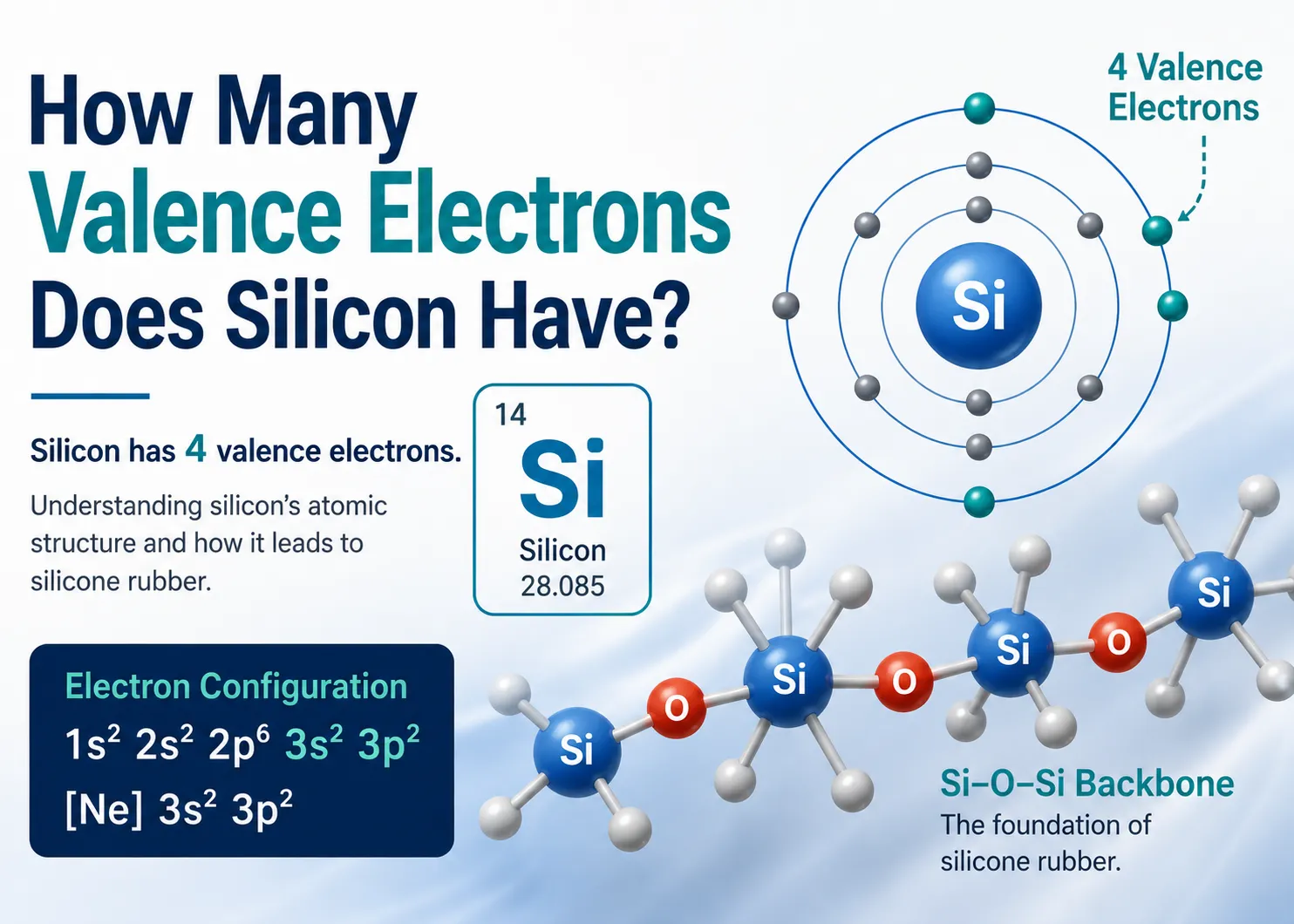
Silicon has 4 valence electrons. Its atomic number is 14, and its electron configuration is 1s² 2s² 2p⁶ 3s² 3p². The four electrons in the outermost third energy level are its valence electrons, which strongly influence how silicon forms chemical bonds. This basic atomic property also provides a useful starting point for understanding silicon-based chemistry, including the silicon–oxygen structures that eventually appear in silicone materials and silicone rubber.
How Many Valence Electrons Does Silicon Have?
Silicon has four valence electrons. These are the electrons located in its outermost occupied electron shell and are the electrons most directly involved in chemical bonding.
Silicon has an atomic number of 14, meaning a neutral silicon atom contains 14 protons and 14 electrons. Those electrons fill the atomic orbitals in the following configuration:
The third energy level is the outermost occupied shell. It contains two electrons in the 3s orbital and two electrons in the 3p orbitals, giving silicon a total of 4 valence electrons.
| Silicon Property | Value |
|---|---|
| Chemical Symbol | Si |
| Atomic Number | 14 |
| Electron Configuration | 1s² 2s² 2p⁶ 3s² 3p² |
| Valence Shell | Third electron shell |
| Valence Electrons | 4 |
| Periodic Table Group | Group 14 |
This four-electron outer shell is one of the reasons silicon can form a wide variety of stable covalent compounds. That chemistry becomes particularly interesting when silicon bonds with oxygen, carbon and other elements.
Where Are Silicon’s Four Valence Electrons Located?
The electrons of a silicon atom occupy several energy levels. The first shell contains two electrons, while the second shell contains eight. The remaining four electrons occupy the third shell.
2
electrons
8
electrons
4
valence electrons
Only the outermost electrons are normally counted when discussing valence electrons. For silicon, those are the electrons represented by 3s² 3p². The inner ten electrons are core electrons and generally do not participate directly in ordinary chemical bonding.
This distinction is important because valence electrons largely determine how an element interacts with other atoms. Silicon's four outer electrons place it in Group 14 of the periodic table, together with carbon, germanium, tin and lead.
Why Does Silicon Have Four Valence Electrons?
Silicon belongs to Group 14 of the periodic table. Elements in this group have four electrons in their outer valence shell. In silicon, the outer configuration is 3s² 3p², giving it two electrons in the 3s orbital and two in the 3p orbitals.
Having four valence electrons gives silicon considerable bonding flexibility. Rather than easily losing all four electrons or gaining another four under ordinary conditions, silicon commonly shares electrons with neighboring atoms through covalent bonds.
As a result, silicon is frequently described as tetravalent, meaning that it can form four chemical bonds in many of its compounds. This is an important feature of silicon chemistry and helps explain the large variety of silanes, siloxanes, silicates and other silicon-containing materials.
How Do Silicon’s Valence Electrons Affect Chemical Bonding?
The four valence electrons allow silicon to form covalent bonds with many different elements. Silicon–oxygen and silicon–carbon bonds are particularly important for understanding silicon-containing materials.
When silicon interacts with oxygen, extremely important Si–O-containing structures can form. Silicon dioxide, silicates and siloxanes all contain silicon and oxygen, but their molecular structures and resulting material properties are very different.
| Bond / Structure | Where It Appears | Why It Matters |
|---|---|---|
| Si–O | Silica, silicates and siloxanes | Fundamental to many inorganic and silicone structures |
| Si–C | Organosilicon compounds | Connects organic groups to silicon atoms |
| Si–Si | Elemental silicon and selected silicon compounds | Important in crystalline silicon and semiconductor materials |
| Si–H | Hydrogen-functional silicones and silanes | Important in certain silicone crosslinking reactions |
It is important not to oversimplify this relationship. The fact that silicon has four valence electrons does not by itself explain every property of silicone rubber. Those macroscopic properties arise from the complete molecular architecture of the silicone polymer, its side groups, crosslinking structure, fillers and other formulation ingredients.
Silicon and Silicone Are Not the Same Thing
This is where a common terminology problem appears. Silicon and silicone sound similar, but they describe very different materials.
Silicon is a chemical element with the symbol Si and atomic number 14. It is found extensively in minerals and silica-containing materials and is also widely used in semiconductor technology.
Silicone, by contrast, refers to a family of synthetic organosilicon polymers. Silicone materials contain silicon atoms, but they also contain oxygen and organic groups. Silicone rubber is therefore not elemental silicon and should not be described as simply “rubber made from silicon.”
Silicon
A chemical element with atomic number 14 and four valence electrons.
シリコーン
A family of polymers built around repeating silicon–oxygen structures with organic side groups.
How Does Silicon Become Part of Silicone Materials?
The relationship between elemental silicon and silicone rubber involves several stages of industrial chemistry. Silicone polymers are not produced simply by melting silicon and turning it into rubber. Instead, silicon is chemically converted into reactive organosilicon compounds that can eventually be transformed into siloxane polymers.
Industrial silicone chemistry commonly begins with silicon-containing raw materials from which suitable silicon intermediates are produced. Organosilicon compounds are then created so that organic groups such as methyl groups can be attached to silicon atoms. Through hydrolysis, condensation and polymerization chemistry, silicon–oxygen–silicon structures can be formed into polymer chains.
Elemental Si
→
Reactive silicon compounds
→
Si–O–Si structures
→
Long molecular chains
→
Crosslinked elastomer
Once the appropriate silicone polymer is produced, it can be compounded with reinforcing fillers, processing additives, pigments, heat-stabilizing systems, curing agents and other functional ingredients. After vulcanization, the polymer chains become connected into an elastic three-dimensional network that behaves as silicone rubber.
Why Is the Si–O Backbone Important in Silicone Rubber?
Most conventional silicone rubbers are based on polysiloxane structures containing repeating silicon–oxygen bonds along the main polymer chain. A simplified representation can be written as:
Organic groups are attached to the silicon atoms. In common methyl silicone rubber, many of these groups are methyl groups. Other functional groups can be introduced when particular properties or curing reactions are required.
The siloxane backbone differs substantially from the carbon–carbon backbone found in many conventional organic rubbers. Its molecular geometry and rotational flexibility contribute to the distinctive behavior of silicone elastomers, including their flexibility across a broad temperature range.
However, the final performance of silicone rubber does not come from the Si–O bond alone. Polymer molecular weight, side groups, reinforcing silica, crosslink density and formulation technology all contribute to properties such as hardness, tensile strength, tear resistance, electrical insulation and long-term aging behavior.
How Molecular Structure Gives Silicone Rubber Its Properties
The transition from atomic silicon to industrial silicone rubber illustrates an important principle in materials science: atomic structure influences bonding, but the performance of the finished material is determined by much larger levels of molecular and formulation structure.
Silicone polymers are valued because their siloxane backbone remains highly flexible compared with many conventional organic polymer chains. When these polymers are reinforced and crosslinked correctly, the resulting silicone elastomer can maintain useful elasticity under demanding thermal and environmental conditions.
| Silicone Rubber Property | Molecular / Formulation Explanation | Why It Matters |
|---|---|---|
| Heat Resistance | Siloxane-based polymer structure combined with suitable stabilizers and crosslinking | Supports seals, electrical parts and components exposed to elevated temperatures |
| 低温下での柔軟性 | Highly flexible polymer backbone maintains molecular mobility at low temperature | Useful where elastomeric performance is required across changing climates |
| 電気絶縁 | Standard silicone formulations can provide high electrical resistivity and dielectric performance | Important for cables, connectors and high-voltage insulation |
| Weather Resistance | Silicone structures resist many forms of UV, ozone and environmental aging | Supports long-term outdoor applications |
| Elasticity | Crosslinked silicone polymer chains can deform and recover | Important for seals, gaskets, membranes and molded components |
| Hydrophobic Surface | Silicone surface chemistry can produce strong water-repellent behavior | Especially valuable in outdoor electrical insulation |
This is also why two silicone rubbers made from similar base polymers can perform differently. A compound developed for food-contact use, for example, may use different additives and compliance-controlled ingredients from a silicone rubber developed for high-voltage composite insulators.
What Is Silicone Rubber Made Of?
Silicone rubber is a formulated elastomer rather than a single pure chemical. The silicone polymer provides the molecular foundation, but industrial compounds normally require additional ingredients to achieve the desired processing and mechanical properties.
HTV and HCR silicone rubber, for example, commonly contain a high-molecular-weight silicone polymer together with reinforcing silica. The filler provides much of the mechanical reinforcement required for tensile strength, tear resistance and practical handling. Processing aids help control the interaction between the polymer and silica, while curing systems create the final crosslinked rubber network.
Silicone PolymerProvides the flexible siloxane molecular backbone.
Silica FillerImproves mechanical strength and controls compound behavior.
Functional AdditivesAdjust processing, heat aging, color or application-specific performance.
Curing SystemCrosslinks the polymer into an elastic silicone rubber network.
The exact formulation depends on the application. Electrical-grade silicone may be optimized for dielectric strength, tracking resistance and hydrophobicity. Food grade silicone requires carefully controlled ingredients and appropriate food-contact compliance. Silicone used in EV or cable applications may instead prioritize heat aging, mechanical strength and electrical insulation.
Why Silicon Chemistry Matters in Silicone Rubber Applications
Understanding that silicon has four valence electrons is basic chemistry, but following the chemistry from silicon to siloxane polymers helps explain why silicone materials occupy such an unusual position among industrial elastomers.
Silicone rubber can combine electrical insulation with flexibility, high-temperature performance and resistance to outdoor aging. These characteristics make silicone useful in applications where conventional organic elastomers may face limitations.
電気絶縁
HTV silicone is widely used in insulating housings, cable components and other electrical products where dielectric performance and environmental durability are required together.
Composite Insulators
Silicone rubber is commonly used as the external housing material around composite high-voltage insulators because of its electrical insulation and hydrophobic surface behavior.
Wire & Cable
Silicone elastomers can provide flexible insulation and protective components for cables exposed to elevated temperatures or demanding electrical environments.
EV & New Energy
Electric vehicles use silicone rubber in high-voltage connectors, seals, cable systems and other components requiring electrical and thermal performance.
Industrial Sealing
Silicone's elasticity and temperature resistance allow it to be used in gaskets, seals, grommets and molded components.
Food-Contact Products
Specially formulated food grade silicone can be used in suitable food-contact applications when the compound meets the required regulatory and performance conditions.
Does Silicone Rubber Still Have “Four Valence Electrons”?
This question needs careful wording. An individual silicon atom has four valence electrons when considered in its atomic state. Once silicon becomes part of a silicone polymer, those electrons participate in chemical bonds with oxygen and organic groups.
It is therefore correct to say that the silicon element has four valence electrons. It is less useful to describe a finished silicone rubber material as simply “having four valence electrons,” because the rubber is a complex network containing many different atoms, molecular bonds, fillers and additives.
When discussing silicone rubber performance, polymer chemistry and compound formulation become more useful concepts than isolated atomic electron counts. The valence-electron question helps explain the starting chemistry, but the finished elastomer must be understood at the molecular and material levels.
4 Valence ElectronsExplains silicon's bonding potential.
Siloxane PolymerDetermines chain structure and molecular flexibility.
Silicone Rubber CompoundDetermines real-world mechanical, thermal and electrical performance.
Silicone Rubber Materials from Yakows
The chemistry of silicon provides the foundation for silicone technology, but industrial performance ultimately depends on how the silicone polymer is compounded and cured. At Yakows, the focus is on translating silicone chemistry into practical HTV and HCR silicone rubber formulations for real manufacturing applications.
Different applications require different combinations of Shore hardness, tensile strength, elongation, tear resistance, electrical performance, heat resistance and processing behavior. A silicone compound for a high-voltage composite insulator therefore requires a different formulation strategy from food grade silicone, cable insulation material or an industrial sealing compound.
Understanding this distinction—from silicon atoms to silicone polymers and finally to engineered silicone rubber compounds—is important when selecting materials for industrial production. The polymer backbone provides the foundation, but formulation engineering determines whether the finished silicone can meet the mechanical, electrical, thermal and regulatory requirements of the application.
よくある質問
How many valence electrons does silicon have?
Silicon has four valence electrons. Its outer electron configuration is 3s² 3p².
Why does silicon have 4 valence electrons?
Silicon belongs to Group 14 of the periodic table. Its outermost occupied energy level contains two 3s electrons and two 3p electrons, giving it four valence electrons.
How many total electrons does silicon have?
A neutral silicon atom has 14 electrons because silicon has an atomic number of 14.
What is the valency of silicon?
Silicon commonly has a valency of four because it can form four covalent bonds in many compounds.
What is the electron configuration of silicon?
The full electron configuration of silicon is 1s² 2s² 2p⁶ 3s² 3p².
Is silicon the same as silicone?
No. Silicon is a chemical element. Silicone is a family of organosilicon polymers containing silicon, oxygen and organic groups.
Is silicone rubber made from silicon?
Silicone rubber contains silicon as part of its polymer chemistry, but it is not elemental silicon. Silicone polymers are manufactured through organosilicon chemical processes and then compounded and crosslinked into elastomers.
What is the backbone of silicone rubber?
Conventional silicone polymers contain a repeating siloxane backbone based on silicon–oxygen–silicon structures.
Why is silicone rubber heat resistant?
Its temperature performance is related to the siloxane polymer structure together with the complete silicone formulation, including fillers, stabilizers and crosslinking system.
Does silicone rubber conduct electricity?
Standard silicone rubber is generally formulated as an electrical insulator. Conductive fillers can also be introduced to produce antistatic, semiconductive or conductive silicone compounds for specialized applications.
What is HTV silicone rubber?
HTV stands for high-temperature vulcanizing silicone rubber. It is commonly used in industrial molding and extrusion applications and is also referred to as high-consistency rubber or HCR.